Tag: London Ontario hidden history

  • A Brief History of Streetcars in London: 1875 to 1940

    A Brief History of Streetcars in London: 1875 to 1940

    Before London had its modern transit system, before buses and bike lanes, there were streetcars. For sixty-five years, these iron-wheeled vehicles clattered along London’s streets, carrying workers to factories, families to parks, and dreams to new neighborhoods. They didn’t just move people; they built the very fabric of our city.

    Today, we’ll journey back in time to explore the rise and fall of London’s streetcar system. Whether you’re a curious visitor planning your first trip to the Forest City or a longtime resident wanting to understand how your neighborhood came to be, this story reveals how transit shaped London’s downtown core into the welcoming, walkable community it is today.

    The Beginning: The Age of Horse Power (1875-1895)

    Picture this: It’s May 24, 1875, Victoria Day. Londoners gather with excitement along Dundas Street, waiting to board something completely new. Not a train bound for Toronto, but a small wooden passenger car pulled by horses, ready to transport locals between Richmond and Adelaide Streets.

    The London Street Railway Company (LSR) had just laid three miles of track, at a cost of $5,000 per mile, and the city would never be the same.

    This wasn’t glamorous travel. The cars were simple, the horses were hardworking, and the ride could be bumpy. Later, on snowy winter days, passengers might even need to step out and give the carriage a push to get it moving again. But for Londoners of the 1870s, this was revolutionary.

    The population of London at the time was 18,413.
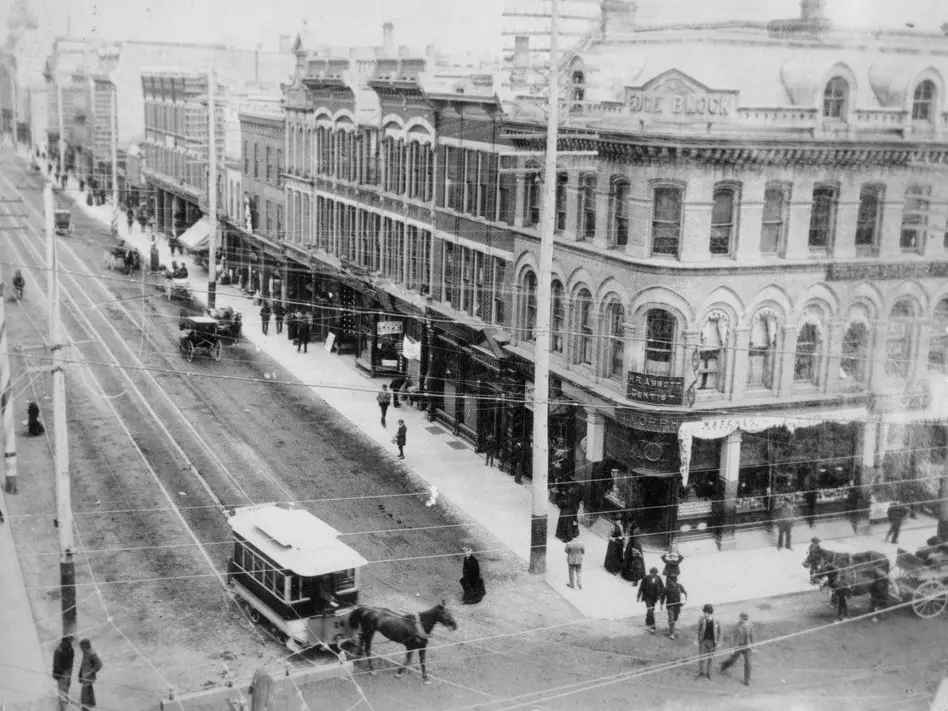
    Looking down on a horse-drawn streetcar at Dundas and Richmond Streets in 1883.
    Looking down on a horse-drawn streetcar at Dundas and Richmond Streets in 1883.
    (Photo credit: Wikimedia Commons).

    The Depot at Dundas and Lyle

    The LSR quickly established its main operations facility at the corner of Dundas and Lyle Streets, creating a hub that would anchor the city’s east end. From this modest depot, horse-drawn cars began connecting London’s scattered settlements, giving early residents a reliable way to reach the bustling downtown core.

    For working-class families in the eastern suburbs, the streetcar wasn’t just convenient; it was essential. It provided a scheduled, affordable link to jobs, shops, and community life downtown. This early transit system began the process of weaving London’s distinct neighborhoods into a single urban fabric.

    The Rise of the Electric Streetcar (1895-1940)

    By 1895, London was ready for an upgrade. The city retired its horse-drawn carriages and embraced the future with overhead wires and shiny new electric trolleys. This electrification transformed everything.

    Suddenly, streetcars could travel faster, carry more passengers, and climb hills that would exhaust any horse. More importantly, they could reach farther. The LSR expanded aggressively, laying tracks into previously isolated areas and opening up new lands for residential development.
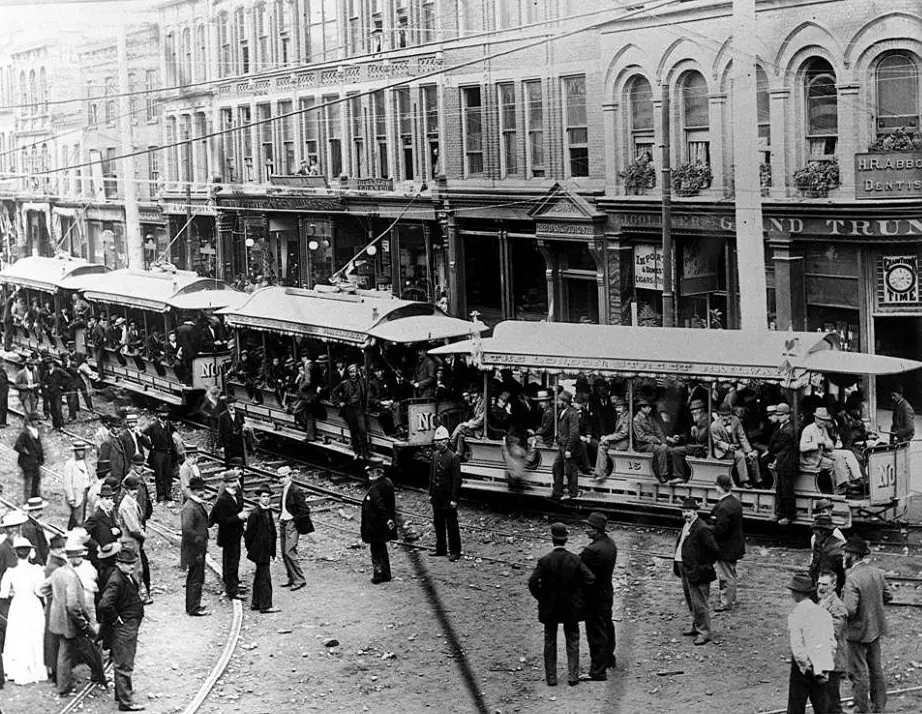
    Inauguration of electric streetcar service, 1895 in London, showing crowds of people on four trolley cars.
    Inaugural run of electric streetcar service in 1895. Because the first order of electric cars was delayed, the trolleys pictured here on Dundas and Richmond were the old horse cars converted to electricity.
    (Photo credit: Archives and Special Collections, Western University).
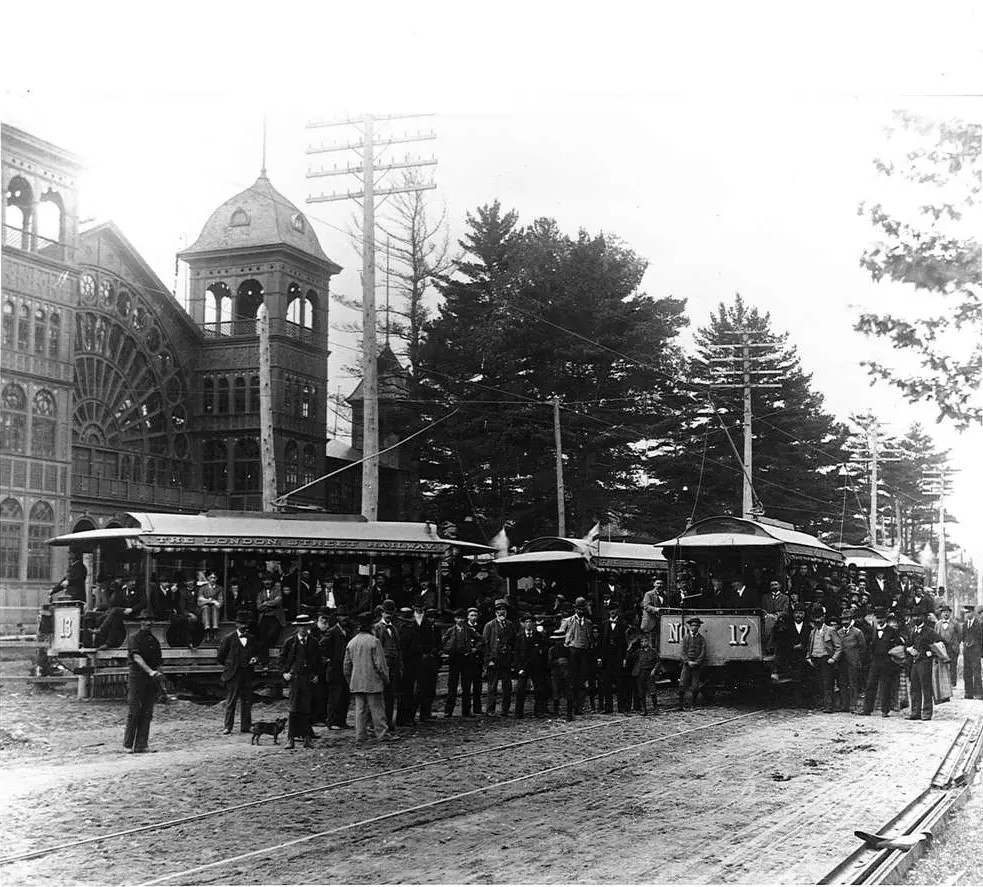
    Crowds of people on streetcars at Western Fair, 1895.
    Crowds clamber aboard this streetcar at Western Fair, 1895.
    (Photo credit: London Public Library, Museum London).

    Branching Out in Every Direction

    At its greatest extent, the streetcar rail system extended 24 miles through the city, spreading like tree roots to connect to London’s growing suburbs:

    Heading East Along Hamilton Road

    • The tracks pushed deep into the Hamilton Road district, connecting industrial workers to factories and providing a vital link between peripheral residential neighborhoods and the city’s manufacturing heart. This corridor became a bustling artery of working-class life.

    Crossing the Thames

    • Bridges over the river at Wharncliffe Road and Ridout Street carried streetcars into the southern and western sectors of the city. Communities that had once felt isolated were suddenly absorbed into London’s economic and social life. Residents could easily reach downtown markets, shops, and services.

    Marching North Up Richmond Street

    • The northern trunk line along Richmond Street accelerated development in the city’s northern quarters. New subdivisions sprang up along the route, confident that residents would have reliable transportation to the downtown core.
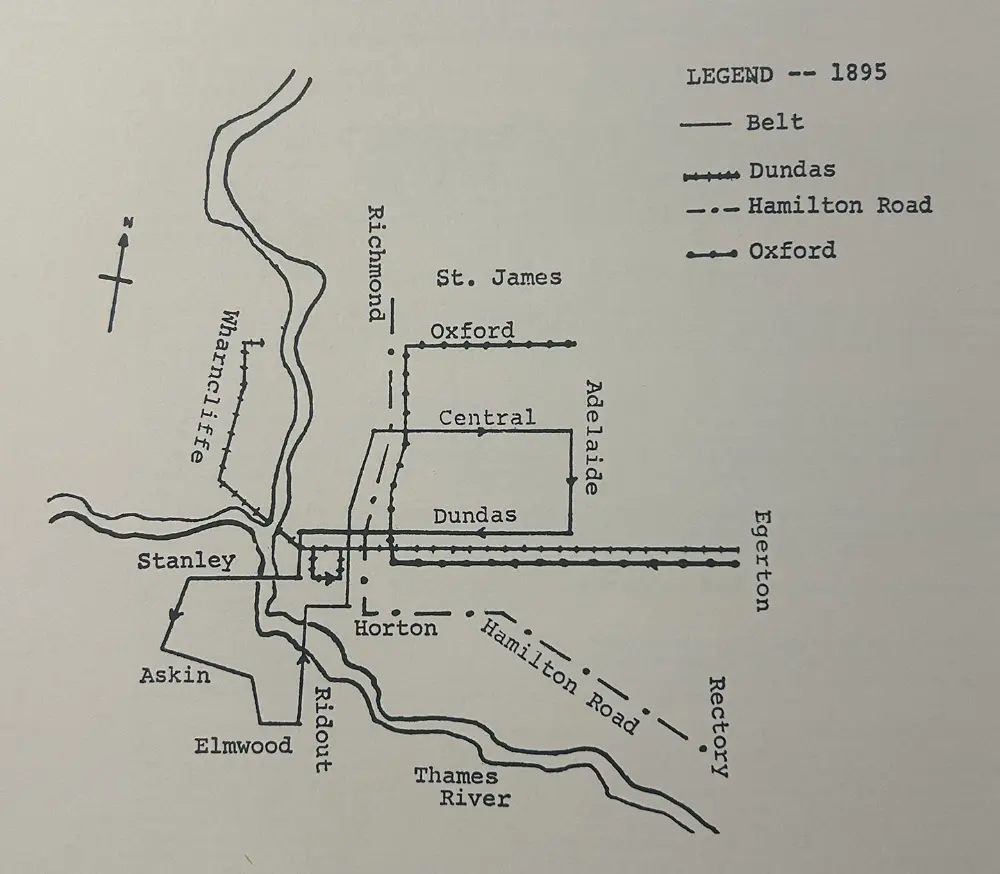
    1895 map of the early LSR transit system.
    1895 map of the early LSR transit system.
    (Source: London Transit).

    The Crown Jewel: Springbank Park

    Perhaps the most beloved streetcar line was the one that terminated at the gates of Springbank Park, then known simply as the Waterworks. On hot summer weekends, Londoners would pile into open-air cars, escaping the city’s heat for a day of leisure by the river.

    To illustrate that point, on May 24, 1896, the first day the new branch line opened, over 10,000 excursionists made the trip to Springbank Park, almost a third of the population of London at the time.

    This line demonstrated something profound about transit. By making a distant park accessible to everyone, the streetcar transformed a peripheral rural area into London’s shared backyard. It brought communities together, created shared experiences, and enhanced the city’s quality of life in ways that still echo today.
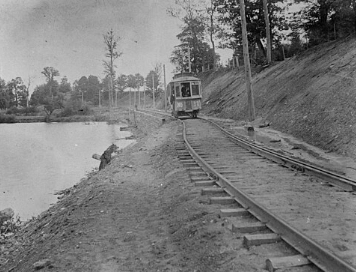
    A streetcar on the Springbank line, passing by Woodland Cemetery on the right and the Thames River on the left.
    A streetcar on the Springbank line, passing by Woodland Cemetery on the right and the Thames River on the left. The entire Springbank line was completed by May 24, 1896 and double-tracked by May 21, 1897.
    (Photo credit: Ivey Family London Room, London Public Library, London, Ontario, Canada).

    Connecting Neighborhoods, Building Community

    By the early 1900s, London’s streetcar network had become the social fabric of the city. It wasn’t just about getting from point A to point B. It was about connecting people. Neighbors met on trolleys. Families made weekend excursions. Workers shared commutes. The streetcar was, in many ways, the original social network, bringing Londoners together one block at a time.
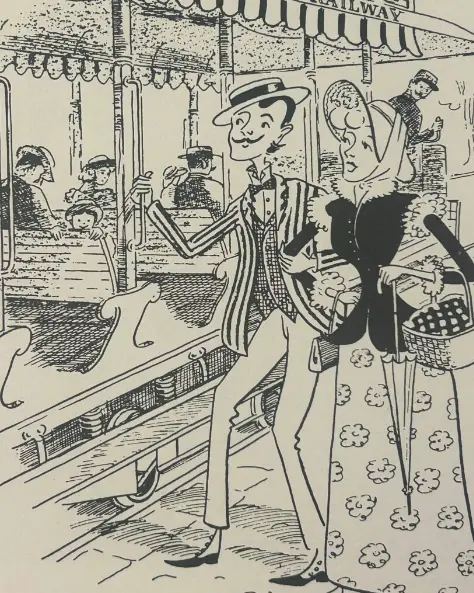
    Illustration of a Moonlight Excursion Car, c. 1905.
    During this period, the LSR introduced special cars that could be rented for theatre parties, dances, or other special events. They were referred to as “Moonlight Excursion Cars”, and were adorned with clusters of electric lights to enhance the atmosphere, c. 1905.
    (Photo credit: London Transit).
    Motorman and conductor, c 1915.
    Motorman and conductor, c 1915. Wages for them at that time were $0.23 per hour.
    (Photo credit: Ivey Family London Room, London Public Library, London, Ontario, Canada).

    The End of an Era: The Trolleys Go Silent

    Winter’s Wrath

    As much as Londoners loved their streetcars, the relationship with Canadian winters was always complicated. Heavy snowstorms regularly brought the iron trolleys to a grinding halt. Ice accumulation on overhead wires and frozen switches caused frequent service interruptions.

    In a city where winter can arrive with vengeance, the fixed-rail system’s vulnerabilities became increasingly apparent. When snow buried the tracks, streetcars simply couldn’t operate. Passengers were stranded, businesses lost customers, and the city’s mobility ground to a halt.

    The Rise of the Bus

    By the 1920s, a new competitor appeared on London’s streets: the gasoline bus. These rubber-tired vehicles didn’t require expensive tracks or overhead wires. They could navigate around obstacles, adjust routes to meet changing demand, and most importantly, they could operate in snow.

    The flexibility and lower maintenance costs of buses made them increasingly attractive to transit operators. The writing was on the wall for the old streetcar system.
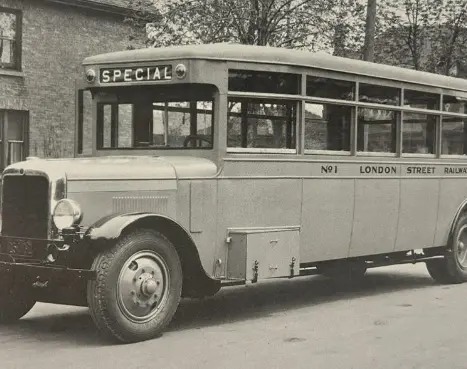
    Early LSR bus, c. 1929.
    In 1929, LSR purchased five gasoline-powered buses at a cost of $7,700 each to be used to service North London and make connections to the streetcar lines.
    (Photo credit: London Transit).
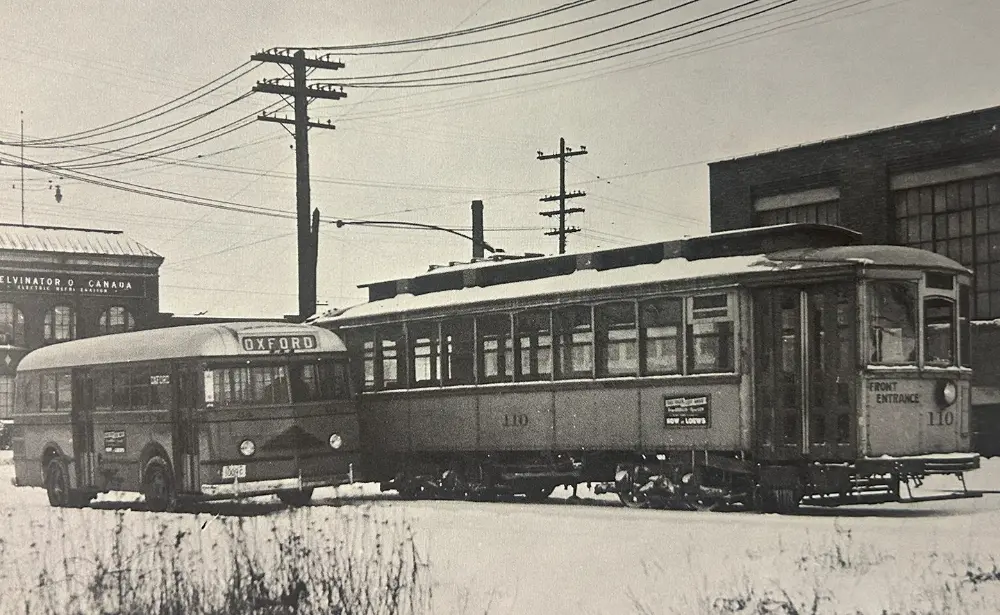
    LSR bus alongside a streetcar, 1940.
    By 1940, it was inevitable that streetcars would soon be replaced by buses.
    (Photo credit: London Transit).

    The Final Stop

    On November 29, 1940, Londoners bid a fond farewell to their last streetcar line. After 65 years of service, the network that had shaped the city’s growth fell silent. In 1941, the tracks were paved over or ripped up, the overhead wires removed, and the trolleys sent to storage or scrap.
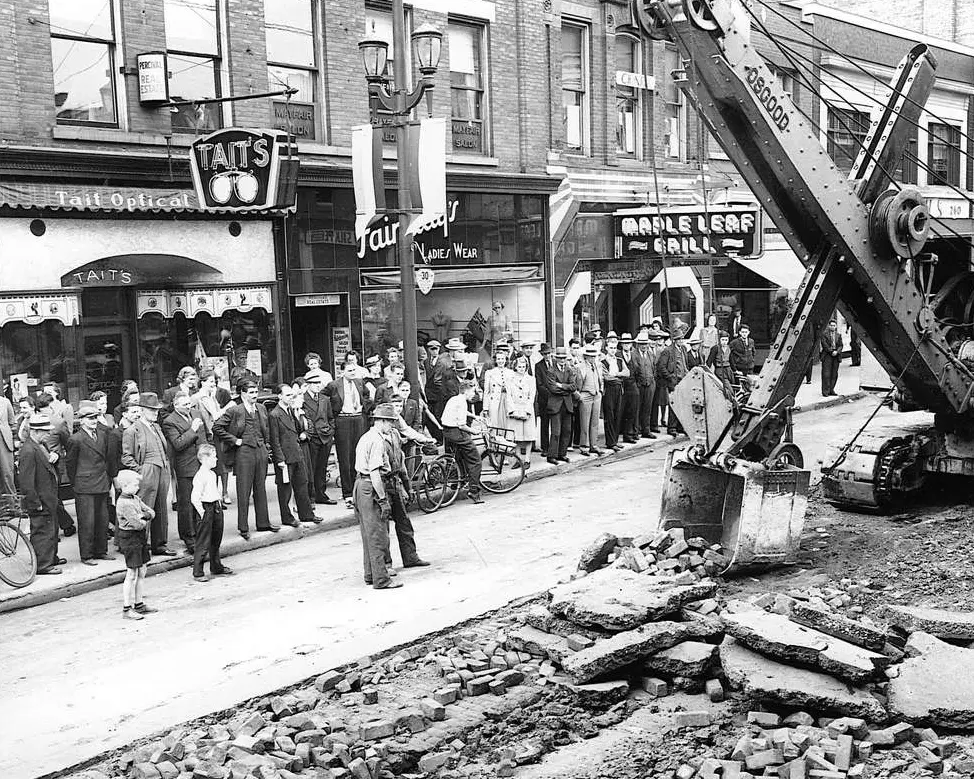
    Excavator ripping up streetcar tracks on Dundas St, 1941 in front of crowds of curious onlookers.
    Ripping up streetcar tracks on Dundas St in 1941.
    (Photo credit: Archives and Special Collections, Western University).
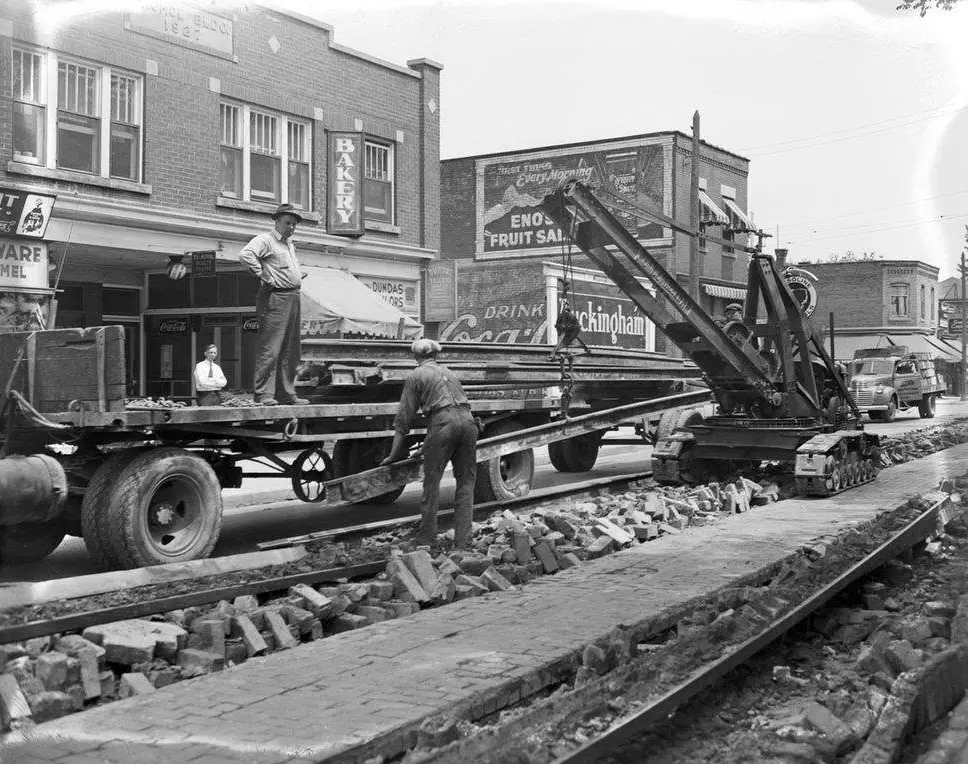
    Workers remove streetcar tracks on Dundas St, in 1941.
    More streetcar tracks being ripped up on Dundas, east of Quebec Street in 1941.
    (Photo credit: Archives and Special Collections, Western University).

    It was the end of an era. But it wasn’t the end of the story.

    Echoes of the Rails: London’s Hidden History

    Buried Treasure Under the Asphalt

    If you walk down certain streets in downtown London today, you might be walking on history. City construction crews occasionally unearth buried wooden ties and steel rails during utility digs beneath downtown asphalt. These ghostly remnants remind us of the network that once connected our city.

    Larry Davidson, construction supervisor, in front of road construction on York Street.
    Larry Davidson, who oversees several construction sites in London, said the latest discovery of a few pieces of wood and concrete about a metre deep during recent road work on York Street is likely the last of the city’s old streetcar system.
    (Photo credit: Julianne Hazlewood/CBC).

    London Street Railway Car #23: A Survivor’s Tale

    Not everything from the streetcar era was lost. London Street Railway Car #23, built in 1901, has a remarkable survival story. After retiring from active service in 1935, it found a second life as the men’s changing room at Wonderland Gardens, serving swimmers and park visitors for decades.

    Eventually it was rescued, and between 1983 and 2000, it was lovingly restored. Car #23 now lives at the Halton County Radial Railway museum in Milton, Ontario, where visitors can step aboard and imagine what it was like to ride through historic downtown London.
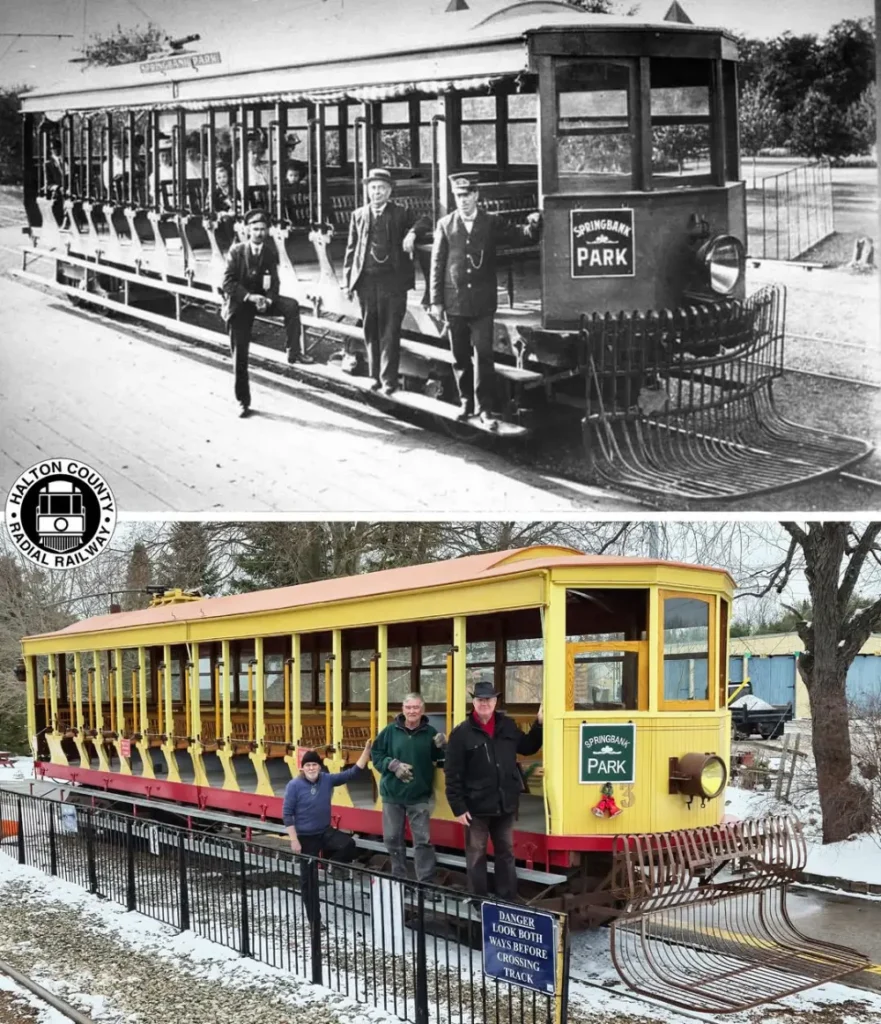
    Two photos showing LSR Car #23, one c. 1920, one in 2025. The second photo is a re-creation, showing similar poses of the three people in both photos.
    LSR Car #23. The first photo above was taken in Springbank Park circa the 1920s. The second photo was taken in 2025 at the Halton County Radial Railway in Milton.
    Notice the near-identical poses of the three people in both photos.
    (Photo credit: Halton County Radial Railway).
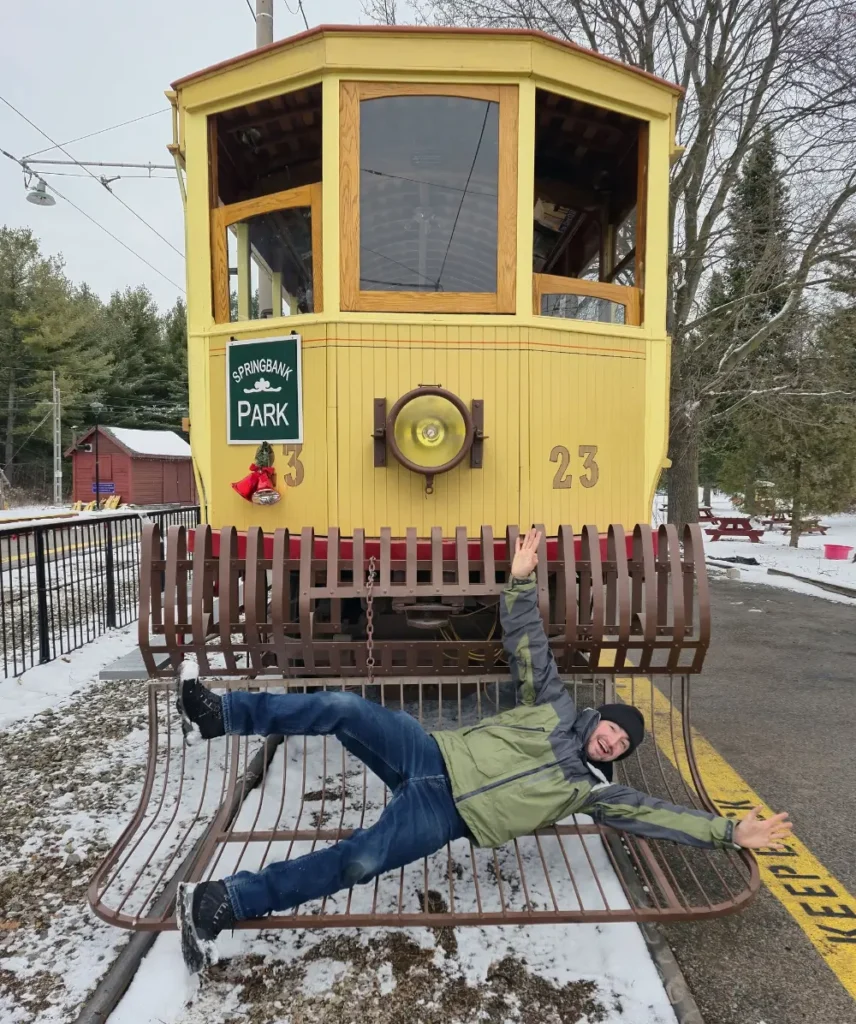
    An enthusiastic volunteer lying down in front of the streetcar on the "people catcher."
    An enthusiastic volunteer demonstrating how the “people-catcher” worked.
    (Photo credit: Halton County Radial Railway).

    Why This History Matters for Visitors Today

    A Walkable, Bikeable City

    The legacy of streetcars is visible in London’s compact downtown core. Because the trolley system encouraged development along transit corridors, many areas of the city remain pedestrian-friendly and accessible today. This makes London an excellent city for exploring on foot or by bicycle.

    Author, Lawrence Durham, standing on the Thames Valley Parkway between the Thames River and Woodland Cemetery.
    The author standing on the old trolley line leading to Springbank Park. It is now the Thames Valley Parkway, a 43 km multi-use pathway that runs alongside the scenic Thames River.
    (Photo credit: Lawrence Durham).

    Hi, I’m Lawrence. I’m a bicycle tour guide, storyteller, and proud Londoner who loves showing off this city’s hidden gems. My passion is helping curious visitors like you discover the fascinating history, vibrant neighborhoods, and beautiful spaces that make London special.

    If you’d like to experience some of these stories up close and personal, join me for a guided bicycle tour. Small groups, big laughs, and plenty of local flavor.
    Click here to learn more!

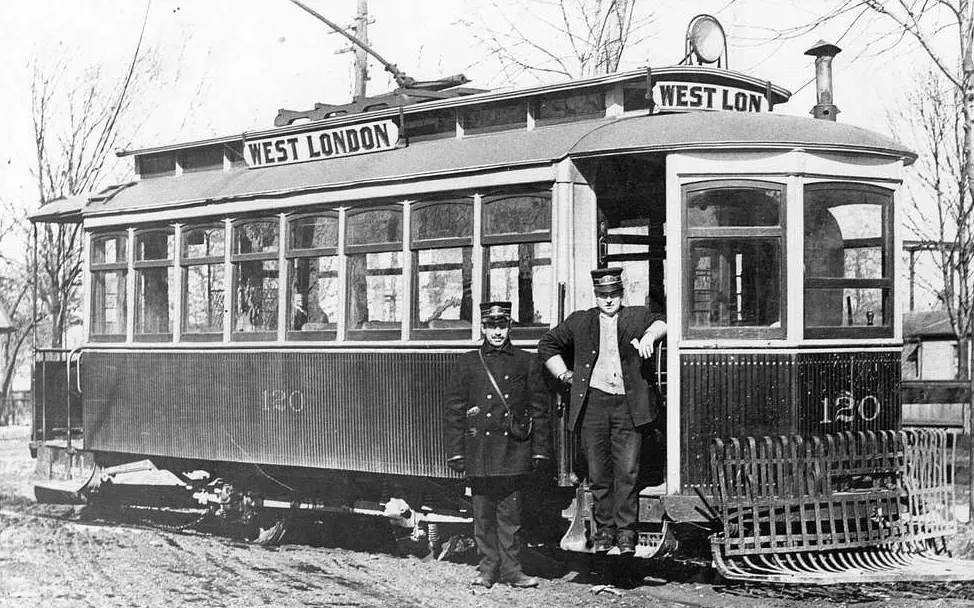
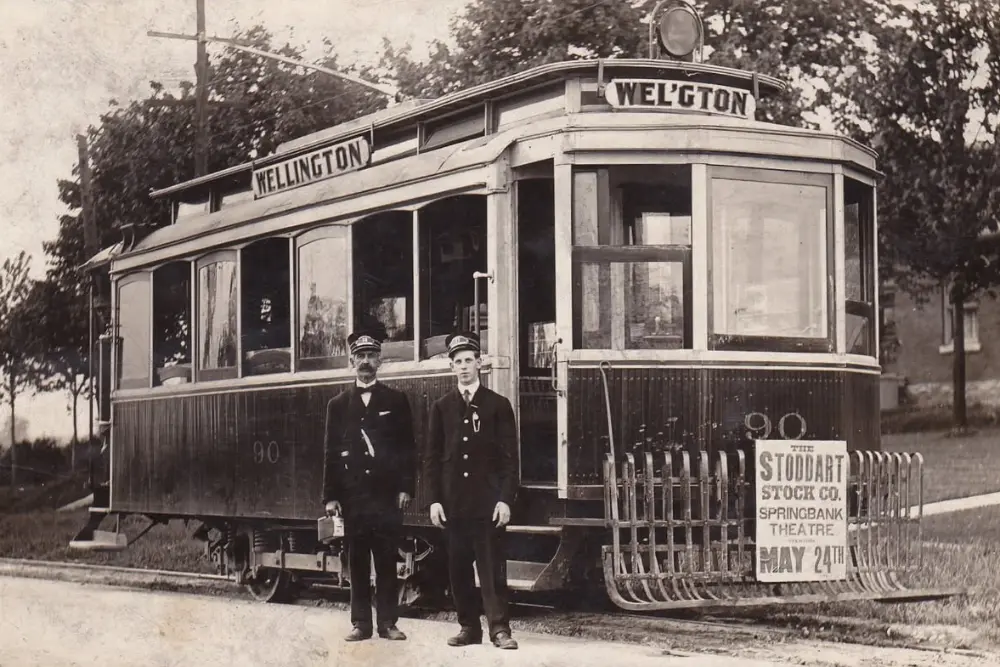
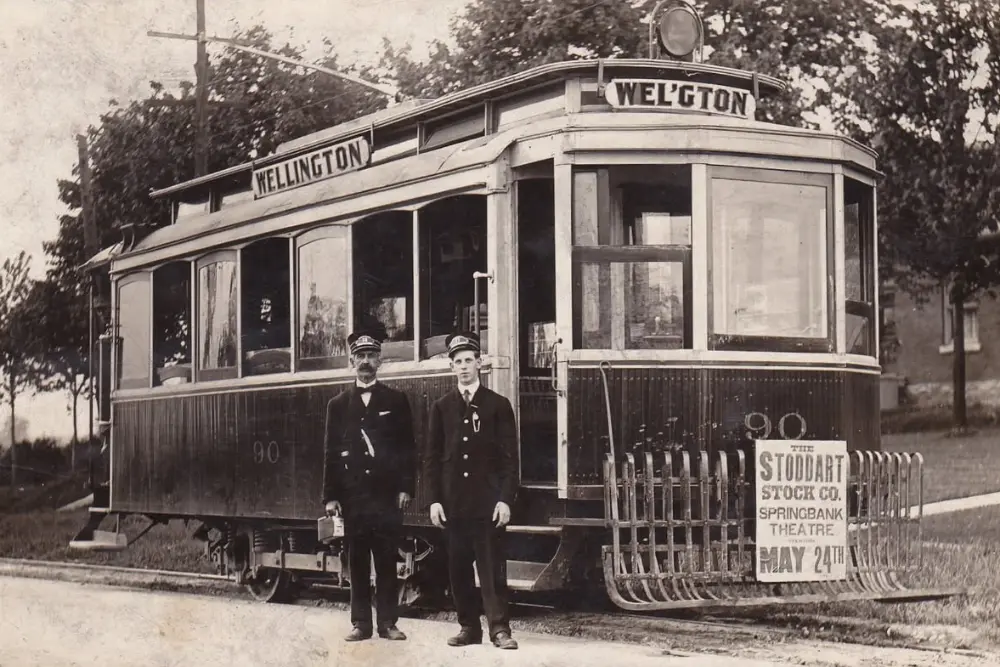
    Motorman and conductor standing alongside a LSR Streetcar, 1911.

    Credit for featured cover photo: Vintage London, Ontario.

  • How Early London Finally Conquered the Scourge of the “Blue Death”

    How Early London Finally Conquered the Scourge of the “Blue Death”

    Imagine a time when a simple drink of water could be a death sentence.

    In 1832, that was the grim reality for the settlers of Upper Canada. Cholera was entirely new to North America, a mysterious and brutal killer that originated in India and tore across Europe before being carried across the Atlantic in the crowded, unsanitary holds of immigrant ships. When it made landfall in Quebec City in June, it began a relentless journey along the St. Lawrence River and the Great Lakes, carried inadvertently by panicked people fleeing the cities. It was only a matter of time before it reached the small but growing settlement of London, with a population of just 400 souls.

    Sailing ship arrives at the port of Quebec City in 1832.
    Immigrants on ships from Europe helped spread the cholera pandemic to North America.
    (Image credit: NorthNomics).

    The Cholera Outbreak of 1832

    A Perfect Environment

    Nineteenth-century London was a frontier town with a fatal flaw. The community relied on shallow, hand-dug wells for drinking water and shared outdoor privies for waste. With no public waste management or sewer systems, human waste seeped directly into the local water table. This turned the town’s very source of life, its drinking water, into a massive delivery system for the Vibrio cholerae bacteria. The stage was set for a catastrophe.

    The “Blue Death”: A Swift and Terrible Killer

    What terrified Londoners most was the horrifying speed of the disease. A person could wake up feeling perfectly healthy, contract cholera in the morning, and be dead by nightfall. The symptoms were agonizing and unmistakable. The bacteria caused sudden, severe, and uncontrollable watery diarrhea and vomiting, leading to extreme and rapid dehydration (up to 25 liters of fluid in a single day). As victims lost fluid volume, their blood thickened, their eyes sank into their skulls, and their skin lost all elasticity. Most distinctively, the intense lack of oxygen turned their skin a ghostly, bruised shade of slate-grey or blue, earning cholera its grim and unforgettable nickname: “The Blue Death.”

    Two women crying over a young woman in bed dying of cholera. Dying woman is blue in complexion.
    People died of cholera quickly, sometimes within hours of ingesting the bacteria.
    (Image credit: NorthNomics).

    Medical Ignorance at the Time

    The medical community of the time was utterly helpless. They had no idea how cholera spread. The prevailing theory was “miasma,” which held that diseases were caused by poisonous vapors or foul odors rising from rotting matter in the air. Because doctors were targeting the air instead of the water supply, their containment strategies and medical treatments were often more dangerous than the disease itself.

    Modern historians have even referred to the standard treatments as a form of “benevolent murder.” That is, despite the physicians’ well-meaning intention to cure their patients, their highly extreme methods often directly caused or accelerated the patient’s death.

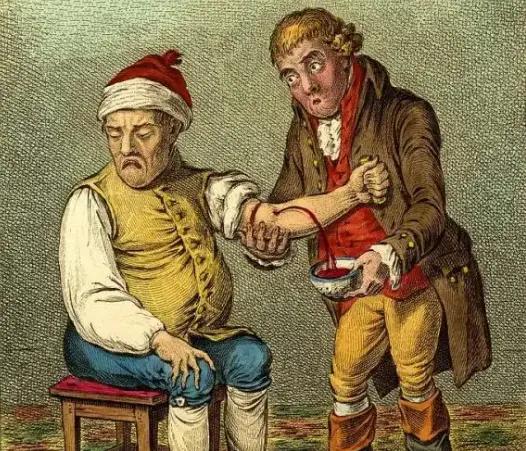
    For example, physicians routinely practiced bloodletting, draining a half-litre to a full litre of blood from patients who were already dying of severe fluid loss. They administered heavy doses of calomel, a toxic mercury compound, to “purge” the bowels, often until patients’ gums bled from acute mercury poisoning. And in a final, tragic twist, they frequently denied water to patients who were literally crying out from dehydration, believing that drinking liquids would worsen internal cramping.

    Illustration of bloodletting from the forearm of a man, 1800s.
    Bloodletting in the 1800s.
    (Image credit: James Gillray, 1804).

    Those who survived cholera at this time usually did so because they had a milder version of the infection or, perhaps, because they ignored medical advice and drank water anyway.

    The Deaths Kept Coming

    In London, the earliest churchyards were instantly overwhelmed. To minimize the spread of the “miasma,” the dead were quickly wrapped, sometimes covered in quicklime to accelerate decomposition, and buried in mass graves or closely packed plots known as “Potter’s Fields.”

    Scene showing smoke wafting over a graveyard with many mourners lamenting the death of their loved ones.
    To clear the “poisonous air,” local authorities set up large smudge pots of burning tar. Obviously, in retrospect, these measures were not successful, and so people continued to die.
    (Image credit: NorthNomics).

    Because these victims were hastily buried without proper monuments, their exact resting places were largely lost to time, which explains why so many remains were missed when the city later attempted to move the bodies out of the city limits.

    In all, the 1832 wave killed an estimated 8,000 to 12,000 people across Upper and Lower Canada.

    The Return of Cholera: Outbreaks in 1849 and 1854

    Cholera was not finished with London. The disease returned with a vengeance in 1849 and again in 1854, but this time the community was better prepared. The city had learned that passivity meant mass casualties, and local authorities shifted their strategy from chaotic panic to structured civic intervention.

    The Creation of a Board of Health

    The most significant change was the formation of a dedicated municipal Board of Health. This civic body was granted emergency powers to bypass standard bureaucracy. Health inspectors systematically patrolled the town’s wards, monitored overcrowding, and issued fines for unsanitary properties. By 1854, the board had become an information and enforcement hub, tracking cases, distributing warning fliers, and taking over local resources to streamline emergency medical care.

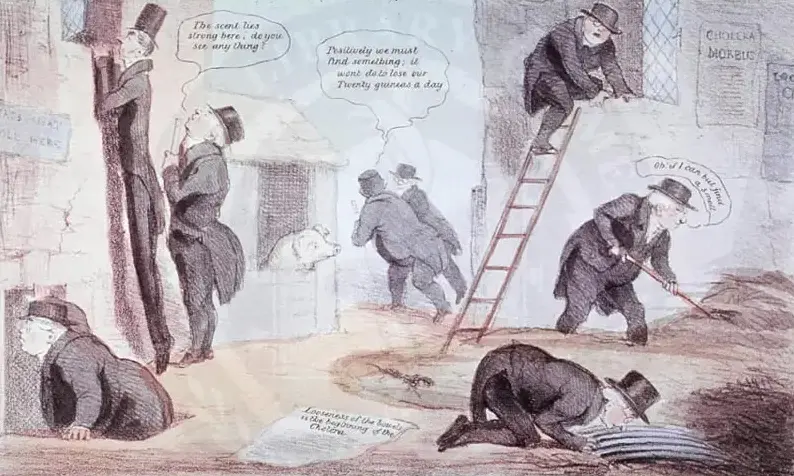
    Cartoon depicting the London Board of Health in the United Kingdom looking everywhere, for the source of cholera, with no success
    People everywhere were mystified as to the source of the disease. This cartoon depicts the London Board of Health in the United Kingdom looking everywhere, with no success
    (Image credit: Broadview Press).

    The Creation of Cholera Sheds

    During the 1832 crisis, the sick had mostly been left to die in their homes.

    In the subsequent outbreaks, London turned to institutional segregation. The city erected temporary wooden structures, grimly known as “cholera sheds,” well away from the downtown core. Health inspectors removed cholera victims from overcrowded boarding houses and placed them into these isolated facilities. While this succeeded in separating the sick from the general population, the conditions inside the sheds were stark, and they primarily functioned as places for the destitute to die in isolation.

    The Irony of the Clean-Up Efforts

    Despite the increased organization, London’s efforts suffered from a tragic flaw. By aggressively flushing the streets and digging deeper drainage ditches to wash away “miasma-causing” waste, the city unintentionally accelerated the flow of human and animal filth directly into the local water table and the Thames River. Because residents still drew their drinking water from shallow wells right next to these drainage areas, the municipal cleaning campaigns inadvertently helped the waterborne bacteria spread even faster.

    The Real Solution: Clean Water and Proper Sewers

    It would take decades more before London finally conquered cholera, but the solution, when it came, was transformative. The establishment of a permanent full-time Provincial Board of Health in 1882 marked a turning point in public health administration. But the true victory came with the development of a centralized municipal water system and proper sewage treatment infrastructure in the later part of the century.

    Map showing the 1878 Waterworks Plan to get water from the reservoir to London via a pipeline.
    Map showing the 1878 Waterworks Plan to get water from the reservoir to London via a pipeline.

    With clean, piped drinking water from the Springbank Reservoir, the city eliminated the shallow wells that had served as delivery systems for the bacteria. Adding proper sewers removed human waste from the immediate environment, preventing contamination of the water supply. These engineering marvels, combined with a growing understanding of disease transmission, finally broke the cycle of cholera outbreaks that had plagued London for decades.

    A Legacy of Resilience

    The story of London’s cholera outbreaks is a powerful reminder of how far we have come. It is a tale of a community that faced unimaginable tragedy and, through hard-won experience and civic determination, laid the groundwork for the modern, safe, and vibrant city we enjoy today. The next time you turn on your water faucet or stroll through Covent Garden Market, take a moment to remember the cholera outbreaks of 1832, 1849, and 1854. They are a part of our story, a testament to the resilience of Londoners, and a hidden layer of history waiting to be discovered.

    The author, Lawrence Durham, atop Reservoir Hill at the entrance to Reservoir Park, where millions of gallons of safe drinking water are stored.
    The author, atop Reservoir Hill at the entrance to Reservoir Park, where millions of gallons of safe drinking water are stored.
    In 1878, this was the place where the city took its first steps to finally conquer the scourge of the Blue Death.
    (Photo credit: Lawrence Durham).

    Hi there. I’m Lawrence, a bicycle tour guide, storyteller, and history nerd. I help curious folks like you discover the best parts of London, from a bicycle seat, of course. Stories like this one, of tragedy and triumph, are woven into the very streets we ride. If you want to experience some of these hidden gems, come on a bicycle tour with me. Click here to learn more! Your next adventure awaits.

    Two women in 1832 mourning over the death of a young woman in bed with cholera.

    Credit for featured cover Image: NorthNomics.

  • You DEFINITELY Wouldn’t Have Wanted To Drive This Wagon In The Early Days of London

    You DEFINITELY Wouldn’t Have Wanted To Drive This Wagon In The Early Days of London

    When you pedal through the tree-lined streets of London, Ontario, today, you’re breathing fresh air, enjoying the beauty of our historic architecture, and maybe even stopping for a coffee at a sidewalk café. It’s hard to imagine that not so long ago, this same city was plagued by something far less pleasant: raw sewage flowing through the streets, toxic rivers, and outbreaks of disease that terrified the population.

    Welcome to the surprisingly fascinating (and occasionally stomach-churning) history of how London cleaned up its act. It’s a story of public health crises, brilliant engineering, and a whole lot of horse manure.

    Part One: The Honey Wagon Era

    What Exactly Was a “Honey Wagon?”

    In Victorian-era London, discussing human waste was considered deeply taboo. The yellowish-brown sludge collected from outhouse vaults bore an unfortunate resemblance to honey, and so the sarcastic euphemism was born. The term “honey wagon” made an unpleasant reality sound somewhat more palatable, though nobody was fooled.

    These horse-drawn carts were the city’s primary method of waste removal before indoor plumbing became widespread. Managed by the municipal Board of Health, these nightly operations were a vital but deeply maligned public health necessity.

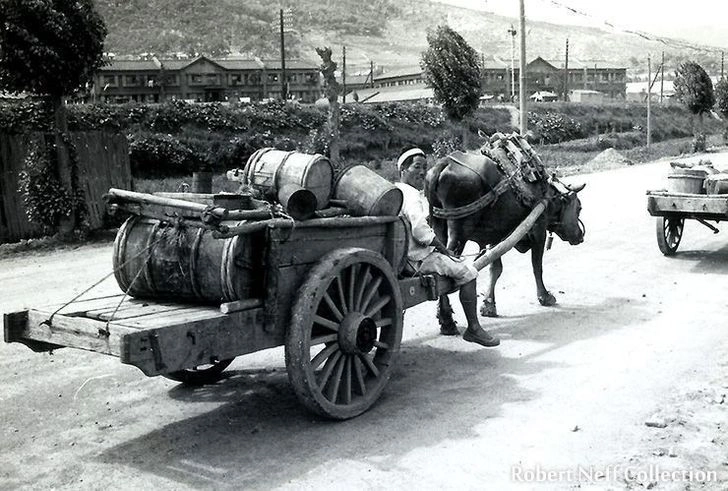
    Honey wagon pulled by an ox in Korea, 1952.
    Honey wagons from around the world.
    This 1952 photo from Korea shows that the use of “honey wagons” was still in practice in the recent past.
    (Photo credit: The Korea Times).

    The Nightmen: London’s Unseen Heroes

    Because the job was considered offensive and the odors unbearable, collection crews worked strictly overnight. They were known as “nightmen” or “night soil men,” titles that sound almost romantic until you understand what they actually did.

    Working in the dark hours, these crews would navigate horse-drawn wagons through back alleys, slide out waste pails from “pail closets,” or use long-handled dippers to scoop sludge from deep cesspools. The foul cargo was emptied directly into open oak half-barrels positioned in the wagon bed.

    The working conditions were brutal:

    • Night shifts in all weather conditions
    • Overwhelming, nauseating odors
    • Social stigma that made the job taboo
    • Constant exposure to disease-causing bacteria
    • Heavy manual labor with rudimentary equipment
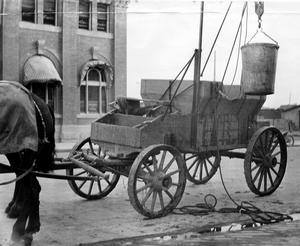
    Horse-drawn honey wagon with rope and pulleys used to load buckets onto the wagon.
    Using ropes and pulleys, the night soil men were able to load the foul contents of outhouses into their honey wagon.
    (Photo credit: Lethbridge Historical Society).

    Disease Prevention

    Early London suffered from rampant outbreaks of typhoid and cholera. These waterborne illnesses were often traced directly to cesspools leaking into local well water and, more problematically, the Thames River.

    The night soil collection was the city’s primary defense against these deadly epidemics. Once the wagons were filled, they hauled the cargo outside city limits, frequently transporting it to surrounding agricultural land to be spread as fertilizer.

    It wasn’t a perfect system, far from it, but it was all London had.

    Farmer using a honey wagon to spread  spreading human feces on a field.
    Human feces were spread on farmers’ fields as fertilizer.
    (Photo credit: lindaseccaspina).

    Part Two: The Public Health Crisis That Forced Change

    Cholera, Typhoid, and a Toxic River

    Before underground infrastructure existed, early Londoners dumped household waste directly into backyard outhouses or, shockingly, into the streets, where rainwater washed it into local wells and creeks.

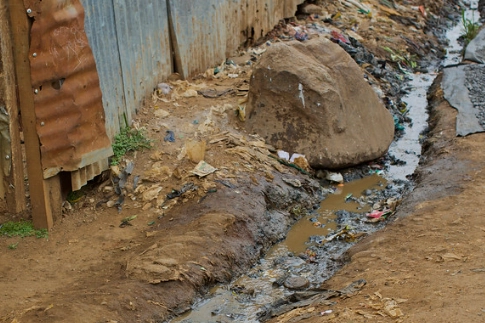
    Raw sewage ran in open ditches in the streets and alleyways of London.
    Raw sewage ran in open ditches in the streets and alleyways of London.
    (Photo credit: ICIMOD)

    The results were catastrophic.

    London was hit by multiple waterborne epidemics throughout the 19th century. Because citizens drew drinking water from shallow private wells positioned just feet from leaky outhouse cesspools, bacteria spread rapidly through the population.

    The Thames River crisis was particularly dire. As the population grew, the city built rudimentary “storm drains” intended only for rainwater. However, citizens and businesses illegally hooked their waste lines into them anyway. This turned London’s beautiful Thames River into an open sewer, leaving parts of it a biological hazard thick with sludge.

    The situation had become intolerable, dangerous, and frankly, embarrassing for a growing city with ambitions of greatness.

    The Legislative Push That Saved Lives

    In 1882, Ontario established the first Provincial Board of Health, later mandating local branches. These health officers quickly realized that relying on independent “nightmen” to scoop out outhouses could no longer prevent mass disease epidemics.

    Something had to change, and fast.

    Part Three: Building the Modern Sewer System

    Clean Water Arrives First (1878)

    The first major step toward sanitation wasn’t removing waste; it was providing clean water. The city established the Springbank Waterworks to pump fresh spring water into London, dramatically reducing reliance on contaminated backyard wells.

    Clean water was the foundation upon which everything else would be built.

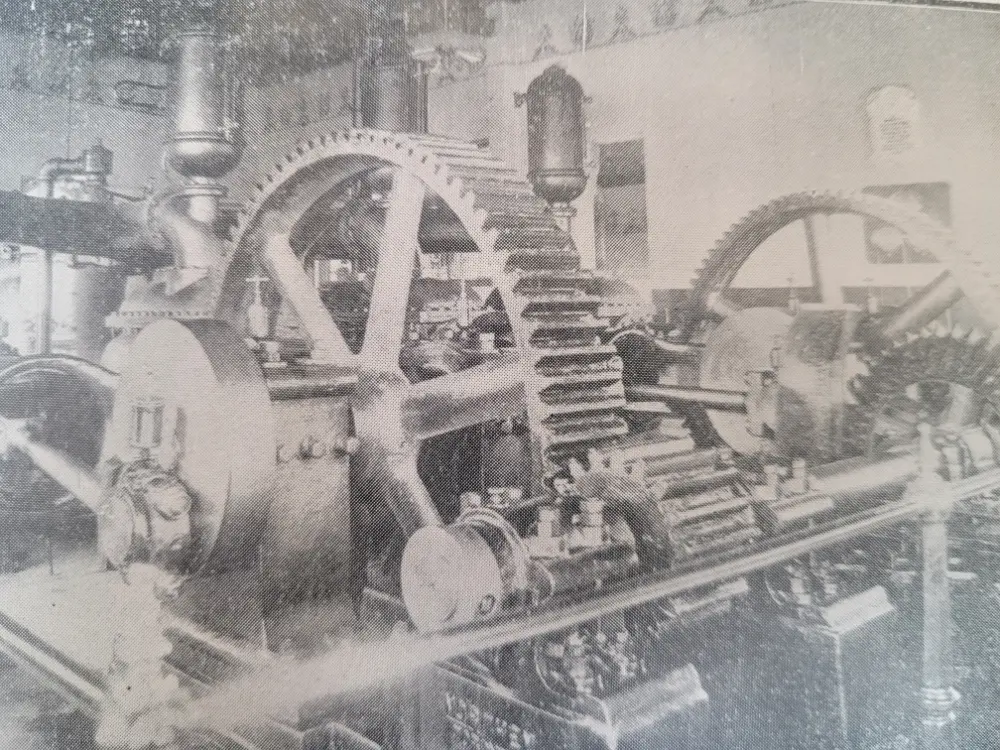
    Inside of the Springbank Pumping Station in 1905.
    Every 24 hours, the Springbank pumps could push up to 11 million litres of spring water from the holding ponds at the base of the hill to the reservoir at the top.
    (Photo credit: Public Utilities Commission 27th Annual Report to the City of London, 1905).
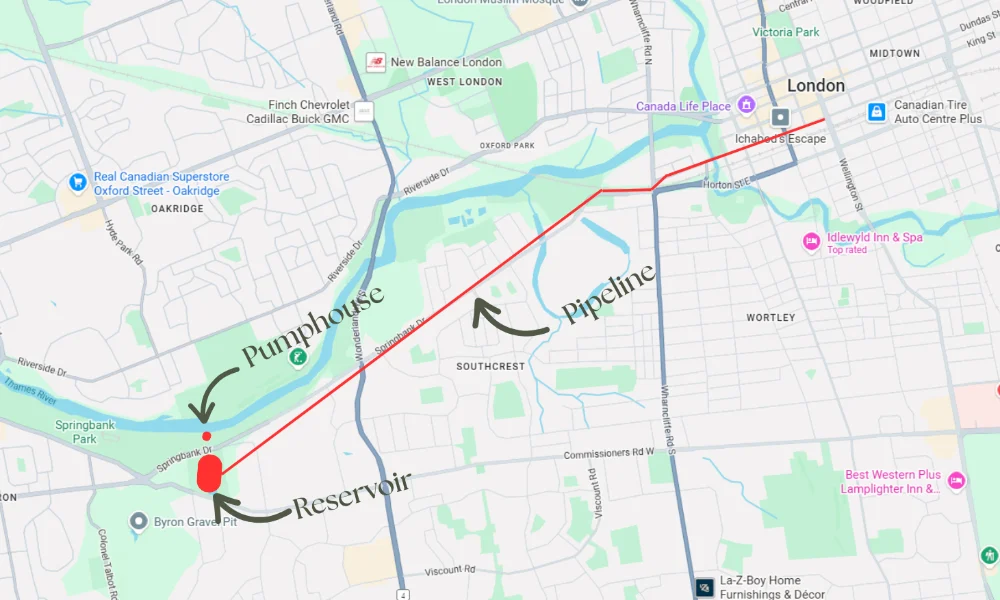
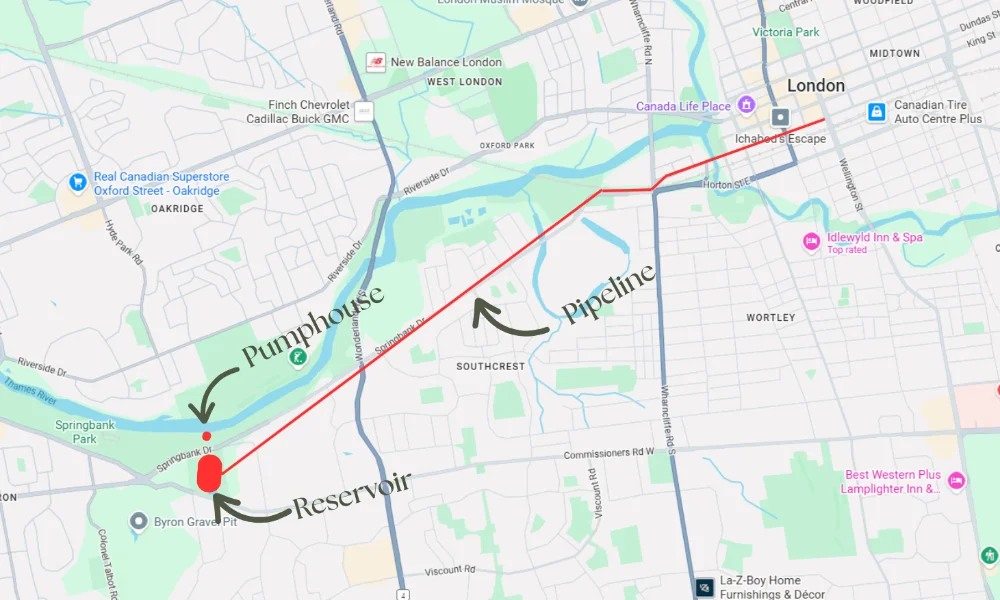
    Map showing the route of the 1878 Waterworks Plan to get water from Springbank Park to downtown London.
    Map showing the 1878 Waterworks Plan to get water from the Springbanks reservoir to London via a pipeline.
    (To explore the area around the waterworks, click here on Google Maps)

    Enter Willis Chipman: London’s Engineering Genius

    In 1891, the City hired Willis Chipman, one of Canada’s legendary civil engineers, to completely redesign London’s sanitation map. His vision was bold, brilliant, and forward-thinking.

    Chipman’s design broke away from standard Victorian engineering using three core principles:

    1. The Intercepting Trunk System
    Instead of allowing individual north-south neighborhood sewers to drain directly into the Thames River, Chipman mapped out a massive, continuous east-west intercepting trunk sewer grid. This massive line ran parallel to the riverbanks, catching all the city’s downhill wastewater flow before it could breach the shoreline.

    2. Separation of Waste (The Double Sewer Concept)
    Chipman championed the “separate system” over the dangerous “combined system.” He designed a strict layout where storm runoff was separate from the highly toxic sanitary sewage, which went into dedicated, watertight clay pipes. This later culminated in the Egerton Double Sewer (1916), where a designated sanitary pipeline was safely insulated inside a massive brick storm tunnel, a rare engineering achievement. It lasted for 100 years before being replaced in 2016.

    Inside view of the Egerton Double Sewer showing separate pipes for sewage and stormwater runoff.
    View inside the Egerton Double Sewer, with sanitary sewer at left and storm flow at right.
    (Photo credit: City of London Engineering Department).

    3. Gravity and Strategic Siphons
    Chipman masterfully used London’s natural topography, engineering the grid so gravity pulled waste downhill toward a centralized collection point. To cross river valleys without exposing waste to the air, he utilized inverted siphons, underground U-shaped pressurized pipe networks that pulled wastewater directly beneath the riverbeds.

    Treatment Infrastructure

    Rather than letting raw sewage flow directly downstream, London began constructing centralized wastewater treatment facilities in the early 20th century. These facilities drastically reduced waterborne illnesses and marked the beginning of the modern sanitation system we enjoy today.

    Part Four: The Forced Transition

    The Economic Reality of Indoor Plumbing

    Engineering a world-class sewer grid meant nothing if ordinary Londoners couldn’t afford to connect to it. And the costs were staggering.

    The financial breakdown for a typical 1890s household:

    • The fixtures: A basic earthenware toilet cost between $6.00 and $12.00. Premium porcelain models with copper-lined wooden tanks pushed closer to $20.00-$25.00.
    • Labor and materials: Homeowners had to hire licensed plumbers to dig up lawns, lay lead or cast-iron drainage lines, build air vents, and connect to the city’s clay sewer tiles. This typically cost between $40.00 and $75.00.
    • Total financial burden: The complete indoor plumbing overhaul averaged $50.00 to $90.00 per household.

    To put this in perspective: An average London laborer earned roughly $1.25 to $1.50 per day ($350-$450 annually). Installing a toilet cost two to three months of their entire gross income.

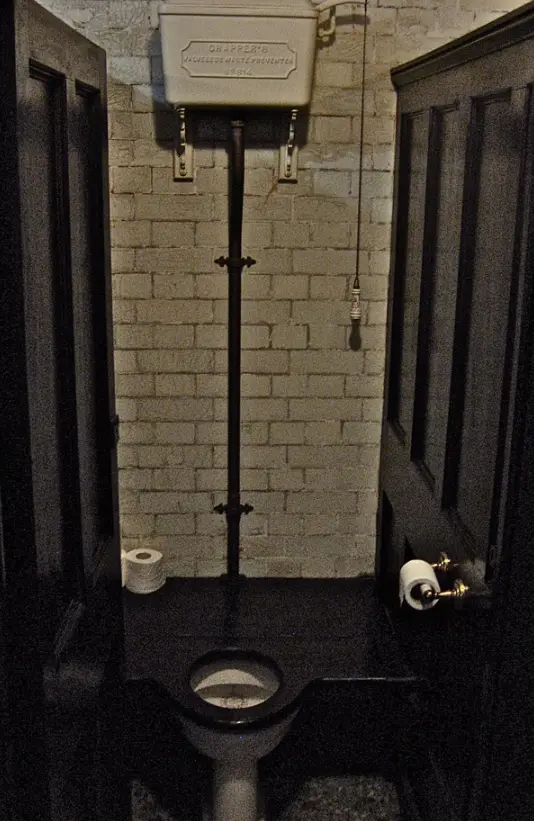
    An original Thomas Crapper toilet from the nineteenth century, still in perfect working order.
    (Photo credit: Spitalfields Life).

    The Board of Health’s Aggressive Bylaws

    To enforce compliance, London’s Board of Health utilized the Public Health Act to pass draconian municipal bylaws:

    Forced Outhouse Bans: The city declared that any privy vault, cesspool, or “dry earth closet” located within 150 feet of a newly laid municipal sewer line was an illegal public nuisance.

    The Compulsory Connection Bylaw: If a property line touched a street with a new sewer tile, landlords and homeowners received strict legal notice. They were given just 30 to 60 days to permanently fill their outhouse pits with lime and earth, demolish the structures, and install indoor plumbing.

    Aggressive Fines and Penalties: For every day a citizen resisted, the Board levied daily compounding fines. If a homeowner refused to comply, municipal workers could enter the property, forcibly seal the outhouse, and install the plumbing connections themselves. The total bill was slapped onto the citizen’s property tax roll as a lien—and if they couldn’t pay, the city could seize and auction the home.

    It was heavy-handed, yes. But it worked.

    Part Five: From Horse Carts to Motor Vehicles

    The Urban Horse Crisis

    By the late 1890s, thousands of working horses populated London’s streets, creating an additional crisis of hundreds of tons of manure and urine daily. Moving away from horses wasn’t just about modernizing sewage removal; it was required to clean up the streets themselves.

    The horse-drawn era was coming to an end, and not a moment too soon.

    Early Motorized Vacuum Carts

    In the 1910s and 1920s, the city began purchasing early motorized utility trucks. For areas not yet hooked up to the expanding sewer grid, these trucks were outfitted with heavy iron tanks and primitive mechanical suction pumps, replacing the manual oak-barrel loading process.

    The Mid-Century Phase-Out

    Horse-drawn waste and utility wagons disappeared completely by the onset of World War II. They were replaced by fully sealed, specialized vacuum trucks, the direct ancestors of modern commercial sanitation fleets.

    A modern-day honey wagon, actually a truck with a holding tank.
    A modern-day honey wagon.
    (Photo credit: Porta Serve).

    The Legacy: A Clean, Beautiful London

    By utilizing Chipman’s mathematical grid and using terrifying financial penalties to force compliance, London successfully eradicated the horse-drawn honey wagon lifestyle and transitioned into a clean, modern city with a modern sewage system.

    The author, Lawrence Durham, standing in front of the Adelaide Pollution Control Plant.
    The author, standing in front of the modern Pollution Control Plant on Adelaide Street, a far cry from the honey wagons of old. (Photo credit: Lawrence Durham).

    Hi. I’m Lawrence, bicycle tour guide, storyteller, and history nerd. I help curious folks like you discover the best parts of London, from a bicycle seat, of course. Whether you’re a local who wants to see your city with fresh eyes or a visitor looking for an authentic experience, I’d love to show you around. Small groups, big laughs, and unforgettable stories await.

    Click here to learn more!

    Have you ever wondered what other surprising stories London’s streets could tell? Join a tour and find out!

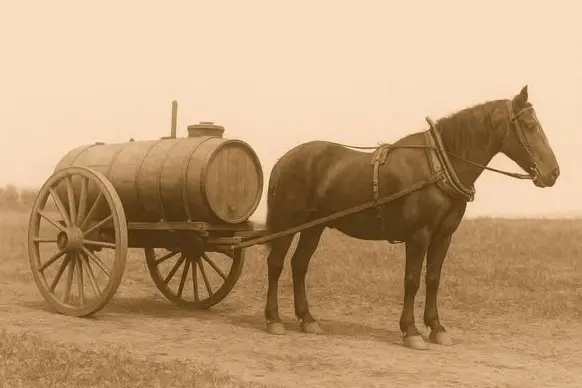
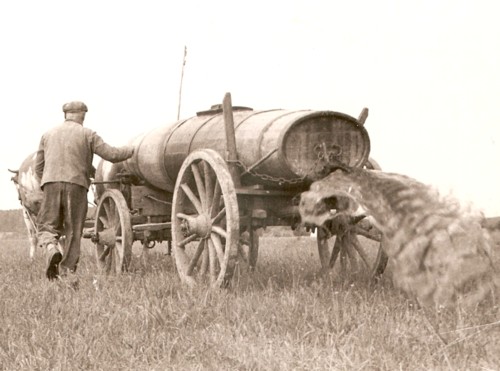
    A horse pulling an old honey wagon.

    Featured cover photo by Porta Serve.

  • Then There Was The Time London Built the Largest Dump Truck in the World

    Then There Was The Time London Built the Largest Dump Truck in the World

    When you think of London, Ontario, what comes to mind? The Thames River. The historic Blackfriars Bridge. Maybe the sulfur spring that launched a Victorian spa empire.

    But here’s a fact that stops people in their tracks: London once built the largest dump truck the world had ever seen.

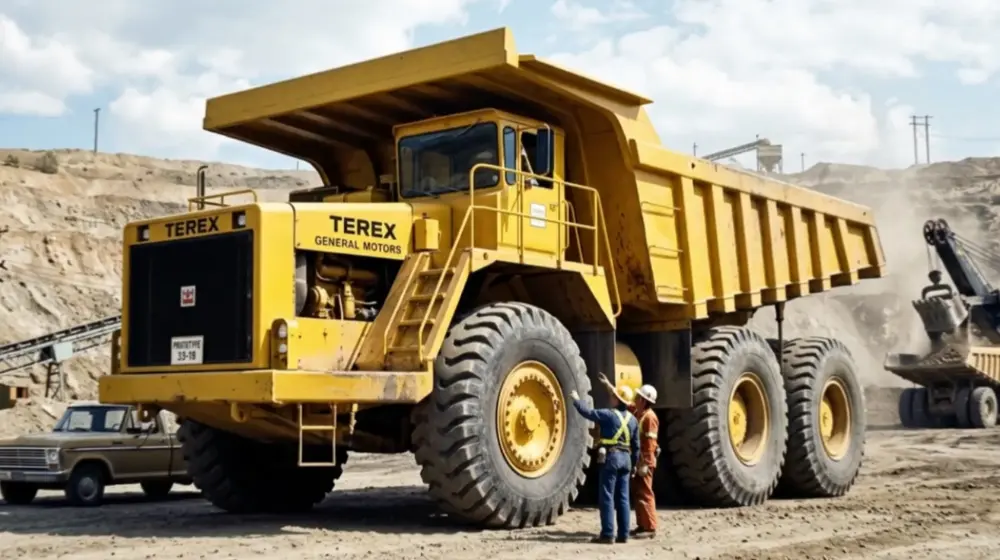
    A 3,300-horsepower, 1.2-million-pound, house-sized behemoth that held the Guinness World Record for a quarter of a century. It was called the Terex 33-19 “Titan,” and it was assembled right here in 1973 at the General Motors Diesel Division plant at 2021 Oxford Street East.

    Why Build a Truck the Size of a Building?

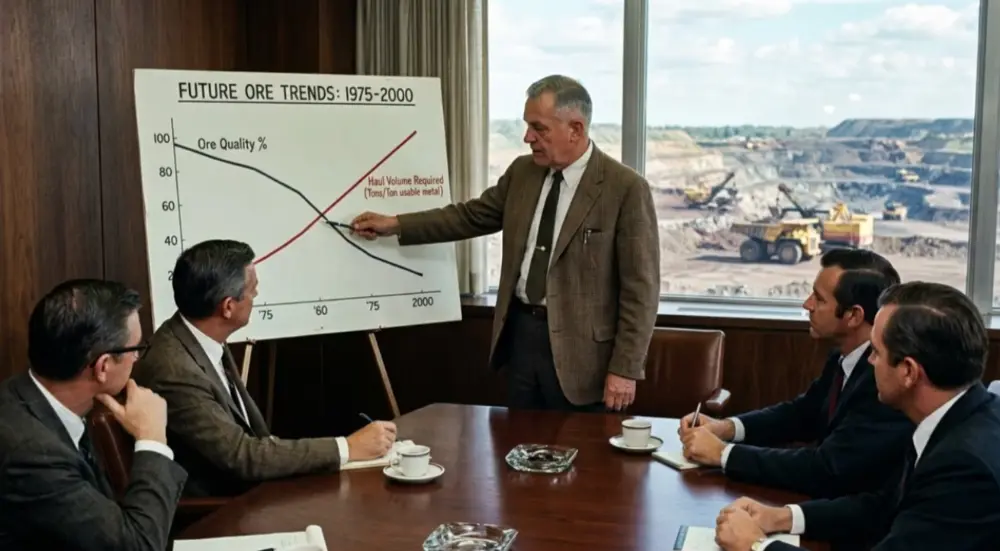
    In the early 1970s, General Motors’ Terex division saw a problem brewing. Open-pit mines around the world were digging deeper, and the quality of ore was declining. To stay profitable, miners needed to move more rock, a lot more, in fewer trips.

    The solution? Build a truck so massive it would make every other large haul truck look like a toy.

    GM executives in the 70s examining industry trendlines.
    GM Executives in the 70s could see the obvious industry trendlines
    (Photo credit: Car Clever)

    GM’s engineers sketched out a prototype that defied all existing conventions: a three-axle, rigid-frame, diesel-electric hauler with a payload capacity of 350 tons. It was the biggest in the Terex 33 series, a line of off-road trucks that had already made a name for itself in mining circles.

    The project was ambitious. Maybe too ambitious. But London was about to make history.

    Assembly in London: 1973

    The Titan was assembled at the General Motors Diesel Division plant in London, Ontario; the same facility that had been building railway locomotives and heavy equipment since 1950. The plant was no stranger to big projects, but this one was different.

    This was a one-off prototype. Only one Titan would ever be built.

    Workers pieced together a machine that would stretch 66 feet, 9 inches long, longer than a city bus, and stand 22 feet, 7 inches tall. When the dump box was fully raised, it towered 56 feet into the air.

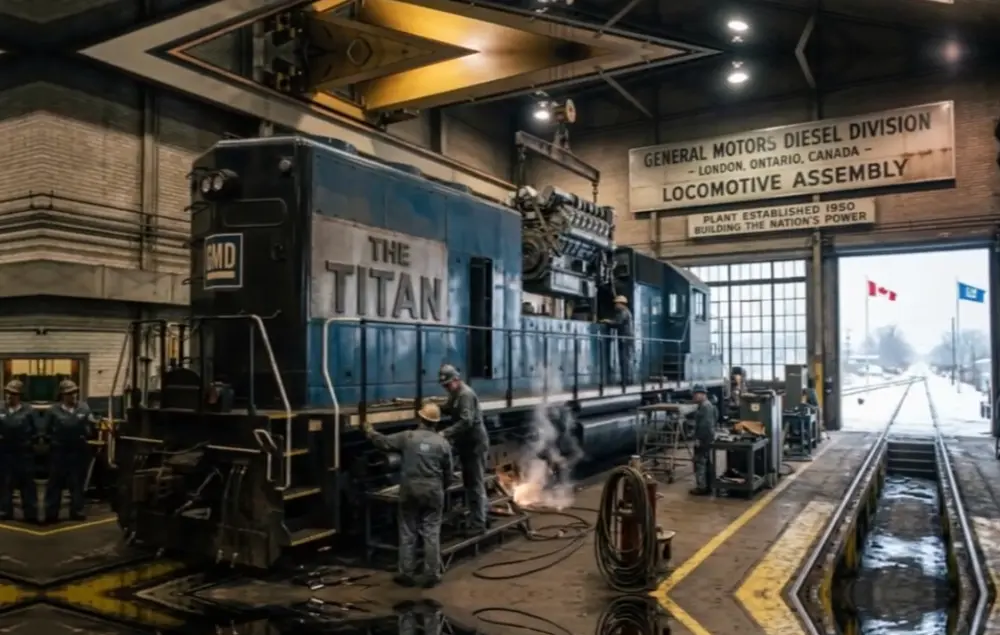
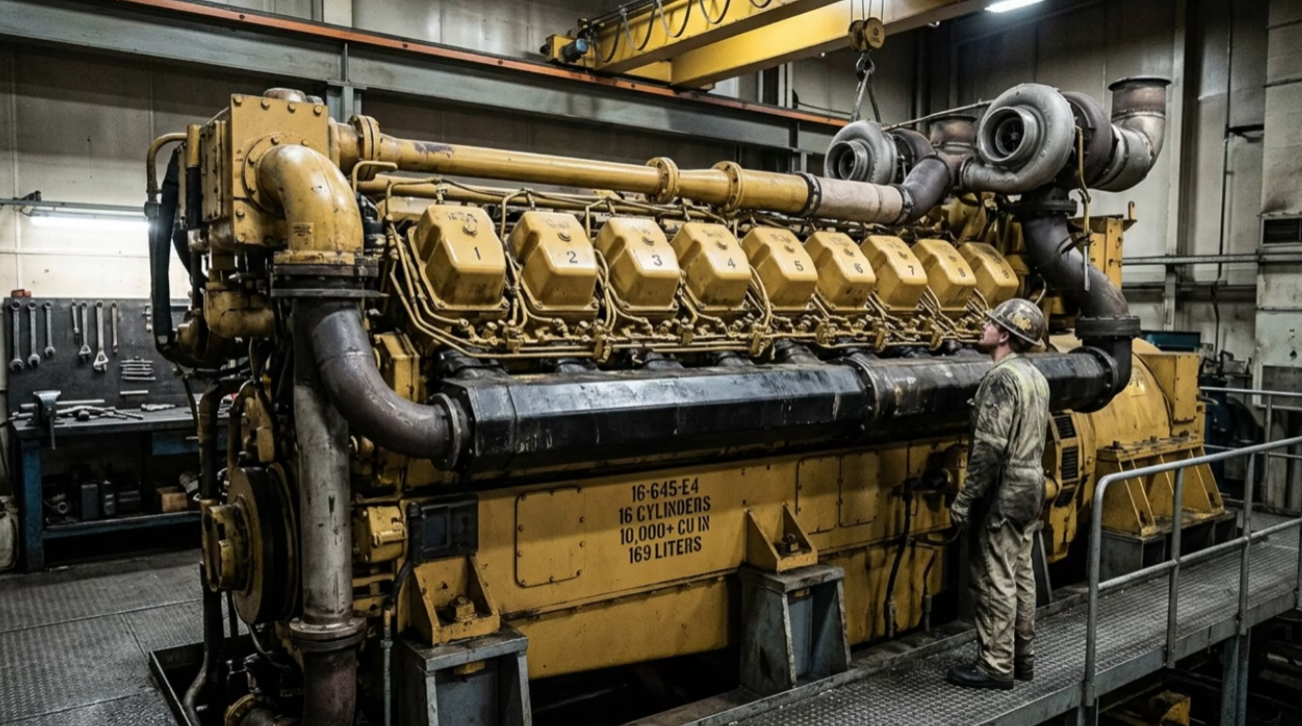
    Because the Titan relied on a massive 16-cylinder Electro-Motive locomotive engine and a diesel-electric powertrain, it was assembled inside the exact same bays used to build heavy railway locomotives.

    Inside the General Motors Diesel Division locomotive plant on Oxford Street.
    Inside the General Motors Diesel Division locomotive plant on Oxford Street.
    (Photo credit: Car Clever)
    A closer look at the massive 3,300-horsepower 16-cylinder Electro-Motive locomotive engine.
    A closer look at the massive 3,300-horsepower 16-cylinder Electro-Motive locomotive engine.
    (Photo credit: Car Clever)

    Once basic assembly was completed in 1974, the truck was rolled out into the plant’s expansive open yards and rear test track areas along Oxford Street to undergo initial mechanical testing before being disassembled for rail transport.

    It was unveiled to the public in October 1974 at the American Mining Congress in Las Vegas.

    The mining world gasped.

    What Made the Titan So Incredible?

    Let’s break down the numbers, because they are genuinely staggering:

    • Engine: A 16-cylinder, 10,343-cubic-inch Electro-Motive Division (EMD) locomotive engine pumping out 3,300 horsepower. Yes, locomotive, the same kind of engine that pulls trains across the prairies.
    • Gross Vehicle Weight: When fully loaded with 350 tons of ore, the Titan weighed 1,209,500 pounds, over 1.2 million pounds of steel, rubber, and raw power.
    • Tires: Twelve feet tall. Each one weighed more than a car.
    • Fuel Consumption: The Titan drank fuel at a rate of 5 gallons per mile. It carried 1,560 gallons in its tank, and it needed every drop.
    • Steering: All ten wheels, including the eight rear wheels, could steer, giving this monster surprising agility despite its size.
    • Braking: The Titan used regenerative braking, with the electric motors acting as generators to slow the truck and produce up to 5,400 horsepower of braking force.

    The driver sat in a cabin nearly 20 feet off the ground, essentially a second-story view of the mine. Contemporary reports said the truck was surprisingly easy to drive.

    We’ll take their word for it.

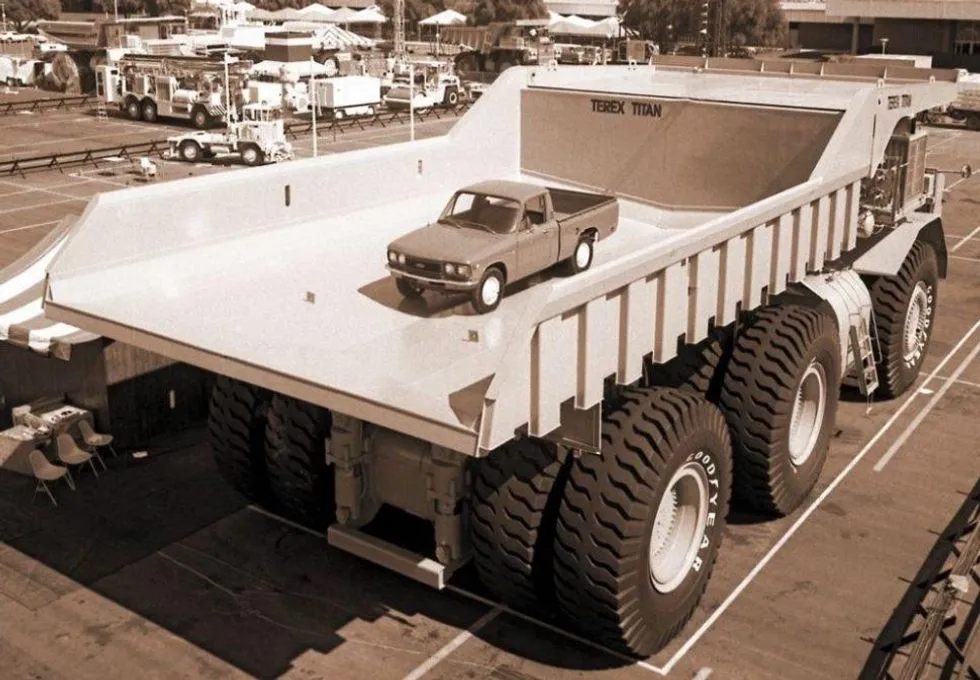
    Workers and normal-sized vehicles were dwarfed by the 1.2 million-pound Titan.
    Workers and normal-sized vehicles were dwarfed by the 1.2 million-pound Titan.
    (Photo credit: Car Clever)

    A Commercial Star (With Jack Nicklaus!)

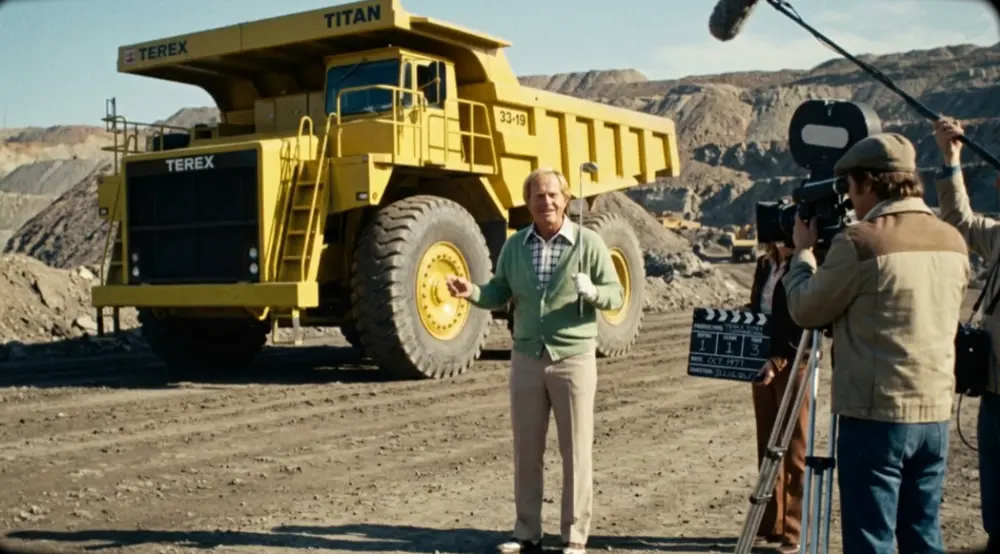
    In 1977, the Titan became a celebrity. Terex filmed a television commercial featuring golf legend Jack Nicklaus standing inside the loaded bed of the Titan, hitting golf balls.

    Imagine the scene: the greatest golfer of his era, surrounded by 350 tons of rock, swinging away inside a truck built in London, Ontario.
    Jack Nicklaus shooting a Terex Titan  TV commercial on location in Eagle Mountain, California, 1977.
    Jack Nicklaus shooting a TV commercial on location in Eagle Mountain, California, 1977.
    (Photo credit: Car Clever)
    The Jack Nicholson TV commercial. (Source: YouTube Video by Neal Peller).

    From California to British Columbia

    After its Las Vegas debut, the Titan went to work. In January 1975, it was put into service at Kaiser Steel’s iron mine in Eagle Mountain, California. It hauled approximately 3.5 million tons of earth over four years.

    Then, in late 1978, the Titan was disassembled, loaded onto rail cars, and shipped north to Sparwood, British Columbia. It would spend the next 13 years working in the Canadian Rockies, hauling coal for Westar Mining.

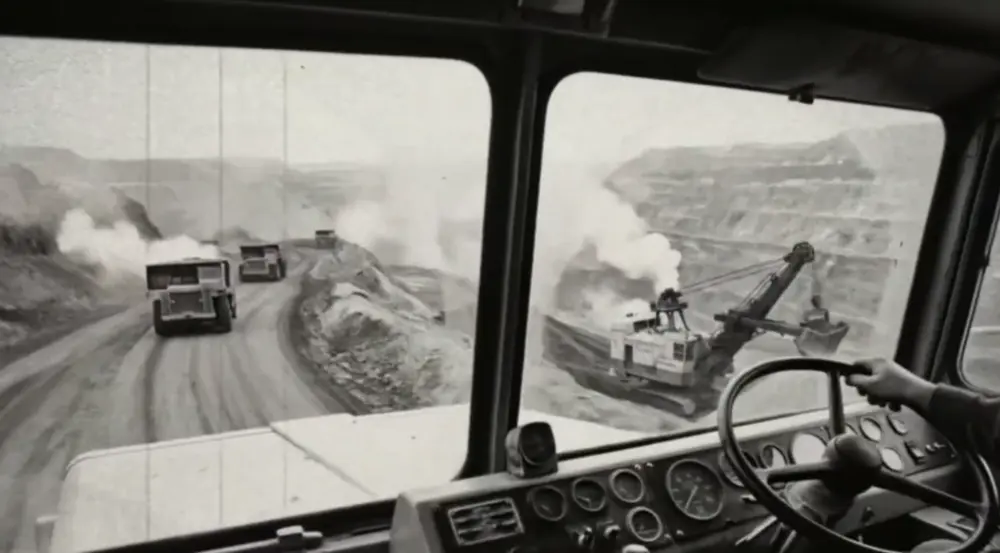
    The view from inside the Titan crew cab, two stories up.
    The view from inside the crew cab, two stories up.
    (Photo credit: Car Clever)
    Terex Titan hauling 350 tons of rock.
    When the Terex Titan debuted in 1974 with its unmatched 350-ton payload, the next largest dump trucks in the industry were clustered around 170 to 200 tons.
    (Photo credit: Car Clever)
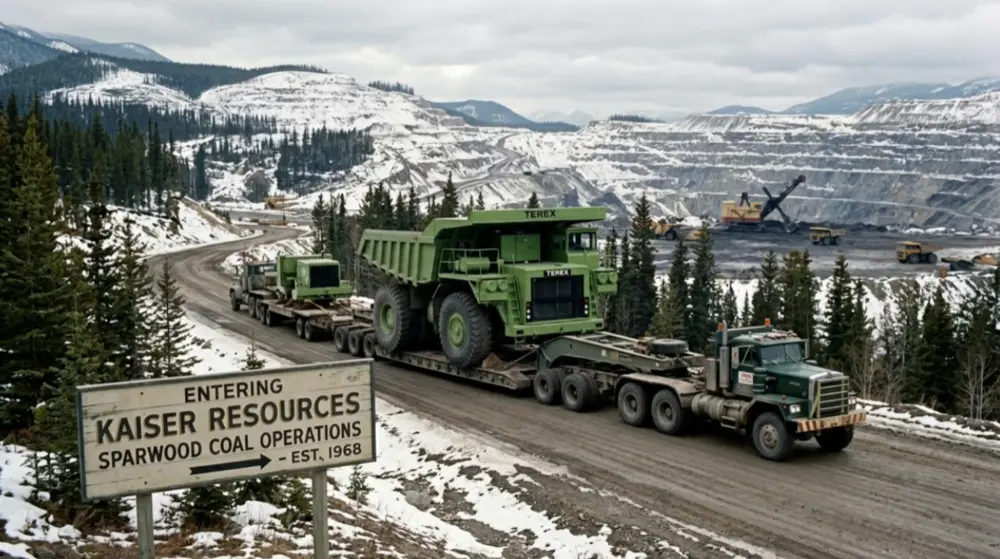
    Terex Titan arrives at Sparwood, B.C. on a flatbed truck.
    The Terex Titan arrives at the Canadian coal mine in Sparwood, B.C.
    (Photo credit: Car Clever)
    Terex Titan with its dump box raised 56 feet in the air.
    When the dump box was raised, it towered 56 feet in the air.
    (Photo credit: Car Clever)
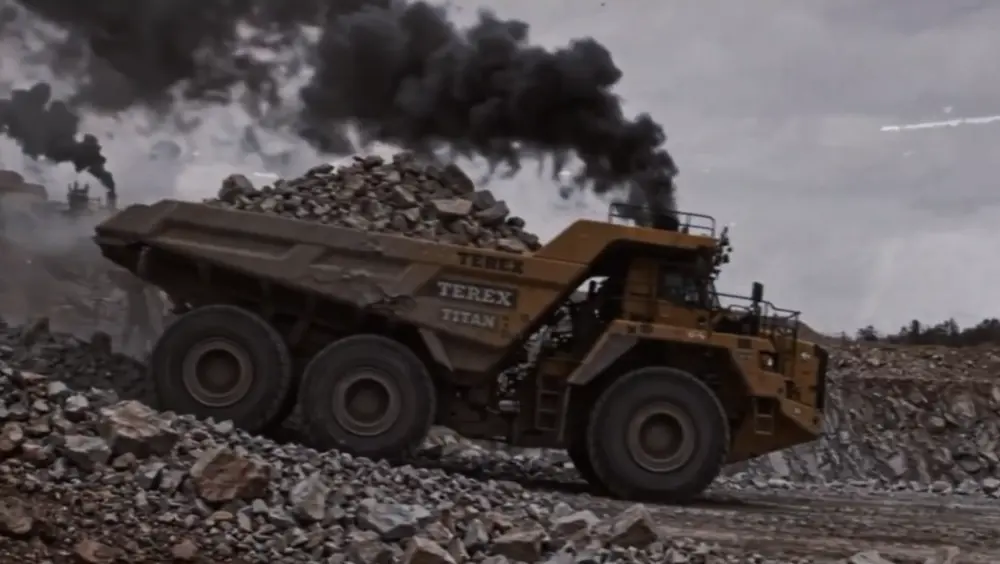
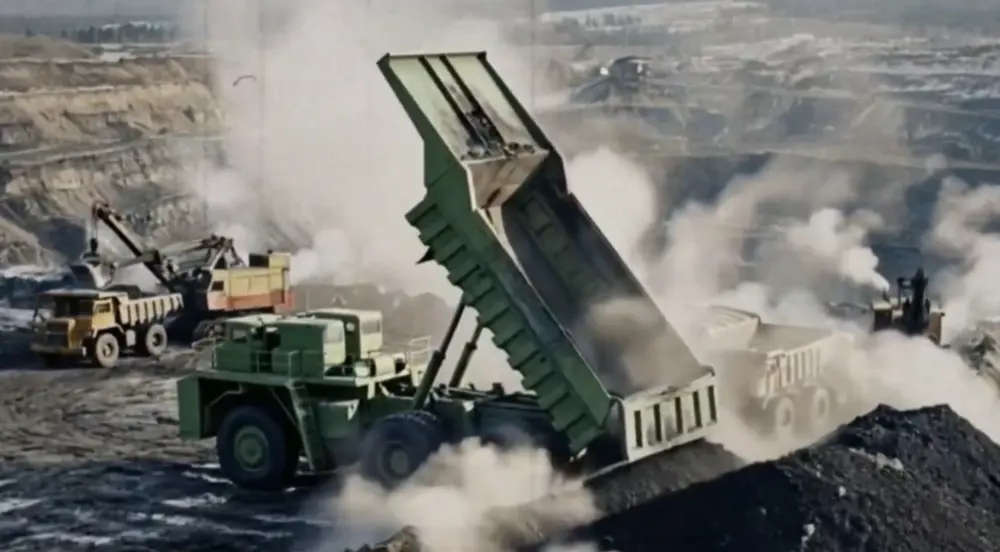
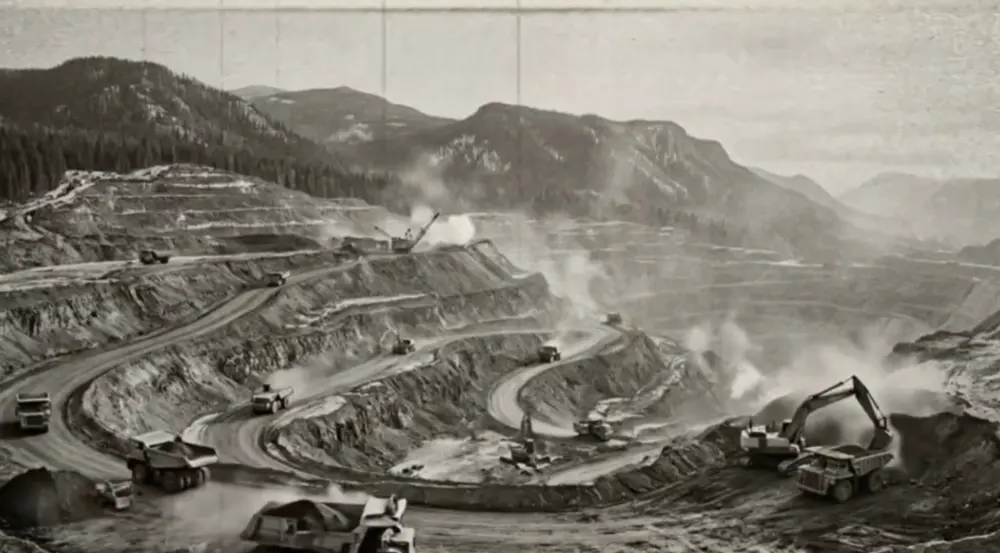
    Terex Titan working in an open-pit mine.
    The Terex Titan was built for this kind of open-pit mining.
    (Photo credit: Car Clever).

    During that time, the Titan was repainted from its original Terex lime green to Westar’s blue and yellow livery. It regularly hauled loads exceeding 350 tons, pushing the limits of its already legendary design.

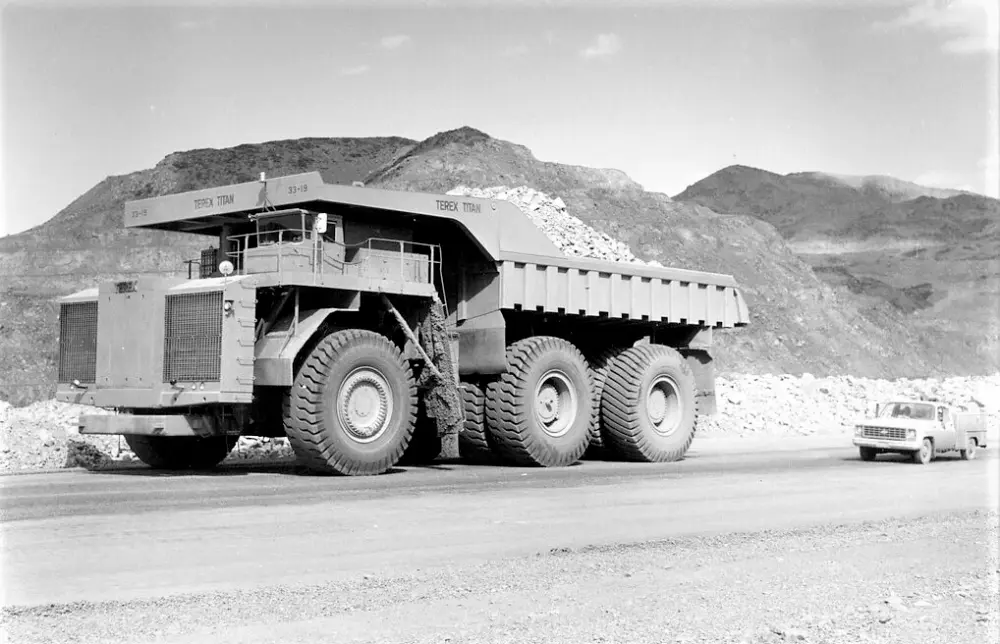
    Terex Titan dwarves smaller vehicles next to it.
    The one and only Terex Titan 33-19 in action during its working life.
    (Photo credit: Graham Newell on Flickr).

    Retirement and a Second Life

    By 1991, the Titan had logged nearly two decades of hard labour. Maintaining a one-off prototype was expensive; every replacement part had to be custom-made. So the mine operators retired the giant.

    But the story didn’t end there.

    In 1992, Teck Corporation acquired the Sparwood mine and offered the Titan for preservation as a public monument. The Sparwood Chamber of Commerce raised funds, restored the truck, and put it on display in Titan Park, right off Highway 3.

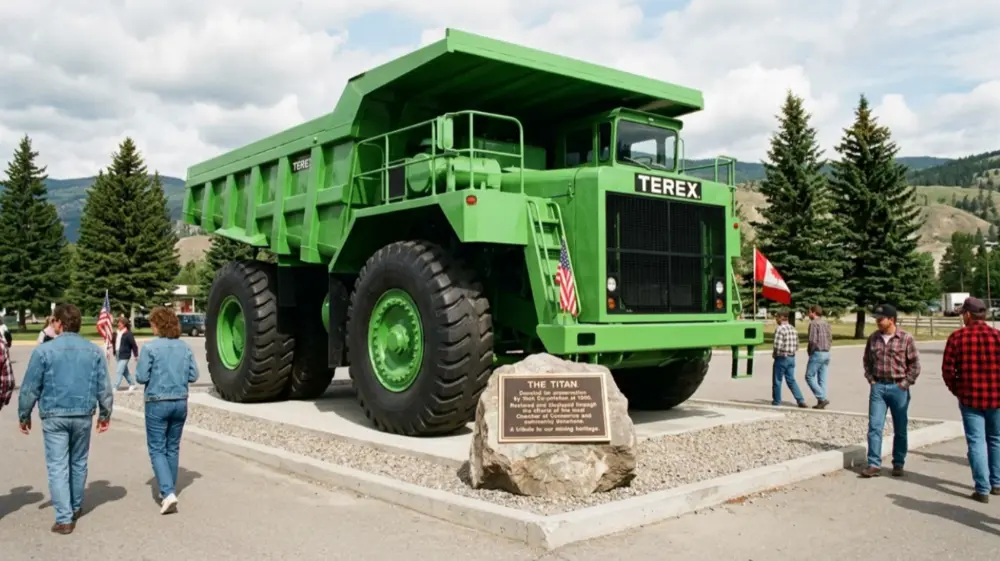
    Today, the Titan sits proudly in Sparwood, British Columbia, as a roadside monument and tourist attraction. The engine has been removed (a necessary step for preservation), but the massive frame, towering tires, and unmistakable silhouette remain. It draws visitors from around the world who want to stand beside the truck that once held the title of the largest in the world.

    The Titan (minus the engine) was repainted lime green, then put on display in Sparwood, B.C.
    The Titan (minus the engine) was repainted lime green, then put on display in Sparwood, B.C.
    (Photo credit: Car Clever).

    The Titan’s Legacy

    For 25 years, from 1973 until the debut of the Caterpillar 797 in 1998, the Terex Titan was the largest, high-capacity haul truck on the planet. No other truck held that title longer.

    The Titan never went into full production. The global coal market softened in the late 1970s, and the projected demand for ultra-class haul trucks never materialized. But for those of us in London, the Titan remains a source of quiet pride: proof that this city can build world-class, world-record, world-stopping things.

    See London’s Bigger Picture

    The Titan may now be 4,000 kilometres away in British Columbia. But its legacy is part of London’s DNA, a city that has always been willing to dream big, build bold, and surprise the world.

    When you visit London today, you can still see the bones of that ambition: the historic factories in London’s east end, the railway lines that carried industrial products across the country, and the innovative spirit that put this city on the map.

    I might not be able to take you to see the Titan itself. But I can show you, one bicycle pedal at a time, the city that built it.

    Lawrence Durham, author, standing in front of the old General Motors factory at 2021 Oxford Street East in London, Ontario.
    The author, standing in front of 2021 Oxford Street East.
    The General Motors factory shut down in 2012 following a prolonged labor dispute, ending over six decades of locomotive manufacturing in London. A new industry now occupies the plant
    (Photo credit: Lawrence Durham).

    Hi. I’m Lawrence.

    I’m a bicycle tour guide, a storyteller, and a proud Londoner who loves sharing the unexpected stories of this city. The Titan is proof that London has zeal and drive, and that spirit is alive and well today.

    If you want to explore London’s hidden history, its industrial past, and its charming present, come ride with me. Small groups, big laughs, and a city full of surprises.

    Click here to learn more!

    Featured cover photo: Terry Shea.