
London is known for many things, but not usually for one of the most gripping manhunts in North American history.
Pull up a chair, because the story of Marion “Peg-leg” Brown is the kind of tale that makes you look at London a little differently. It’s a story of violence, a continent-wide manhunt, mistaken identities, a prophecy from the gallows, and a grave that refused to stay silent.
The Son of a Mexican Desperado Arrives in London
To understand this story, we need to travel back to June 24, 1898. London was a bustling railway hub. Trains rumbled through constantly, bringing goods, travellers, and sometimes, those who preferred to ride without a ticket.
On that summer evening, a young man hopped off a freight train into the London rail yards. His name was Marion Brown, though history would remember him by a different name: Peg-leg.
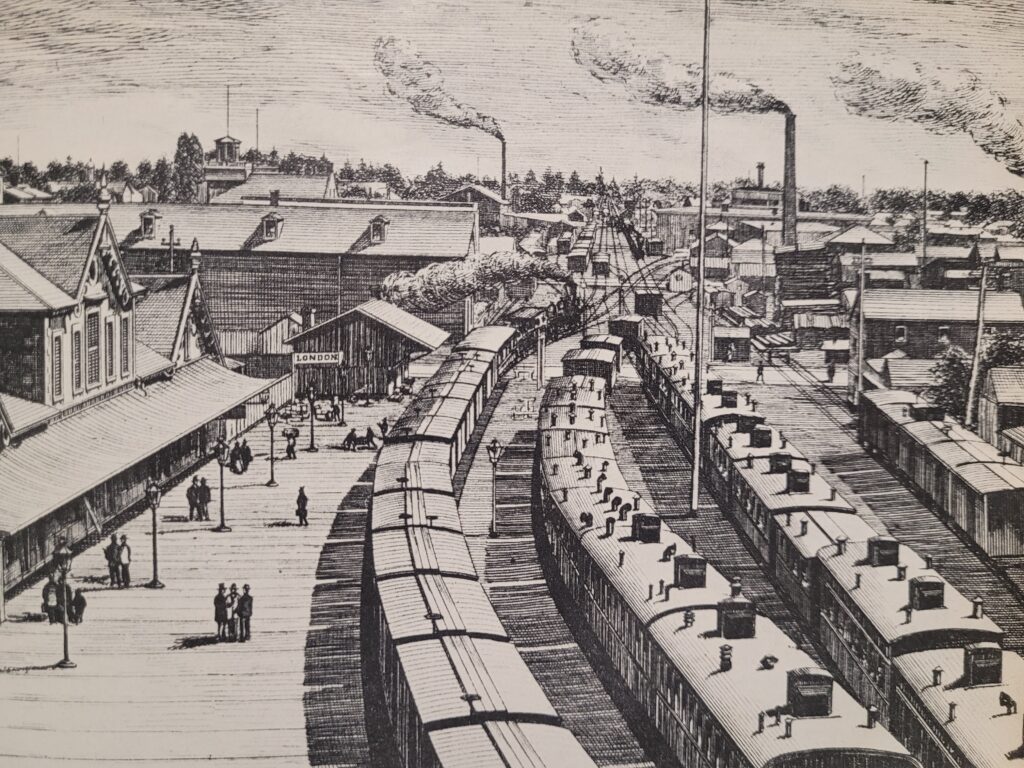
Drawing on the left above: The chaos of a busy rail yard in London at the turn of the century. (Source: Archives and Special Collections, Western Libraries, Western University, original source: Canadian Illustrated News).
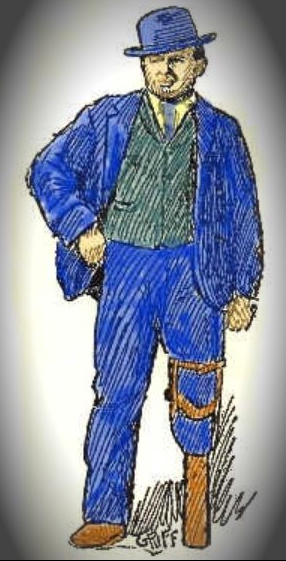
Drawing on the right above: Marion “Peg Leg” Brown at age 25. (Find a Grave)
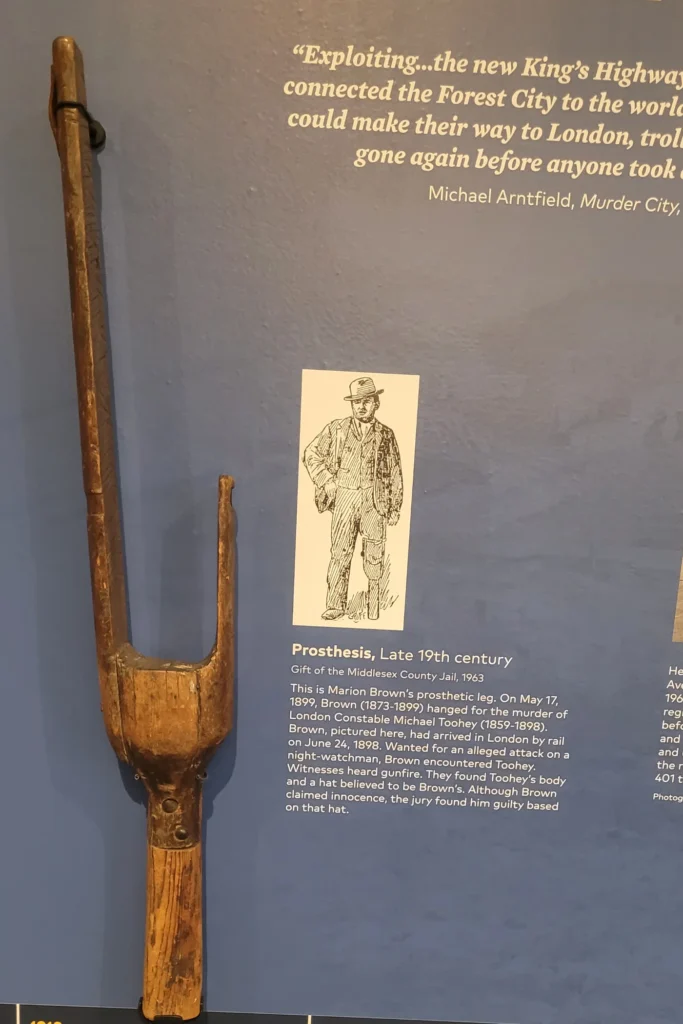
Born around 1873 in San Saba, Texas, Brown was the son of a Mexican desperado. With that background, he seemed predestined for a life on the wrong side of the law. At just 19 years old, he lost his left leg while attempting to hop a train, an injury that would define the rest of his short life. He now walked with a prosthetic limb crafted from elm wood, a detail that made him unforgettable.
By the spring of 1898, Brown found himself in a Texas jail for burglary. But in June, he managed to break out, taking with him a .44 caliber revolver loaded with six bullets. He would use every single one before the month was over.
After escaping in Texas, Brown hopped a series of freight trains and made his way north. His journey ended in London, Ontario, on the evening of June 24.
A Fatal Encounter at the Train Yards
What happened next unfolded rather quickly.
Brown confronted a railway guard, knocking him unconscious. When Constable Michael Toohey of the London Police Force arrived to arrest the suspect for assault, Brown raised his revolver and fired. The first shot struck Constable Toohey’s pocket watch, a timepiece that saved his life. But Brown’s second shot found its mark, ripping through the police officer’s abdomen. Constable Michael Toohey died at the scene, leaving behind three young children.
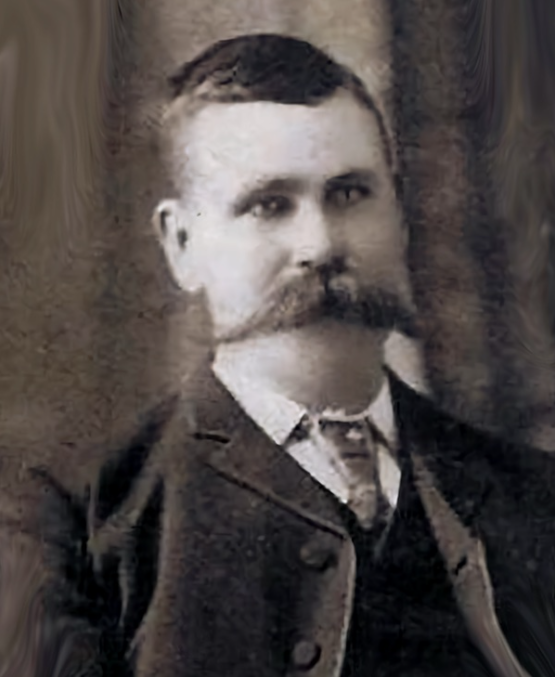
(Photo credit: Ontario Police Memorial Foundation)
In the chaos of the rail yards, the shooter vanished, disappearing into the night. And just like that, a three-month manhunt for Marion “Peg-leg” Brown began.
A Continent-Wide Dragnet
The challenge facing the London police was immense. They were searching for a needle in a haystack – a needle with one wooden leg, to be sure, but a needle that knew how to move quickly along the railway lines that crisscrossed the continent.
London Police Chief Williams wasted no time. His first instruction was decisive and sweeping: arrest every tramp in the county matching the suspect’s description. Within days, jail cells filled with drifters and transients, all questioned about the murder. But the real killer remained at large.
Next, authorities announced a reward: $500 for the capture and delivery of the suspect to any police station in Ontario. In 1898, this was a significant sum, enough to attract attention across the province and beyond.
Soon, a detailed description of the suspect was dispatched to every town and village with a population greater than 150 residents in both Canada and the United States.
Think about that for a moment. In an era before radio, television, or the internet, word of Marion Brown’s crime reached literally every hamlet and crossroads across two countries. The description was unmistakable: a one-legged man, probably travelling by rail, armed and extremely dangerous.
Unintended Consequences
The panic that gripped the nation had real human costs. Before Brown was finally captured, over forty other one-legged drifters were taken into custody across Canada and the United States based on nothing but their missing limbs. These innocent men were deprived of their freedom, some for weeks, simply because they shared a physical characteristic with a fugitive.
The Capture
For months, the trail went cold. Brown seemed to have vanished into the vastness of North America. He hopped trains through the Canadian wilderness, crossed back into the United States, and kept moving. Along the way, he reportedly engaged in a second gun battle near Watford, Ontario, though details of that encounter remain murky.
But London hadn’t forgotten Constable Toohey. Telegrams continued to fly across the continent, and police departments remained alert.
The break in the case came nearly three months later, nearly 4,000 kilometres from the scene of the crime. United States Marshal A.L. Dilley received a tip about a one-legged man in Washington State. Following up, Dilley tracked his quarry to an opera house and arrested him on Sept 24th without incident.
The international manhunt was over. Marshal Dilley had captured one of the most wanted men in North America.
The Return
Brown was extradited to Canada and transported back to London. When news of his arrival spread, a large crowd gathered, eager to catch a glimpse of the notorious killer. The man who had terrorized the continent was finally back in the city where his crime had occurred.
Brown’s preliminary hearing was held before a crowd of 400 spectators, with standing room only in the courthouse. From the very beginning, Brown insisted that the trial would not be fair or impartial. The public, he argued, was already prejudiced against him. The crowd in the gallery seemed to prove his point.
At the request of the defence, Brown’s trial was postponed to allow time to prepare their case. His attorney, a man named McPhillips, would need every moment.
The Trial: Justice or Prejudice?
By the time the trial finally commenced in March of 1899, it had already become one of the most expensive legal proceedings in the history of Middlesex County. The costs, estimated at around $4,500, were staggering for the time, reflecting the case’s notoriety and the resources devoted to the widespread manhunt.
McPhillips concluded his defence with a powerful statement: none of the ninety witnesses could “show positively that the man who fired the shot at Toohey was Brown.” According to the defence, the wrong man was on trial. They pointed to the chaos of the moment, the confusion in the rail yards, and the possibility of mistaken identity.
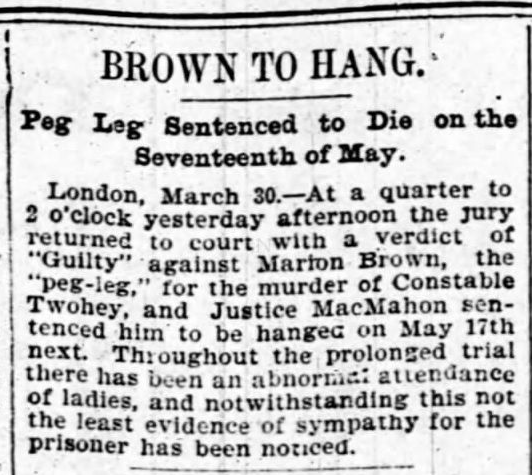
But the evidence against Brown was substantial. His revolver, his presence at the scene, his flight from justice, all pointed toward guilt. The jury deliberated and returned a verdict of guilty. Marion “Peg-leg” Brown was sentenced to hang on May 17, 1899.
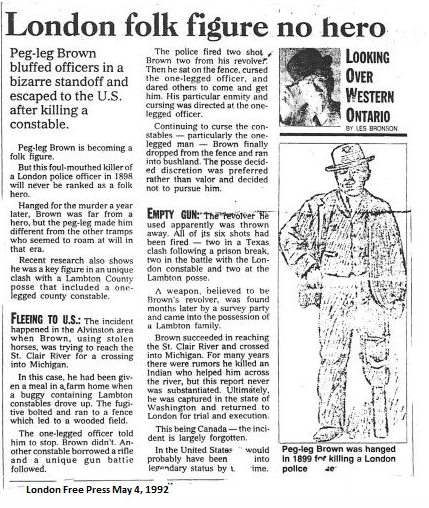
An interesting footnote: Despite the massive effort to capture Brown and despite the $500 reward that had been promised, Marshal A.L. Dilley never received his payment. For reasons lost to history, the reward for the capture and delivery of one of the most notorious criminals of the era went unpaid.
A Deathbed Conversion and a Desperate Appeal
(Photo credit: Find a Grave)
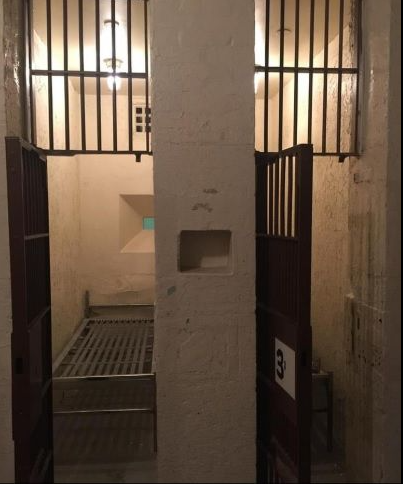
In the months between his conviction and his execution, something remarkable happened to Marion Brown. Confined to his cell in the London jail, he underwent a deathbed conversion to Christianity. He read the Bible regularly, sang hymns, and struck up a friendship with Rev. Dr. Johnston, the pastor of St. Andrew’s Presbyterian Church.
Johnston, unlike many in London, believed Brown was innocent. Just days before the scheduled execution, he traveled to Ottawa in a desperate attempt to have the conviction appealed. He sought intervention from both the Governor General and Prime Minister Wilfrid Laurier himself. Over forty lawyers had already appealed to Laurier on Brown’s behalf, arguing that the trial had been biased and unfair.
The appeals went nowhere. Prime Minister Laurier and his government ignored the pleas, and the execution was allowed to proceed.
The Prophecy: “No Grass Shall Grow on My Grave”
As Brown was led away to the gallows on that stormy May morning, he spoke words that would echo through the decades:
Rev. Johnston and a small group of officials accompanied Brown to the scaffold at the appointed hour. Outside, a massive crowd had gathered around the London jail yard, though their view of the hanging had been deliberately blocked by wooden siding. London was determined to carry out justice, but not for it to be a spectacle.
Brown was hanged as scheduled. His body was buried in an unmarked grave within the prison yard, a common practice for executed criminals in that era, denying them proper burial in consecrated ground.
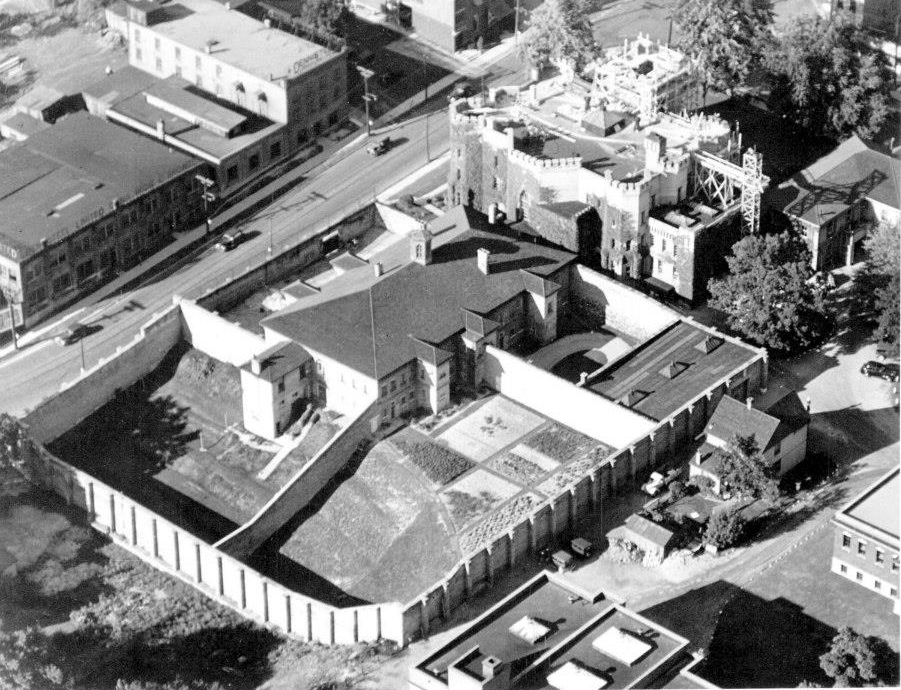
(Photo credit: Ivey Family London Room, London Public Library, London, Ontario, Canada)
And for decades, the prophecy seemed to hold. The area became the walled-in exercise yard for prisoners, and later, when the jail evolved into other uses, it became part of the Middlesex County Courthouse parking lot. Grass never grew on his grave. Layer after layer of concrete and tarmac covered the spot where Brown’s body lay.
Then, in 1985…
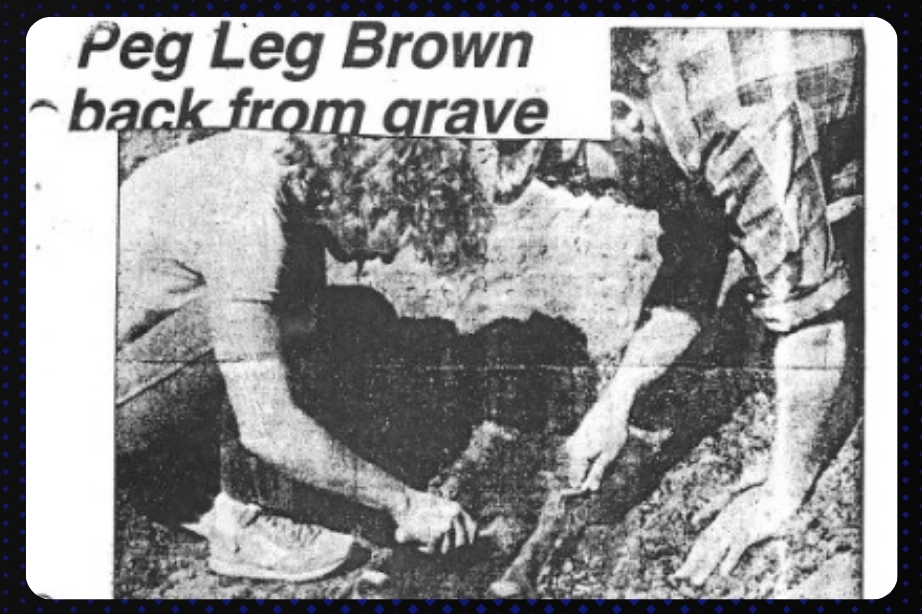
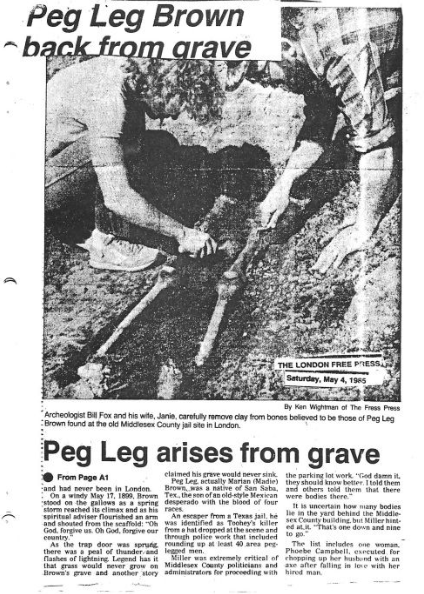
Construction workers were excavating the courthouse parking lot for a new project. A backhoe operator dug into the earth and uncovered something unexpected: a human skeleton. The machine had severed the upper torso cleanly from the rest of the body.
Local historian Orlo Miller was furious. “They should have known better,” he fumed. “I told them and others that there were bodies buried there.”
A missing left leg made it immediately clear whose body had been found. Archaeologists were sent to comb through the earth that had already been removed and dumped as landfill, but they could only recover fragments of the upper skeleton.
As for his Wooden Leg…
One piece of Marion Brown never left public view. His wooden leg, that infamous prosthetic crafted from elm wood, survived. Today, it hangs on the wall of Museum London, just across the street from where Brown was hanged. Visitors can see it for themselves, this tangible connection to one of the most dramatic chapters in our city’s history.
(Photo credit: Lawrence Durham)
Questions Remain
The story of Marion “Peg-leg” Brown raises questions that still resonate today. Was he guilty, or was an innocent man executed? Were the appeals of forty lawyers and a Presbyterian minister simply ignored by a government unwilling to reconsider his plight? Does a prophecy fulfilled mean anything at all?
We may never know the truth. But we do know this: London’s history is richer, stranger, and more fascinating than most people realize. Every corner has a story. Every building has witnessed something. Every park has known laughter, and yes, sometimes tears.
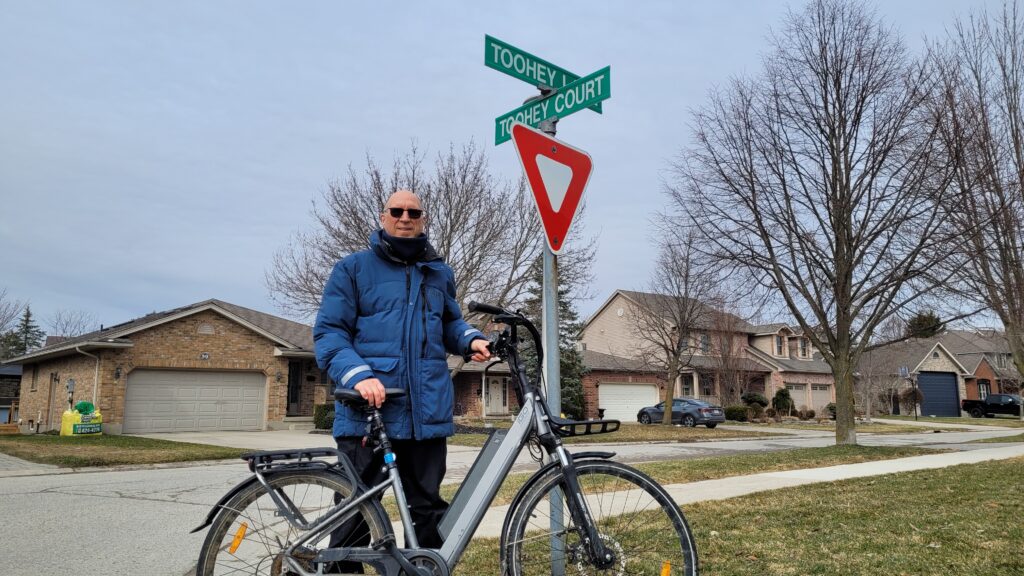
As for Constable Michael Toohey, he was not forgotten. Nearly one hundred years after his death, two streets were named in his honour.
(Photo credit: Lawrence Durham).
Hi. I’m Lawrence, bicycle tour guide, storyteller, and lover of tales that make you see our city in a whole new light. I help curious folks like you discover the best parts of London, and stories like this are just the beginning. On my tours, we don’t just ride through the city; we travel through time. We’ll explore the places where history happened, from the dramatic to the delightful, from the solemn to the surprising. Whether you’re a visitor seeing London for the first time or a local who thought you knew your hometown, I promise you’ll discover something new. Small groups and big laughs, your next adventure awaits.
Leave a Reply