
[6-minute read]
Cornelius Burley (1803–1830) was a blacksmith and the first person to be executed in London.
His death is famous for three reasons:
- a mysterious confession
- a failed first hanging attempt
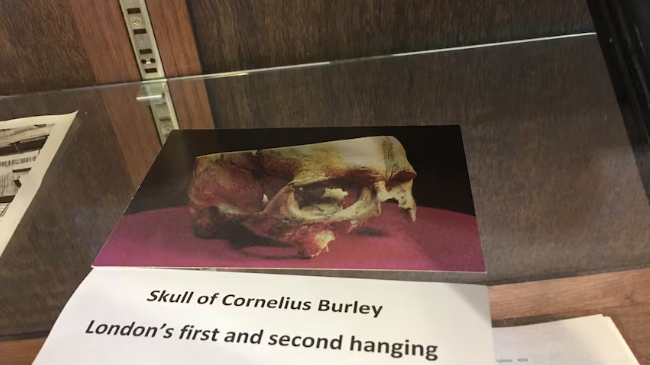
- the bizarre post-mortem use of his skull
Even though he paid the ultimate price for murder, people still wonder. Did the authorities get the right man?
You be the judge.
The Crime and The Arrest
In 1829, a warrant was issued for the arrest of Cornelius Burley after he shot one of his neighbour’s cattle during a heated argument, and then fled to his uncle’s farm in Bayham Township near Aylmer.
When Constable Timothy Pomeroy arrived to bring Burley to justice, Pomeroy was shot and killed.
Burley, along with his uncle, Henry Ribble, and his cousins Anthony and David Ribble, was accused of shooting Officer Pomeroy.
The Ribbles had a lawyer, were established farmers in the area, and were well educated, whereas Burley was from out of the county and was described by some as “poor, ignorant, weak-minded, and almost an idiot”.
Nevertheless, the Ribbles and Burley were all put into the cells of the temporary wooden courthouse in London, which was the seat of the regional government.
A Non-Jail Break and a Dubious Confession
Interestingly, during a jailbreak that winter, all the prisoners escaped except Burley. He, being certain, he said, of his own innocence, remained behind to await his acquittal.
Later, however, he signed an eloquent written confession while in prison, though many believe he was coerced or “brainwashed” by a certain Reverend James Jackson into confessing to save his cousin from the gallows.
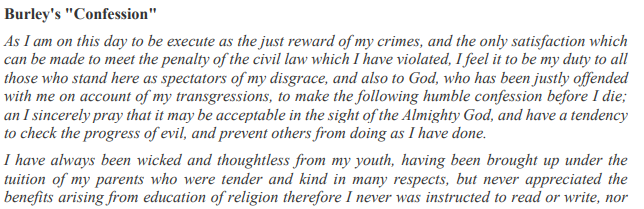
Burley was reportedly illiterate, which made the handwritten and eloquent confession that Jackson read for him from the gallows on the day of his execution all the more questionable.
Tellingly, Jackson printed and published a copy in a pamphlet titled “The Dying Confession of Cornelius Burley” two weeks after the execution (see below).
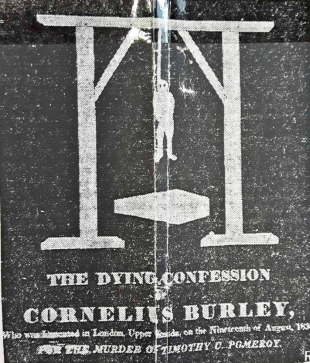
(Photo credit: Death, Disaster, and Disgrace in Victorian London – Walking Tour)
Below are the opening words of Burley’s confession, as reported by Reverend Jackson. As you read them, ask yourself: are these the words of an uneducated and illiterate man, or are they the words of the preacher himself?
The Trial
Records show the policeman was shot at night. There were no eyewitnesses.
Unfortunately, at the trial, even though the evidence given by the witnesses who did testify against him was circumstantial, Burley was found guilty and sentenced to hang.
The First Drop: A Broken Rope
Burley’s execution took place on August 19, 1830. Even though the population of the tiny village of London was only about 300 people at the time, a crowd of roughly 3,000 people, from the surrounding countryside, showed up for the hanging.
On the first attempt, the rope snapped, and Burley fell 20 feet to the ground. While someone was sent to fetch a new rope from the general store across the street, Burley regained consciousness and was forced to climb the scaffold a second time. This time, the rope held, and he was successfully hanged.
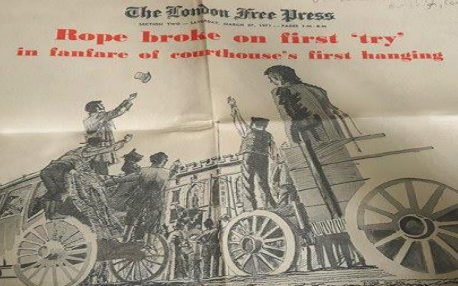
(Photo credit: Death, Disaster, and Disgrace in Victorian London – Walking Tour)
Public Dissection and His Skull’s Long Journey
After he died on the gallows, his body was cut down and immediately set upon by medical doctors, who in those days would dissect corpses at the scene of a hanging as a kind of second show for those attending, and to practice their autopsy skills.
During this macabre show, Orson Squire Fowler, a famed phrenologist, decapitated the corpse and sawed off the top portion of his skull. After emptying the contents of Burley’s skull, Fowler inserted a lighted candle in the spinal hole at the base.
Sure enough, the geography of Burley’s cranium bore out Fowler’s predictions. Where he had said the skull walls were thin, the candlelight shone through; whereas in other areas, Fowler pointed out, Cornelius’ thickheadedness allowed no light to emerge.
Fowler used this demonstration to illustrate his pseudoscientific theory that the location of thin and thick sections of the wall of the skull indicated certain characteristics that could predict certain behaviours.
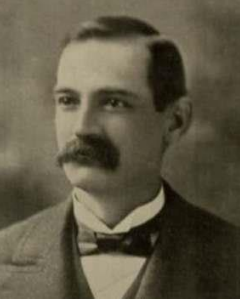
dissection.
(Photo credit: Death, Disaster, and Disgrace in Victorian London – Walking Tour)
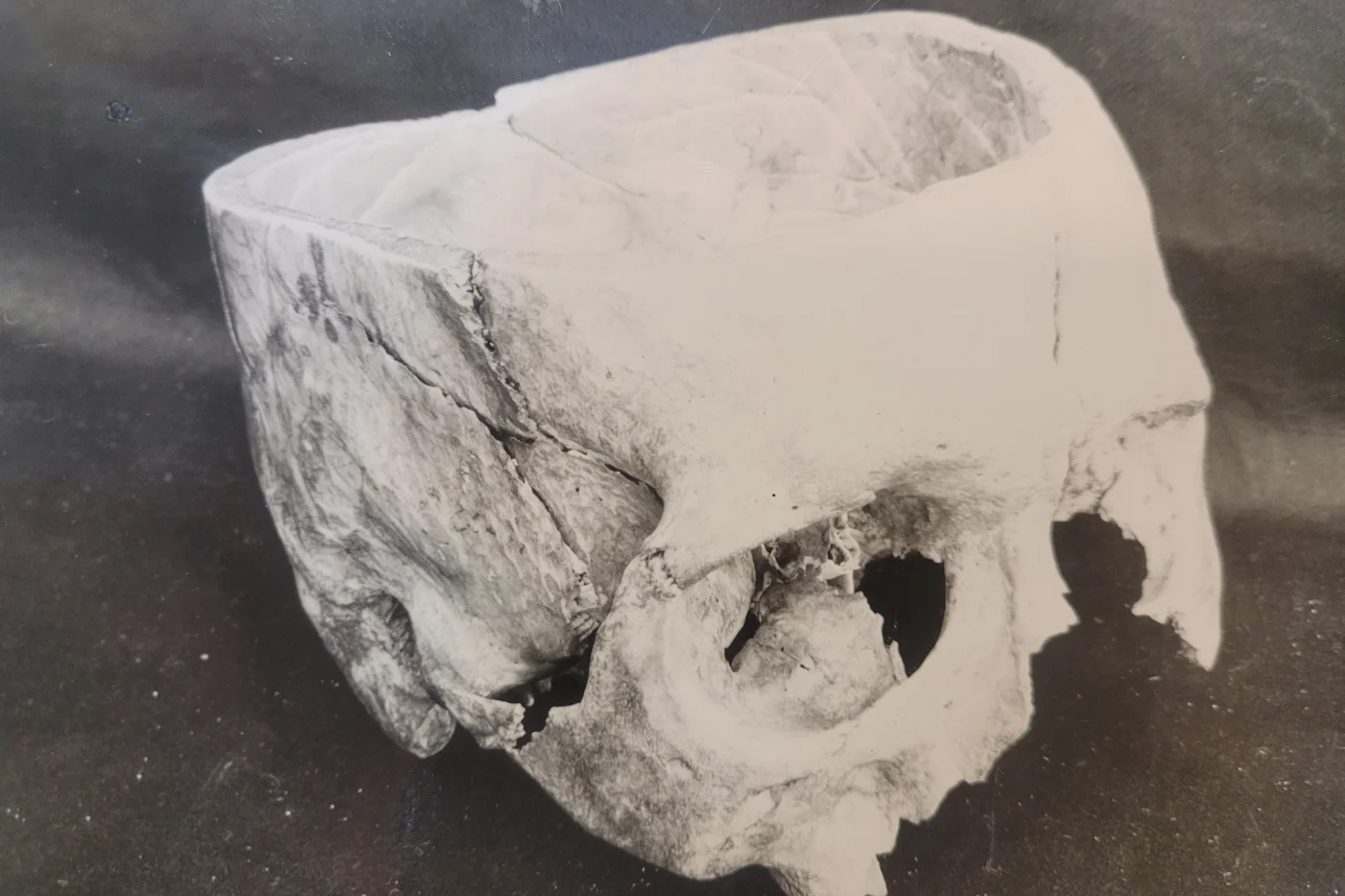
And so young Burley’s skull began a journey of decades and thousands of miles. Not his whole skull, mind you. You can see in the picture below where Fowler sawed the skull across, above the eyes, keeping the bowl-like top for his exhibitions.
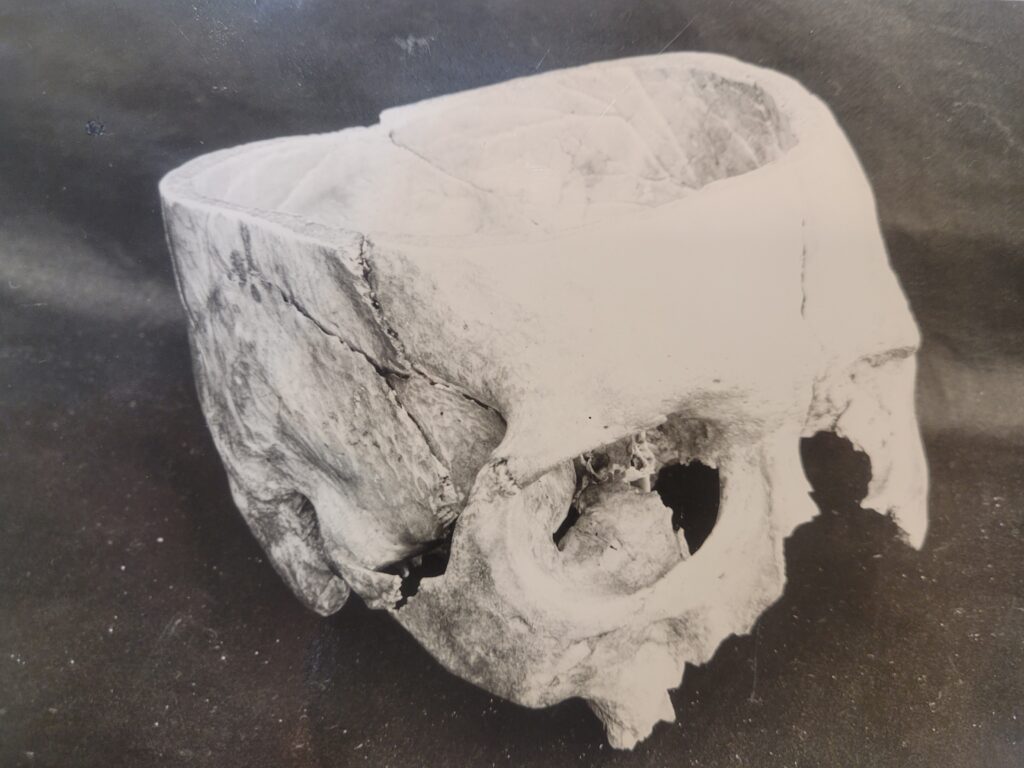
(Photo credit: Ivey Family London Room, London Public Library, London, Ontario, Canada)
So, off went the top of Burley’s head through the United States and Europe, to be touched and stroked and handled by anyone willing to pay the price of admission to one of Fowler’s exhibitions. He would hold out the skull cap to illustrate the theories he had borrowed from the European phrenologists to any paying customers who came to have their skulls read.
Fowler eventually became one of the most famous phrenologists in the world, having built a multi-millionaire business by using Burley’s skull to promote his theories.
Lingering Doubts and Final Rest
There is one more twist to Burely’s story.
Scholars now believe that he was innocent and that he was sacrificing himself to save his cousin. Although Burley did confess to the shooting death of Constable Pomeroy, there was, and remains, a great deal of skepticism over his guilt.
As for the skull remnant, it eventually found its way back to Eldon House, a local museum in London, where it was reportedly turned into an ashtray before being stored in the museum’s collections.
In 2001, after more than 170 years of display and displacement, Burley’s remains were finally given a proper burial when the skull fragment was returned to Burley’s distant relatives in Michigan and buried in a family plot.
And so ends the curious case of Cornelius Burley, the first (and second) man to be hanged in London.
(Photo credit: Lawrence Durham)
Hi. I’m Lawrence – bicycle tour guide, storyteller, and lover of London’s many fascinating quirks.
This is just one of many interesting tales that are hidden in the fabric of London.
If you’d like to discover more of the London that only locals know, I’d be delighted to have you come along with me on a guided bicycle tour.
Leave a Reply