
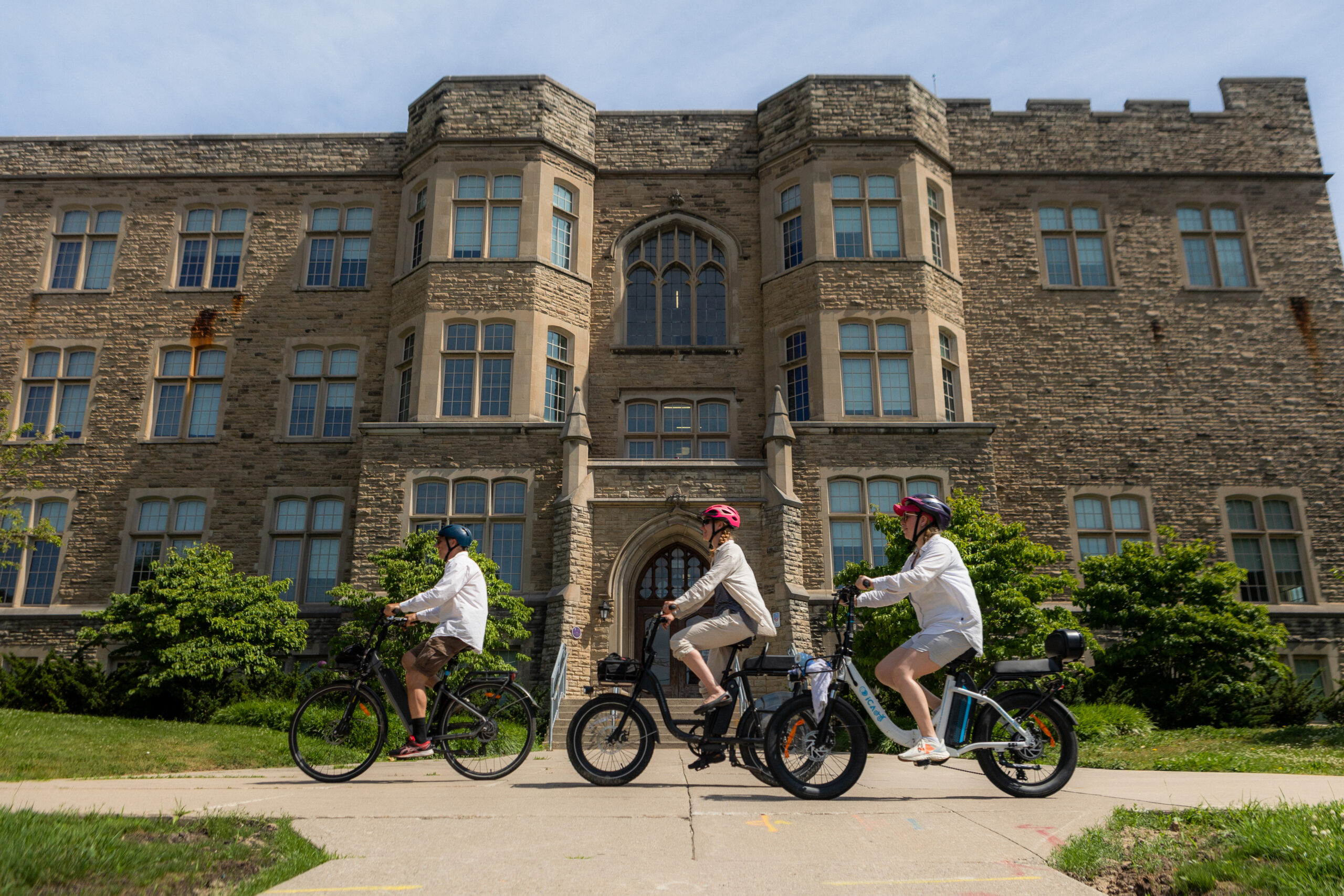
You don’t need Train Platform 9 ¾ to find magic in Southwestern Ontario.
Here’s the secret that even many Londoners don’t know: the architectural makeup of Western isn’t an accident. It is one of the most visually cohesive Collegiate Gothic campuses in Canada, a deliberate, decades-long architectural love letter to medieval Europe, hiding in plain sight on the banks of the Thames River.
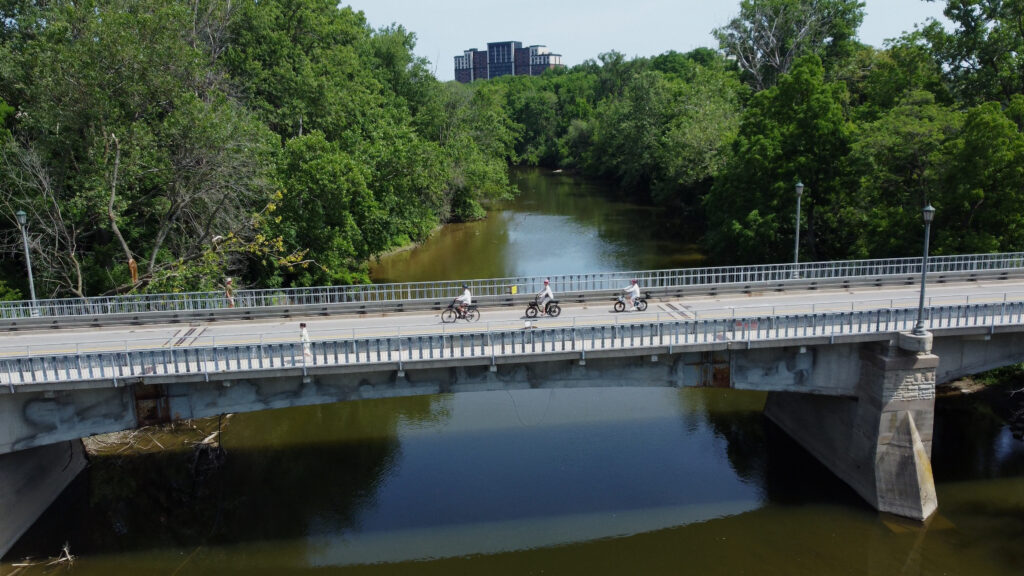
(Photo credit: Ben Durham).
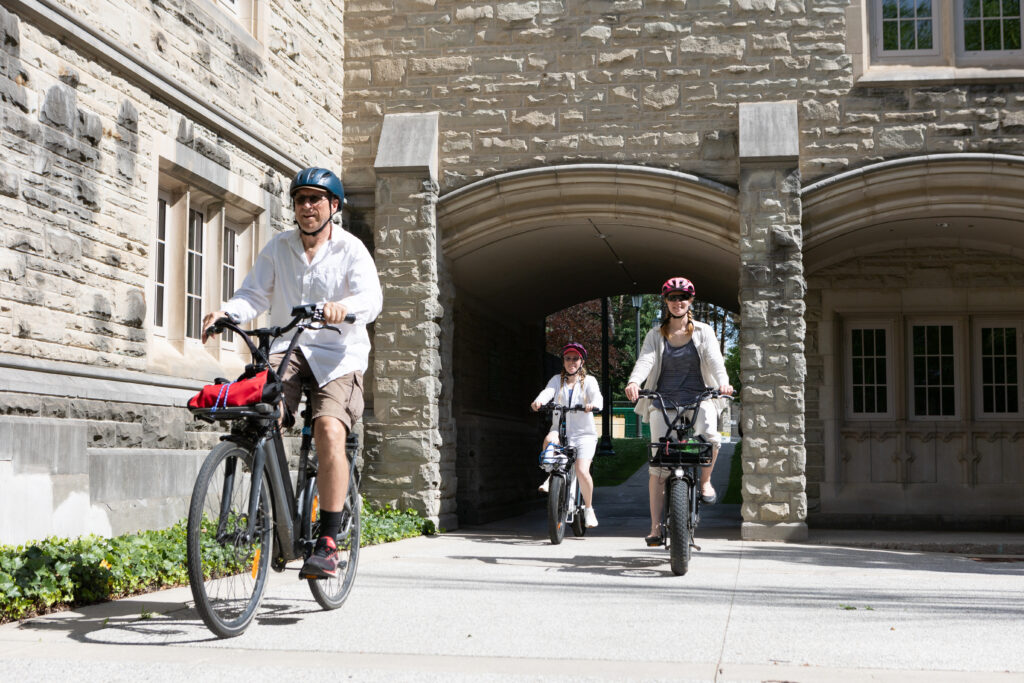
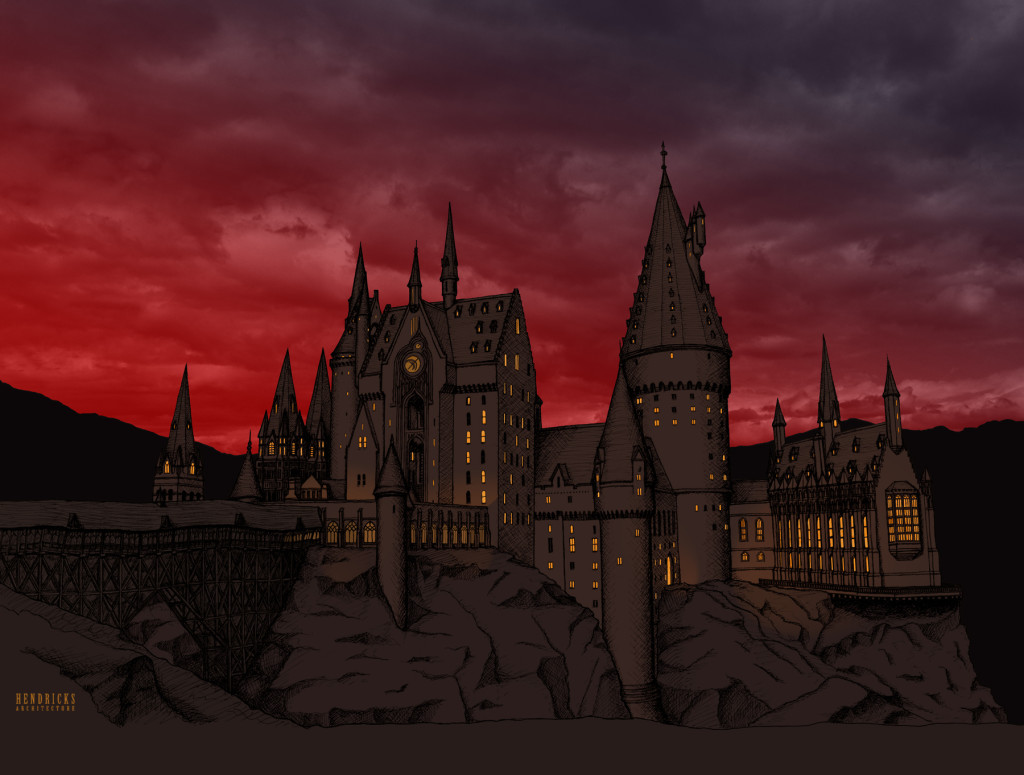
All you need to do is pedal your bicycle up the gentle hill toward Western University in London. Suddenly, the modern city falls away. Limestone towers rise against the sky. Stone arches cover quiet walkways. And if you squint just a little, you could be forgiven for thinking you’ve stumbled onto the set of a Harry Potter film.
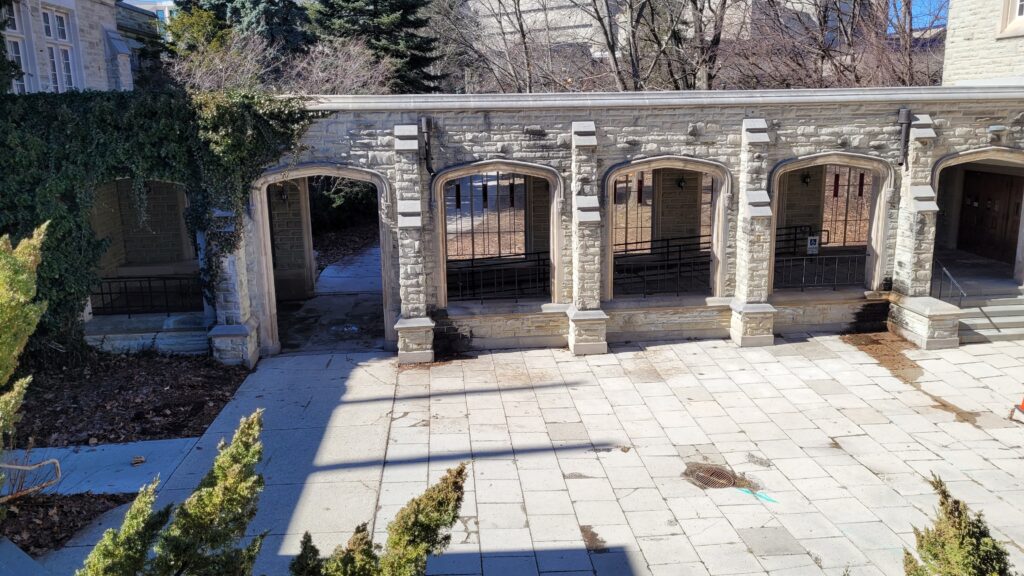
(Photo credit: Lawrence Durham).
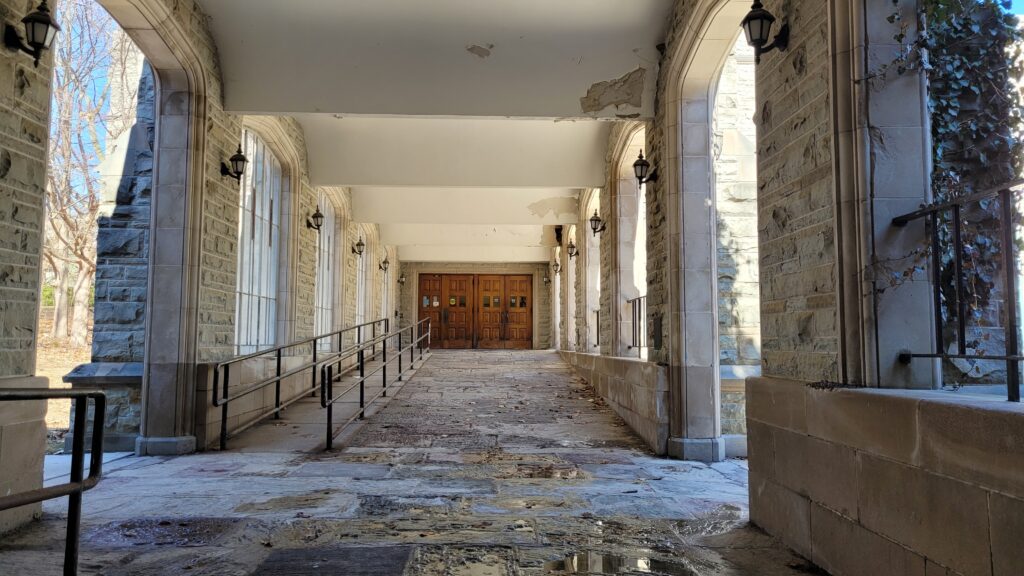
(Photo credit: Lawrence Durham).
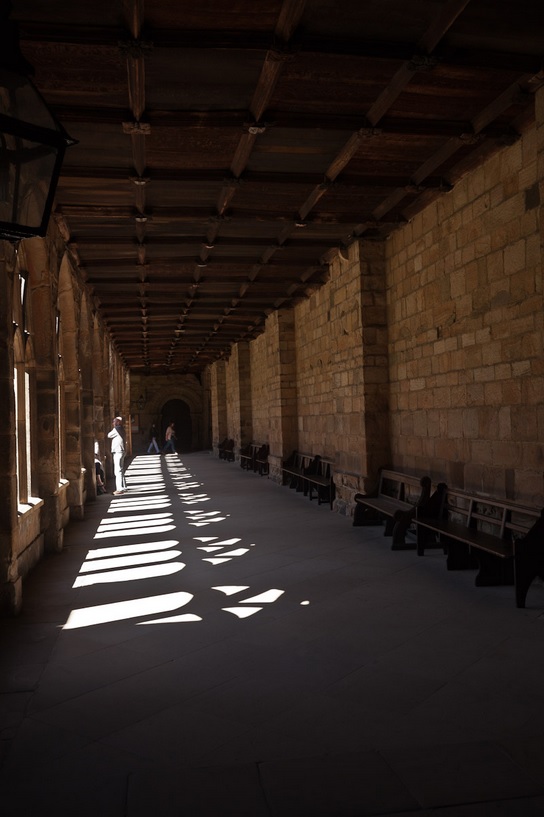
(Photo credit: Les Bessant).
Hogwarts vs. Western: The Architectural Kinship
Let’s start with the obvious question: What style is Hogwarts?
The Harry Potter films borrowed heavily from real-world history. The filmmakers blended Medieval, Gothic, and Gothic Revival architecture, mixing the pointed arches of Gothic cathedrals with the heavy, circular forms of Norman Romanesque and the turreted charm of Scottish Baronial castles.
Real-life inspirations included Durham Cathedral, Gloucester Cathedral, and, most relevant to us, the ancient colleges of Oxford and Cambridge.
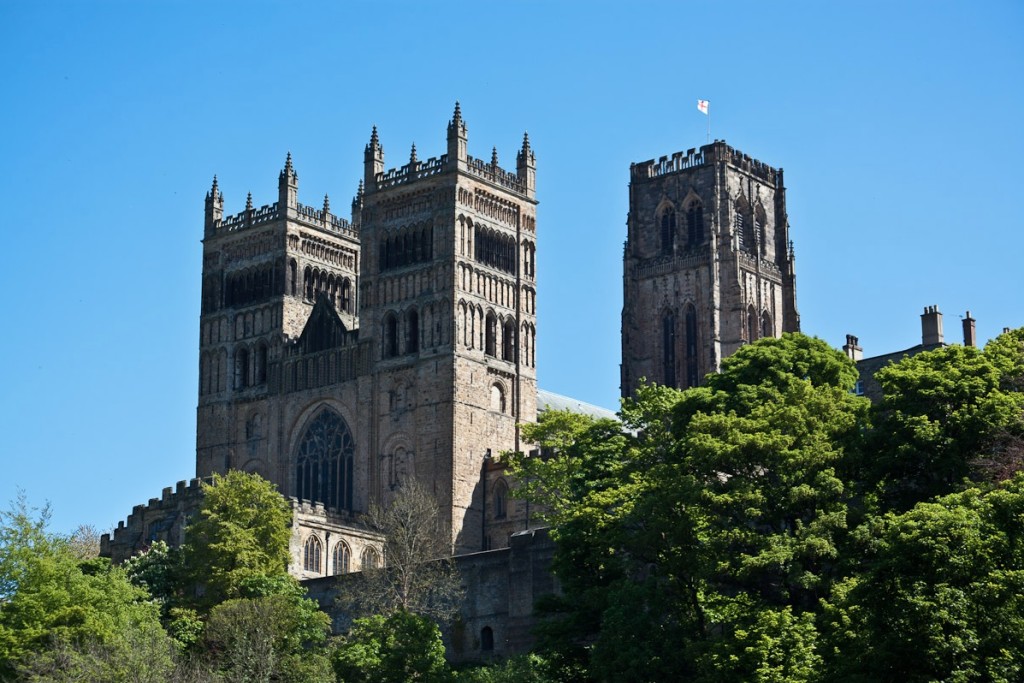
(Photo credit: Les Bessant).
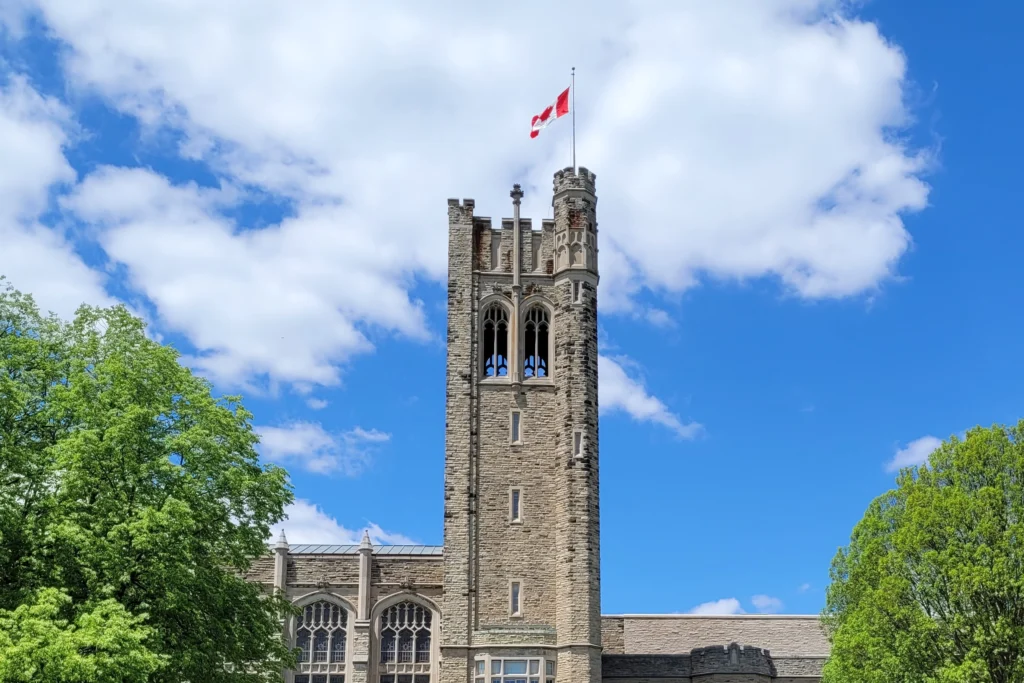
(Photo credit: Lawrence Durham).
Western University’s architects were doing the exact same thing as rivalist architects elsewhere, at the exact same time, for the exact same reason: to make a young institution feel ancient, wise, and worthy of respect.
Author’s Note: The remaining photos were all taken by the author, unless otherwise indicated.
How Western Compares Nationally
Canada has several beautiful university campuses, but Western sits in the top tier for a trio of reasons that go beyond a single pretty building.
1. Consistency of Style
Many Canadian universities have a “Gothic quad” surrounded by later architectural chaos. Not Western. From the 1920s through to 1960, the university used Collegiate Gothic as its baseline architectural identity. Across 1,100 acres, the core campus speaks one visual language: stone, tower, arch, tradition.
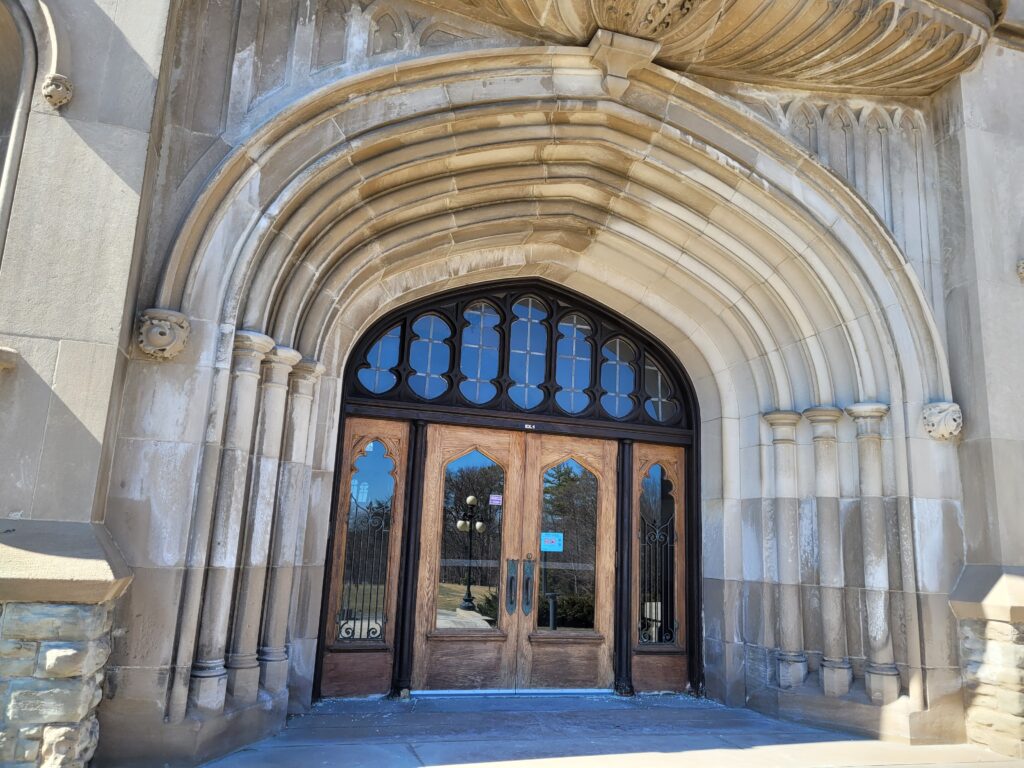
(Photo credit: Ben Durham).
2. The Power of the Signature Landmark
Every great campus needs a defining exclamation point. For the University of Toronto, it might be Hart House. For the University of Saskatchewan, the iconic College Building.
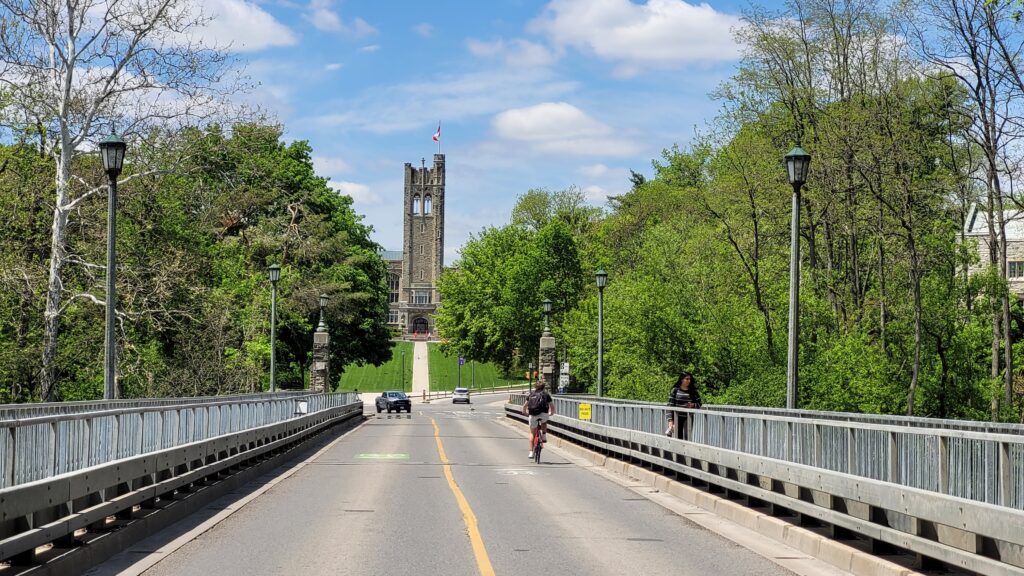
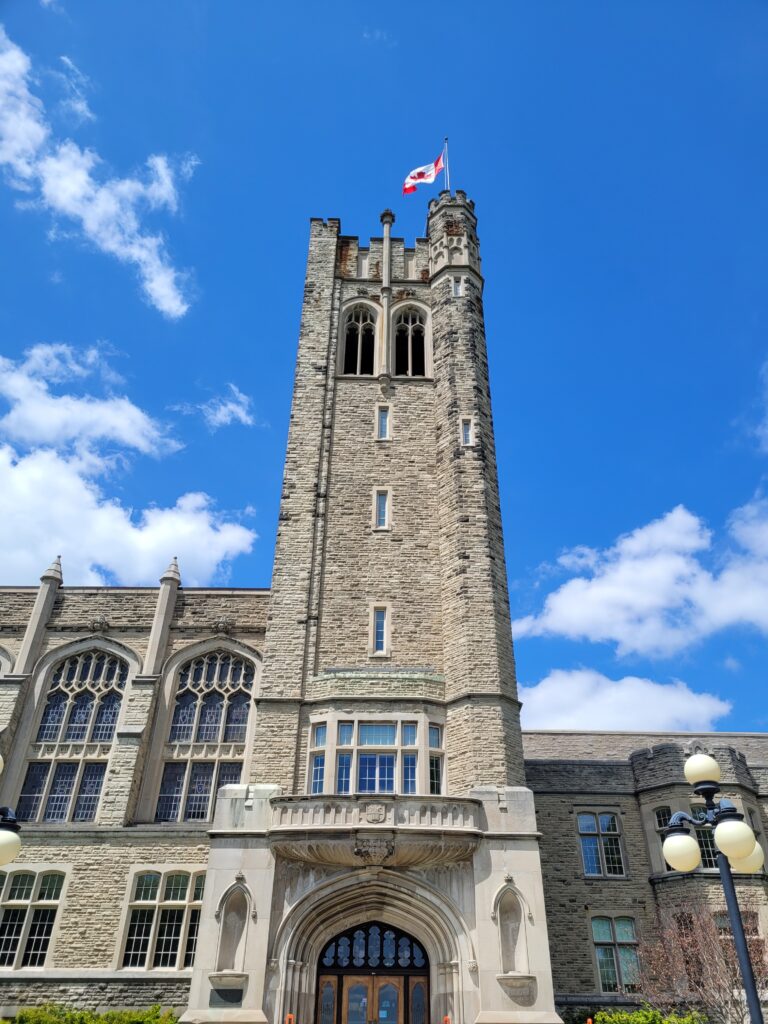
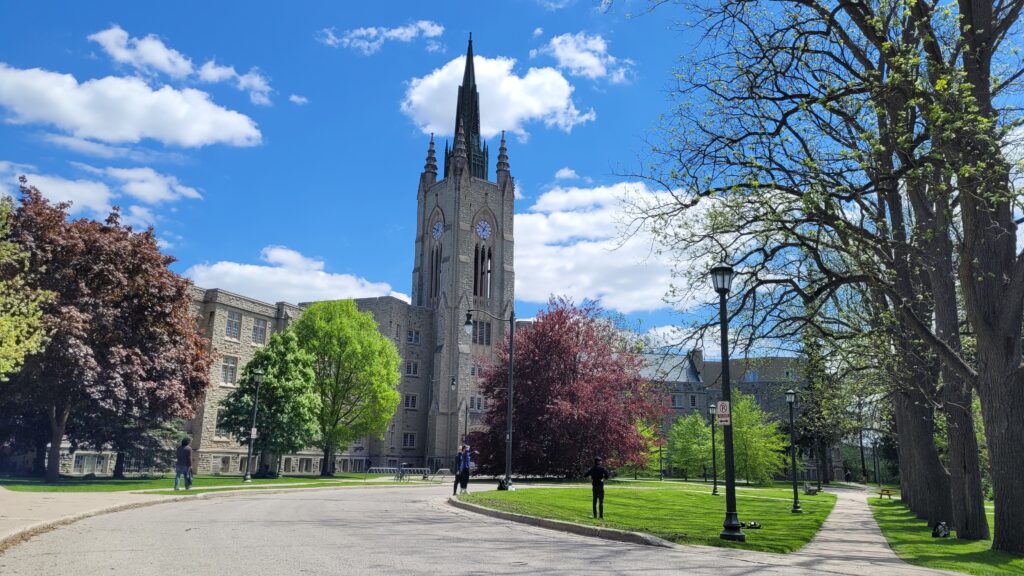
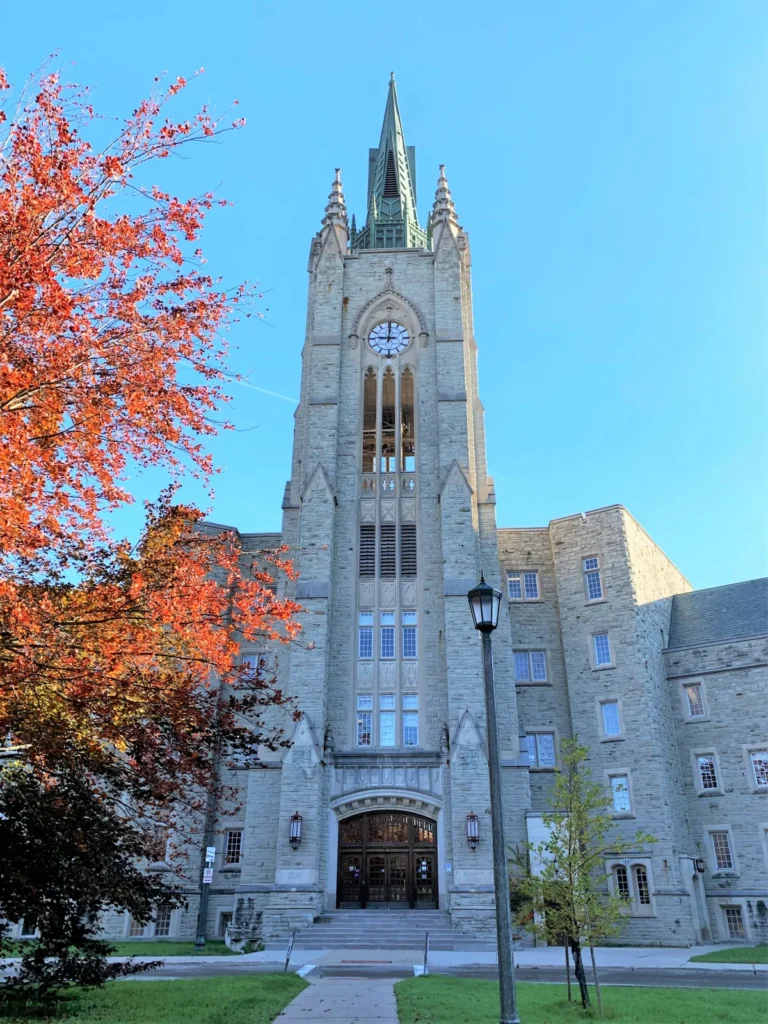
For Western? The Middlesex County Memorial Tower at University College. At 126 feet, it is one of the most recognizable academic landmarks in Canada, a stone exclamation mark that has welcomed students for nearly a century.
3. Longevity of the Era
Here is where Western truly surprises architecture buffs. Most of North America abandoned Gothic stonework immediately after World War II, rushing headlong into modernist concrete.
Western said, not so fast.
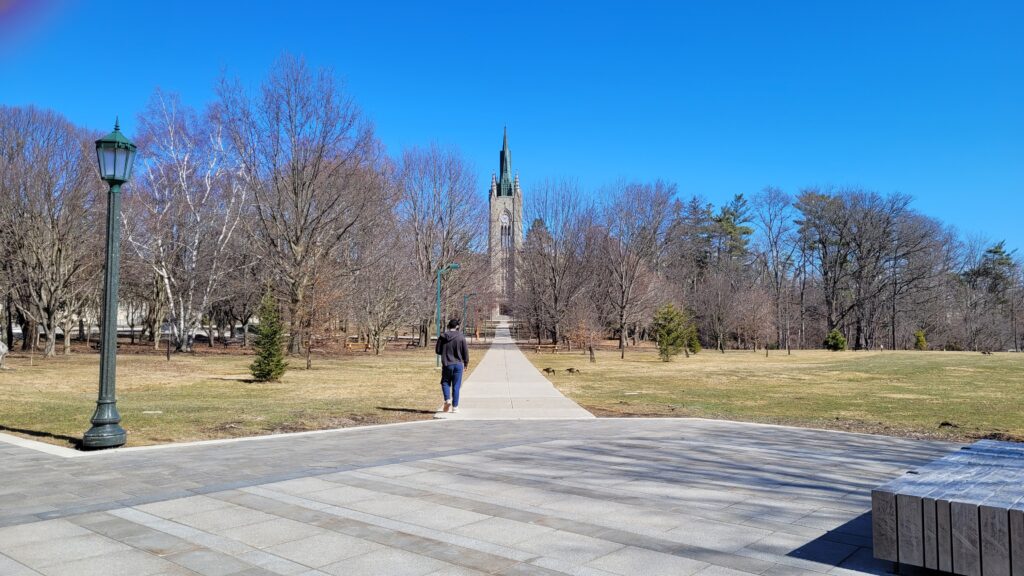
The university continued building true stone Collegiate Gothic structures well into the modern era, culminating in Middlesex College in 1959. That is remarkably late for this style, and it gives Western a seamless, timeless feel that other campuses can only envy.
(Photo credit: Michelle Hatzel).
The Architect and His Palette
The man responsible for much of Western University’s vision was architect John M. Moore. He didn’t just copy Europe; he adapted it for Southwestern Ontario.
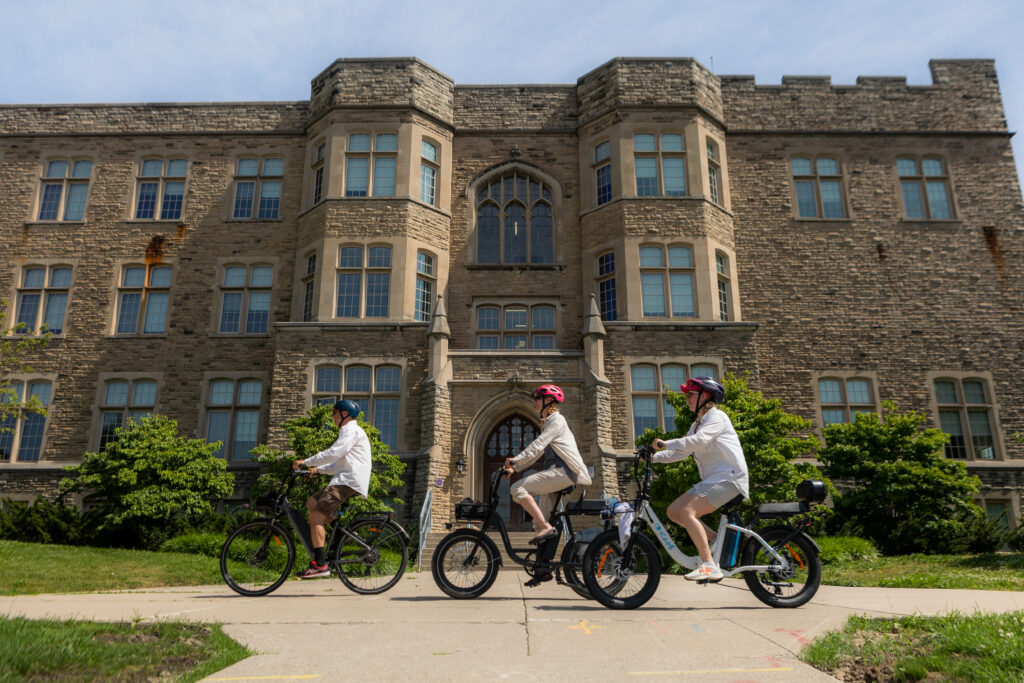
Moore’s architecture at Western leans heavily on:
- Indiana limestone trim (that creamy, warm stone you see around windows and doorways)
- Grey cut stone for the main wall surfaces
- Heavy buttresses that look structural but often serve a decorative purpose
- Crenellated rooflines (those castle-like notches that make you feel safely fortified)
(Photo credit: Ben Durham).
Walk or bike through the campus core, and you’ll see these elements repeated with loving consistency. It’s architecture as a unified symphony, not a chaotic collage.
Architectural Highlights & Hidden Quirks
Beyond the broad strokes, Western rewards the curious visitor with delightful surprises.
The Carved Grotesques
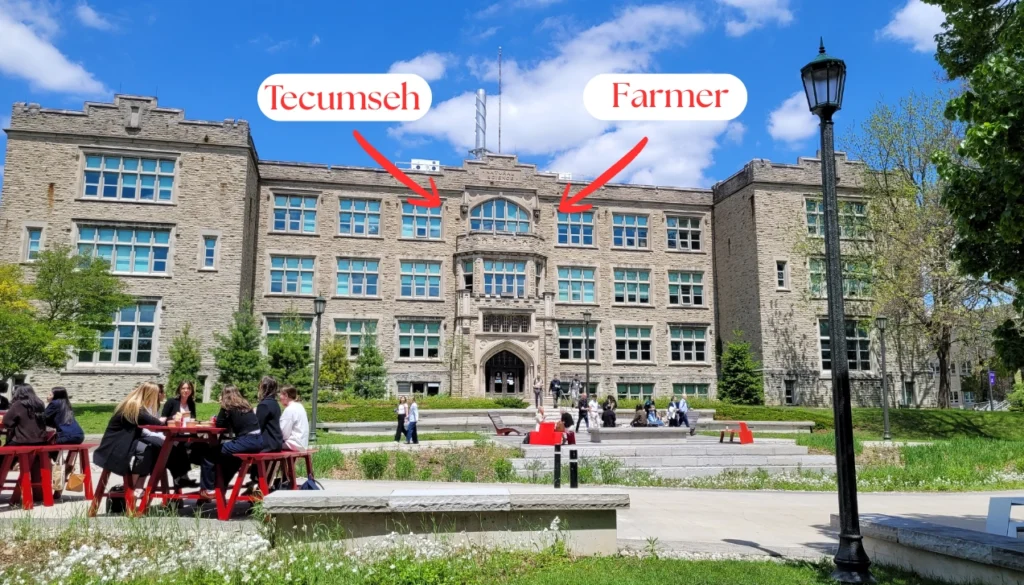
On the Physics and Astronomy Building (completed in 1924), look up.
Waaaay up!
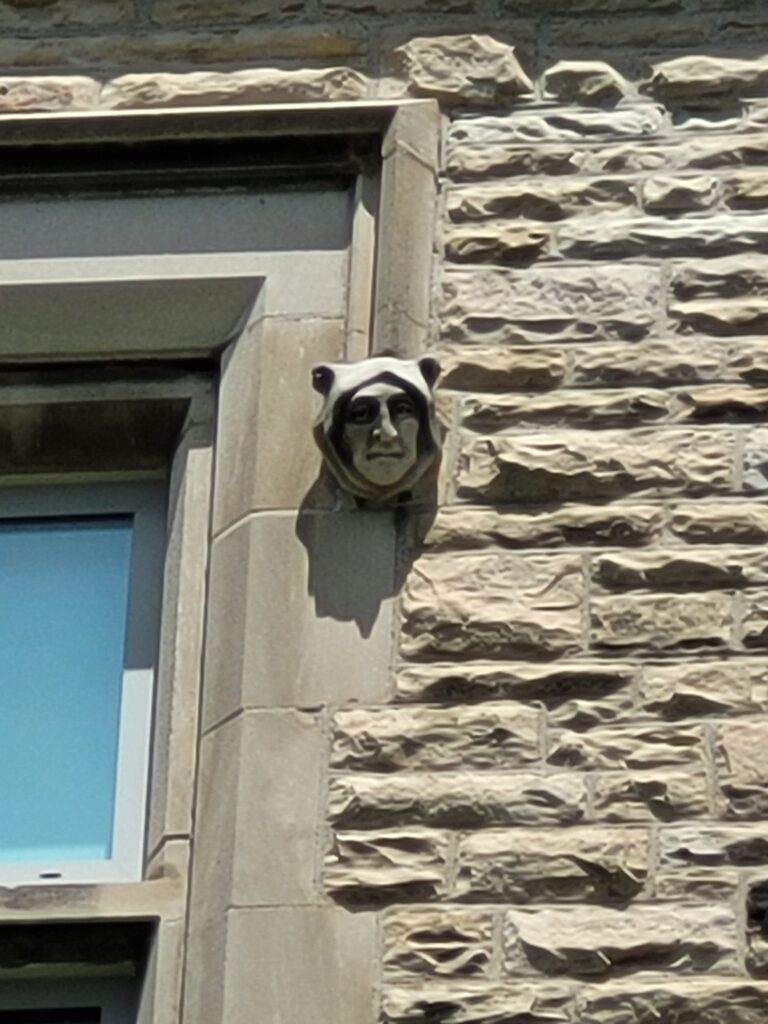
The original stone carvers had a sense of humour, and a sense of place. Hidden among the Gothic tracery are playful carved faces and figures, including a Yorkshire farmer (a nod to the masons’ origins) and an image of the Indigenous leader Tecumseh. It’s a small, stone-cold reminder that even medieval-inspired architecture can tell a very Canadian story.
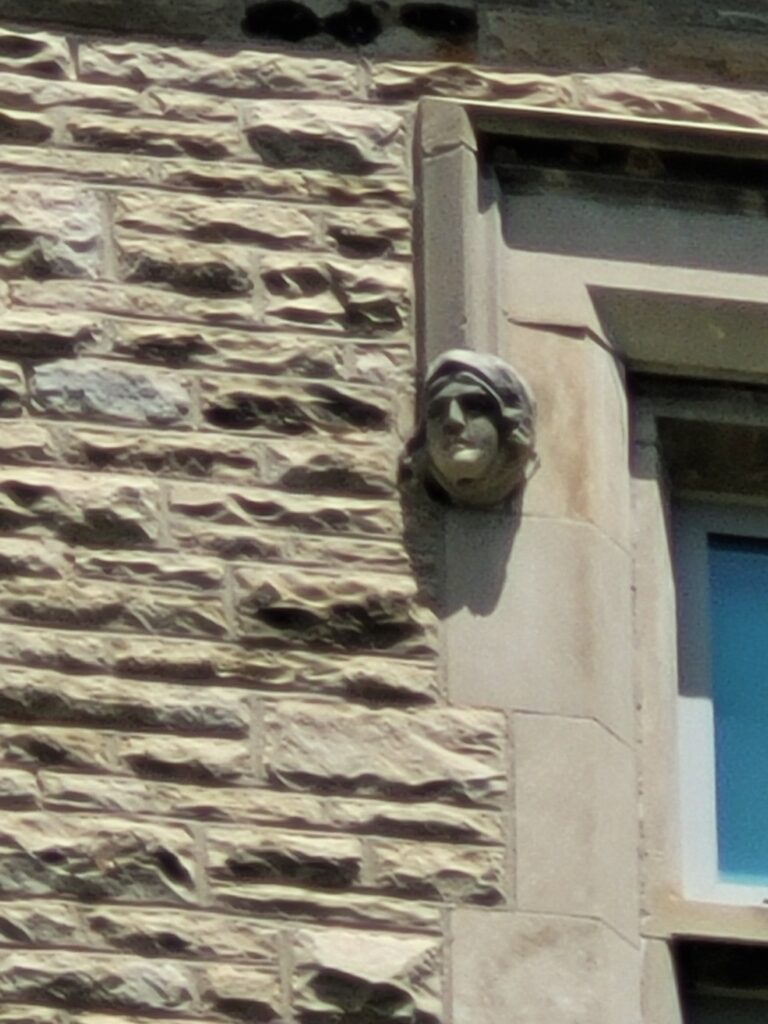
Left photo above: Tecumseh.
Right photo above: Yorkshire farmer.
Global Heraldry Inside Conron Hall
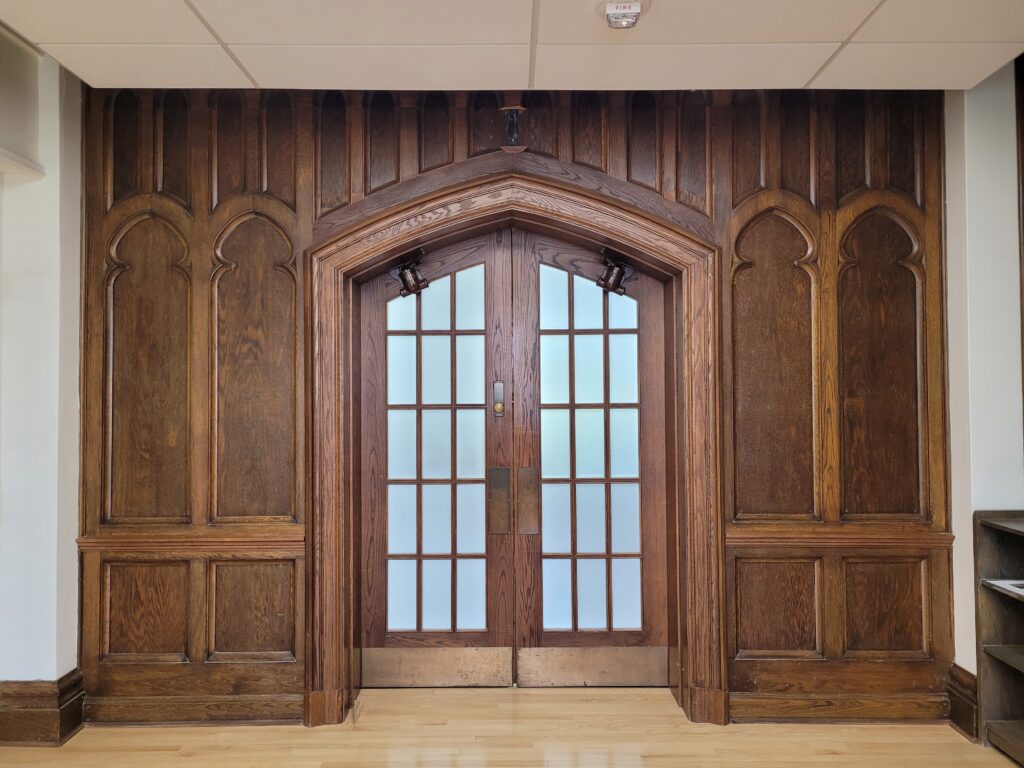
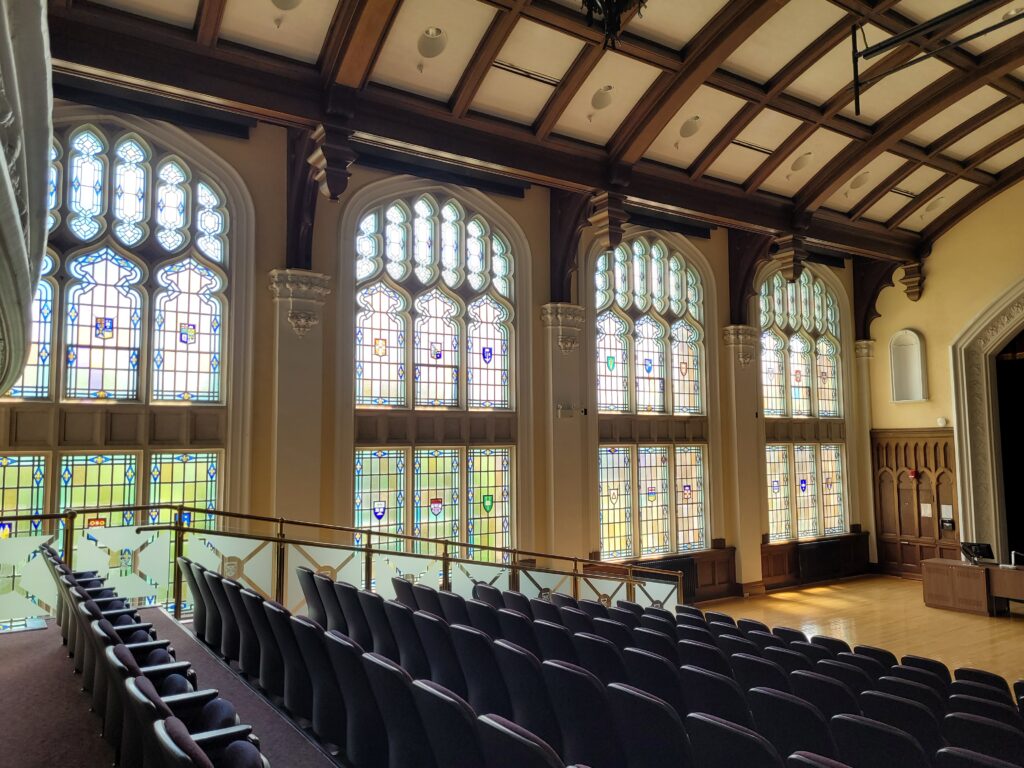
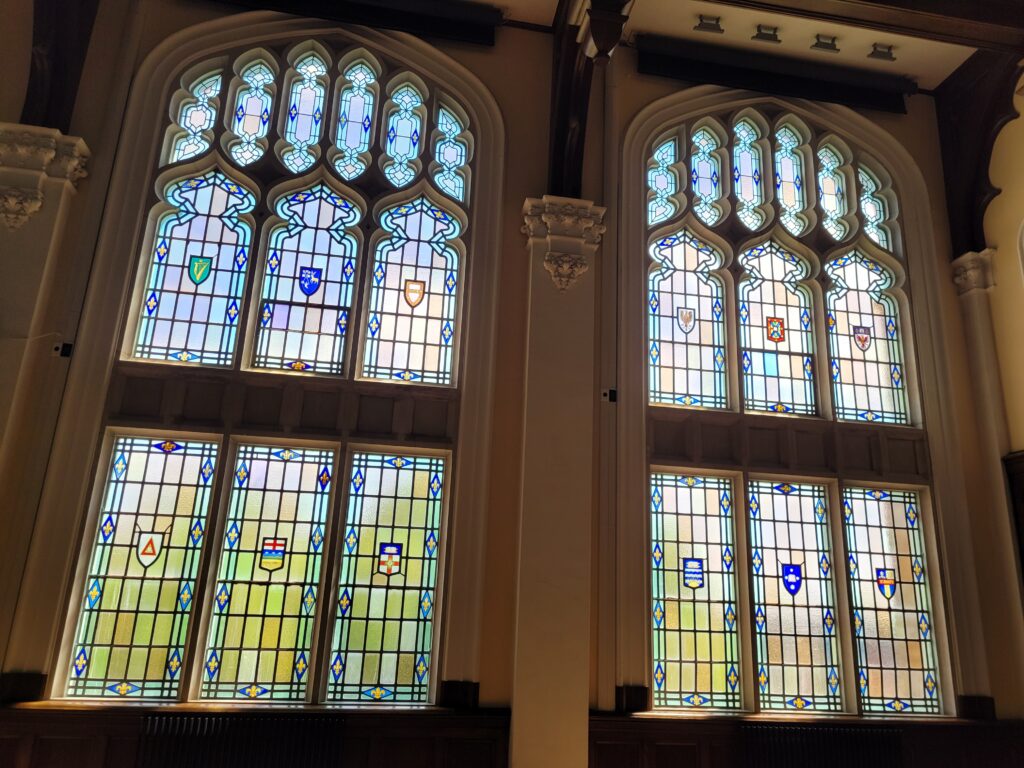
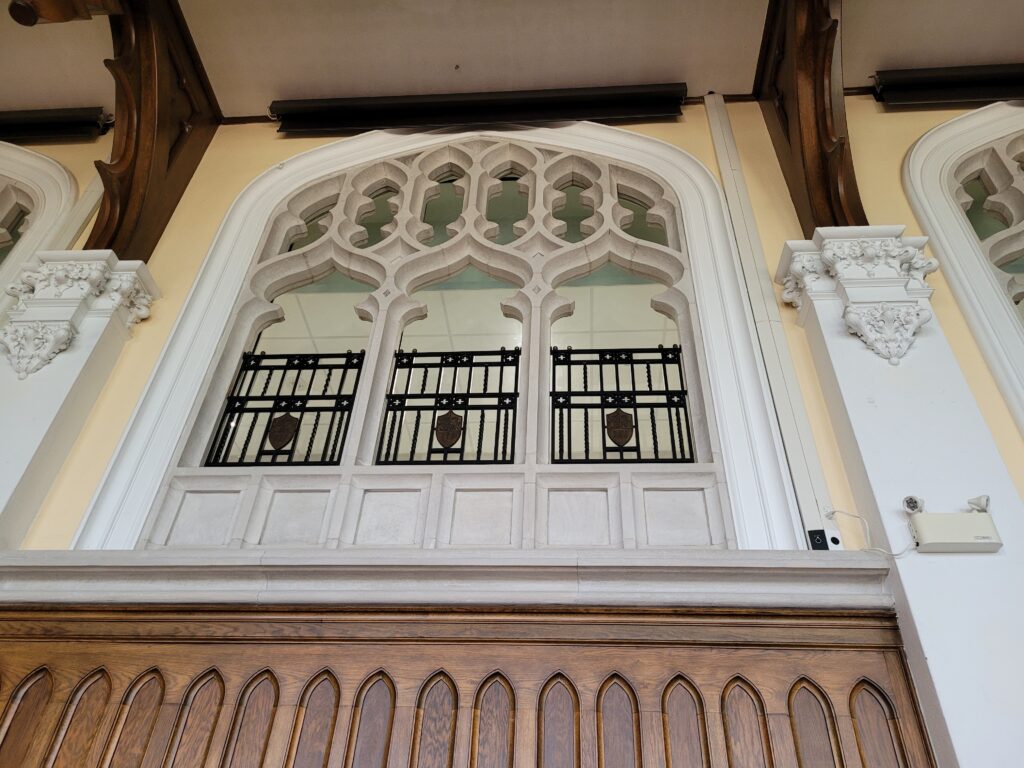
Step inside Conron Hall (part of University College) and you’ll find something that feels ripped from a wizarding library. Intricate stained glass windows display coats of arms and shields from the world’s great historic universities. Oxford, Cambridge, Harvard, and others are represented, physically anchoring this London, Ontario campus to the global academic tradition. It’s a quiet, glorious room on the third floor that many busy students rush past.
The Modern Compromise
No architectural story is without tension.
In the late 1960s, Western, like almost every North American university, experienced an enrollment boom that demanded quick, affordable space. The result? A sharp, temporary break from tradition.
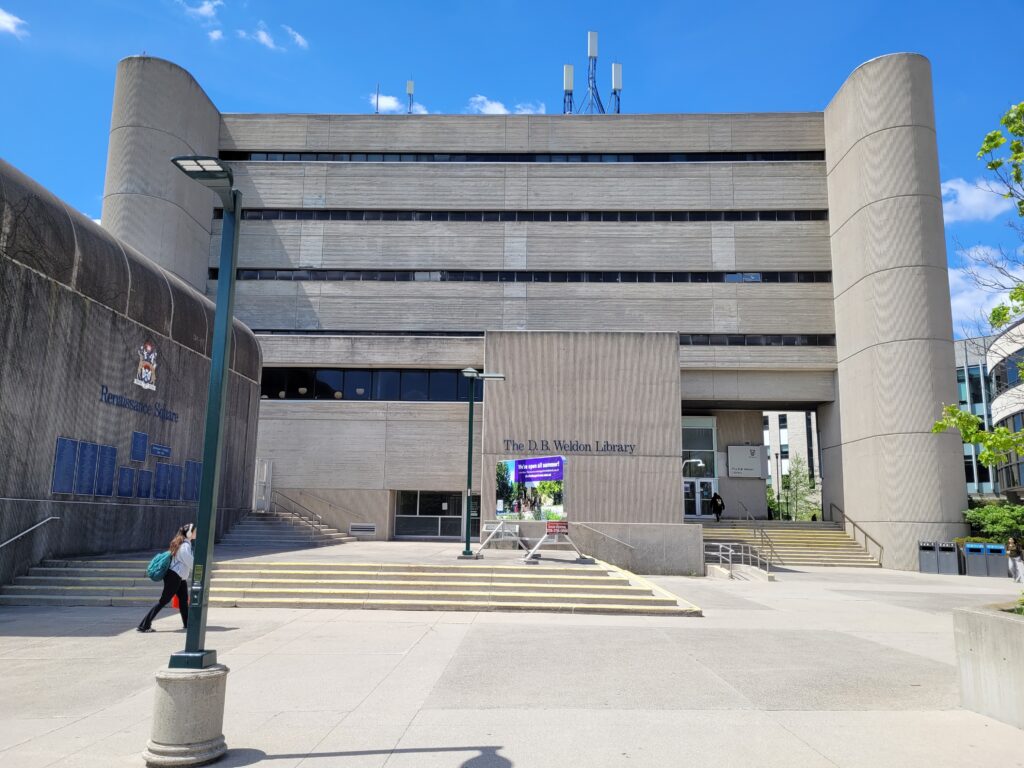
Suddenly, sharply-planed Brutalist concrete structures appeared alongside the limestone. The D.B. Weldon Library and the John Labatt Visual Arts Centre are prime examples: heavy, geometric, functional. They are not ugly, but they are certainly different.
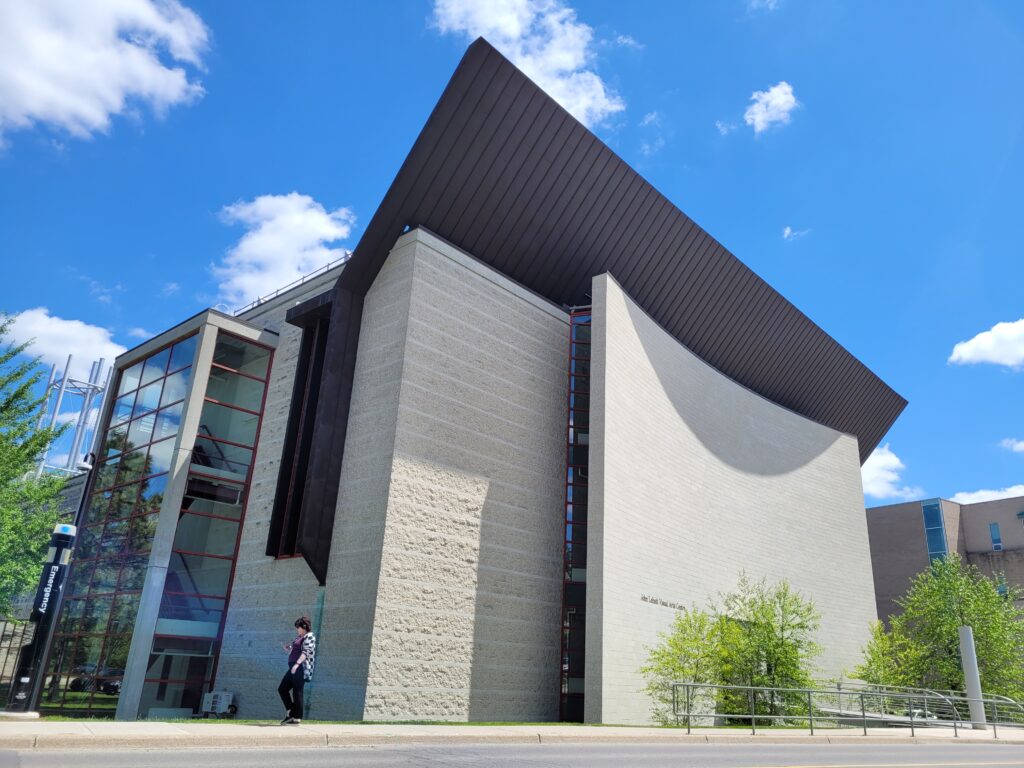
Protecting the Gothic Horizon
Here is the uplifting conclusion to that tension. Western’s Campus Master Plan now enforces strict protections for the historic core. Any new building must respect the visual weight and focal point of University College Hill. The tower remains dominant. The stone remains honoured. And the Gothic horizon is protected for future generations of students and curious bicycle tourists.
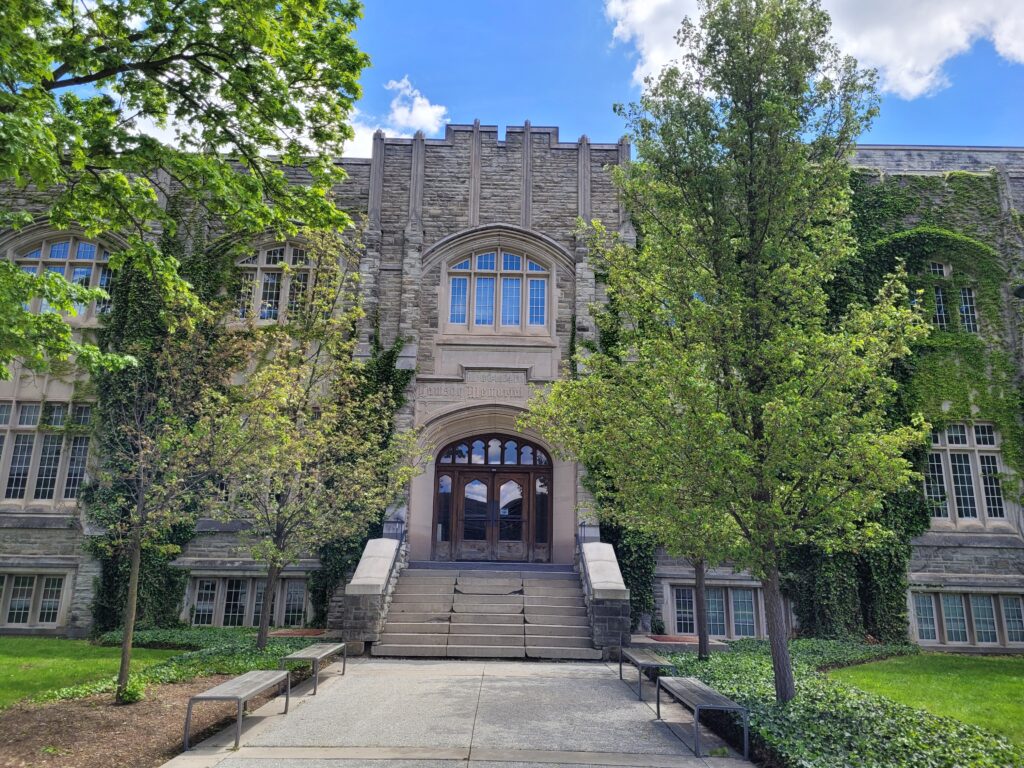
Why This Matters
You are not a casual traveller. You are the kind of person who reads plaque texts, looks up at grotesques, and wants to know why a place looks the way it does.
Western University offers a rare thing: a complete, walkable (or bikeable) lesson in early 20th-century academic ambition. The founders of this school did not want a frontier college. They wanted a “university on the Thames” that could stand beside Oxford and Harvard. They built their dream in stone, and it worked.
Come See It for Yourself
The best part? You don’t need permission. Western’s campus is public, welcoming, and free to explore. The university is proud of its heritage, and Londoners love sharing it.

(Photo credit: Ben Durham).
So grab a coffee, hop on a bike, and spend an afternoon wandering the courtyards, spotting Tecumseh in stone, and standing at the base of that 126-foot tower. It’s not Hogwarts, but for one afternoon, it might feel just as magical.
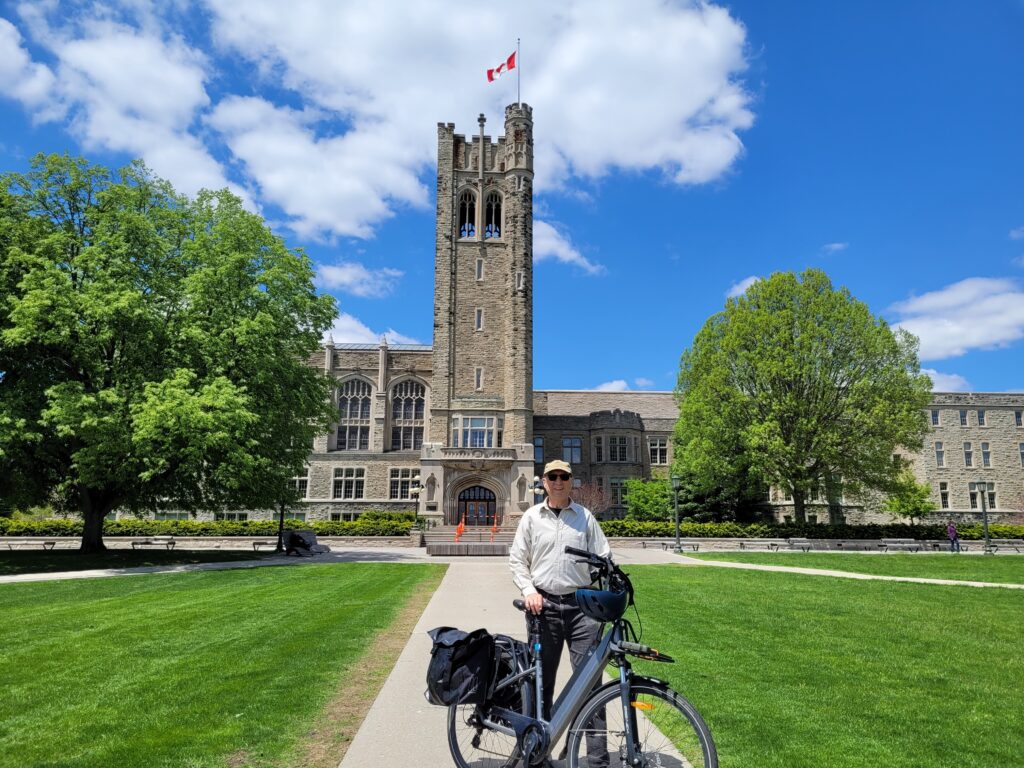
Hi. I’m Lawrence. Bicycle guide, storyteller, and lover of historical architecture.
I guide people through the quiet pathways of Western’s Collegiate Gothic campus, truly the highlight of one of our signature tours.
On a bicycle, you can cover the entire architectural arc of the university in one relaxed afternoon: from the 1920s limestone of University College to the 1959 stone of Middlesex College, past the Brutalist concrete of the 1960s, and back to the protected Gothic horizon.
Ready to discover London’s hidden wizarding world? Click here to learn more about my tours. Small groups, big laughs, and absolutely zero required magic skills – just a love for good stories and great architecture.
See you soon.
Leave a Reply