

In the middle of a suburban neighbourhood is a place that has spent 10,000 years resisting human attempts to civilize it. Welcome to Sifton Bog, a floating, acidic, peat-based reality check that refuses to be conquered.

Sifton Bog isn’t just a patch of green. This is one of the most southerly acidic bogs in all of Canada, a 41.6-hectare time capsule where plants eat meat, the ground literally floats, and a ten-minute walk can transport you through botanical zones that are usually found far apart. And it’s right in our backyard.
A Hole with a Soul: How a Glacier’s Misstep Created a Masterpiece
So, how did such an oddity come to be?
The story begins back when much of Ontario was covered by a massive ice sheet. As it retreated, it left behind a giant chunk of ice buried in the Ingersoll Glacial Moraine. When this ice chunk finally melted, it left a massive, water-filled depression with no natural drainage—a kettle lake.

Over the next ten millennia, nature got to work. Plants grew and died in the water, but because the conditions were too cool and oxygen-poor for them to fully decompose, they did the next best thing: they turned into peat. Layer upon layer of this partially decayed matter built up, eventually forming a semi-floating mat that now surrounds the open water of Redmond’s Pond. This peat layer isn’t just a few inches thick; it’s a staggering 18 metres (60 feet) deep in places. The bog is essentially a giant, waterlogged sponge.
Where North Meets South
What makes Sifton Bog truly bizarre, and a magnet for botanists, is its unique location. It’s where two great forest empires come together.
The Boreal Forest: The centre of the bog is a little piece of the far north. It’s dominated by sphagnum moss, leatherleaf, and stunted trees like black spruce and tamarack that are typically found in the vast boreal forest that covers 75% of Canada.

The Carolinian Forest: Surrounding the bog is a deciduous swamp and upland forest characteristic of the Carolinian zone. This forest region, found only in southern Ontario, is home to a much greater diversity of species than can be found anywhere else in the country.

Visiting Sifton Bog means that in one short stroll, you can experience a change in vegetation so drastic it would normally require a road trip of several hundred kilometres. It’s like climate change, but in reverse, and far more pleasant.
The Meat-Eating Residents (No, Not What You Think)
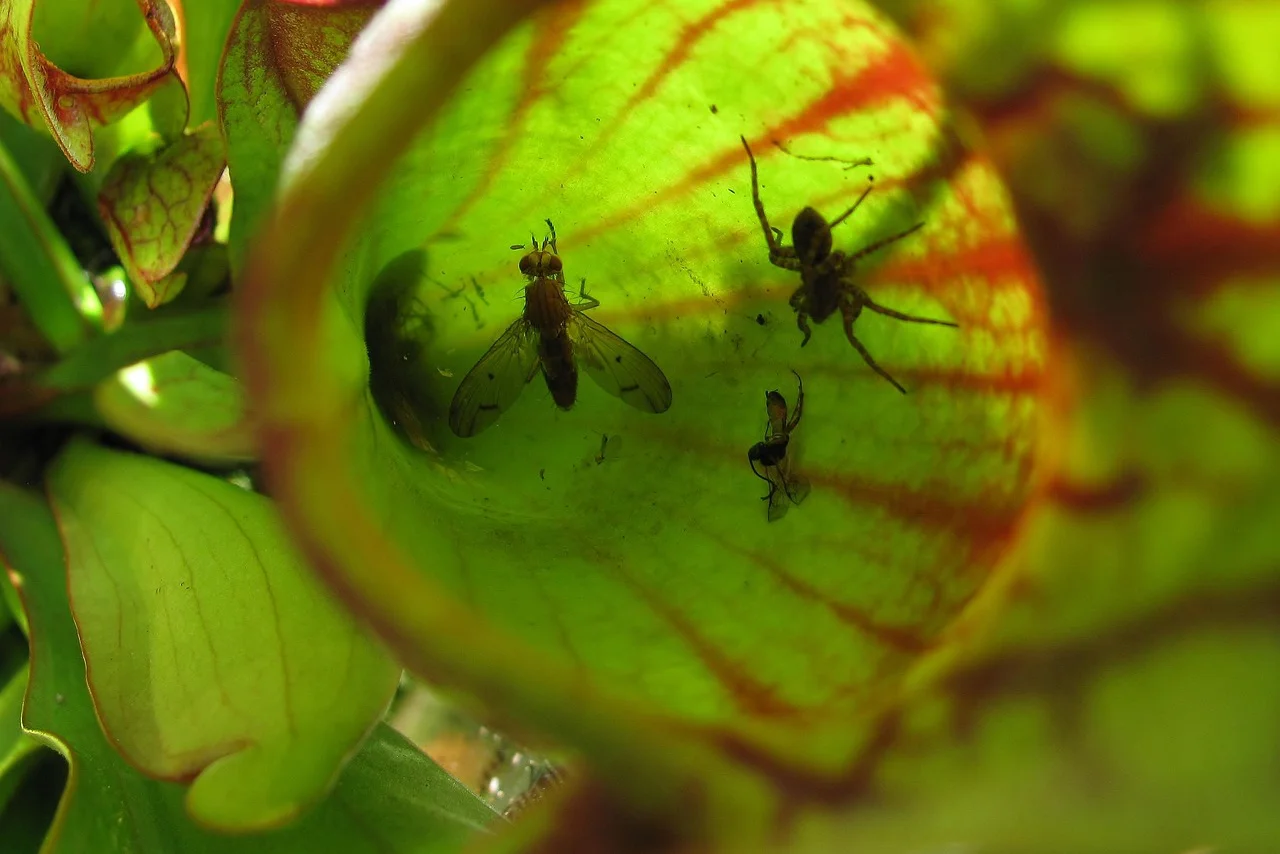
The bog is also home to some of the plant kingdom’s most cunning predators. That’s right, Sifton Bog is home to four types of carnivorous plants that have evolved to thrive in the nutrient-poor, acidic soil by supplementing their diet with a little bug protein.

(Photo credit: jggrz).
You can find the delicate, dewy-leaved sundews (Drosera intermedia and Drosera rotundifolia) and the iconic purple pitcher plant (Sarracenia purpurea). These plants are passive-aggressive assassins. The sundews trap insects on their sticky, glandular leaves, while the pitcher plants drown them in a cocktail of digestive enzymes. It’s a brutal, but highly efficient system. They’re a testament to the fact that in the bog, you adapt or you become lunch.
Humanity’s Failed Attempts to Tame the Bog
Of course, humans being humans, we looked at this unique, fragile ecosystem and thought, “I bet we can make a buck off it.”
And we tried. Oh, how we tried.
- Sphagnum Moss for War: During the First World War, the bog’s sphagnum moss was harvested as an alternative to cotton gauze for bandages, supporting the war effort and local hospitals.
- Gunpowder from Buckthorn: In the Second World War, the Alder Buckthorn plant native to the bog was harvested to produce gunpowder.

But the bog, in its quiet, soggy way, resisted full-scale exploitation. The commercial ventures failed to conquer it, and the city eventually grew around it. Today, instead of being drained for a subdivision, it’s a proudly preserved Environmentally Significant Area (ESA). It stands as a beautiful, mossy island of wilderness, completely surrounded by suburban homes, a daily reminder that the most interesting things are often the ones we couldn’t change.

Your Adventure Awaits
Today, experiencing this natural anomaly is incredibly easy. A well-maintained trail, including a meandering boardwalk, lets you safely traverse the floating mat and leads you out to a platform extending over Redmond’s Pond. It’s a 3.7-kilometre round trip that feels worlds away from the city, even though you’re just steps from it.

As you walk, keep your eyes peeled for painted turtles sunning themselves, dragonflies skimming the water, and, if you’re lucky, even deer wandering through the surrounding woods. The boardwalk is the bog’s greatest gift to visitors. It protects delicate plants from being trampled while letting you become fully immersed in this otherworldly landscape without sinking into 60 feet of peat.
A win-win, really.

Hi. I’m Lawrence – bicycle tour guide, storyteller, and lover of puns.
This ancient peat bog is just one of the many things I’ve discovered while exploring London on my bicycle. But there’s sooo much more. Come and see for yourself. Small groups, big laughs, and zero chance of being eaten by a purple pitcher plant (I promise). I help inquisitive folks like you discover the best parts of London – from the seat of my bicycle, of course.
Leave a Reply