
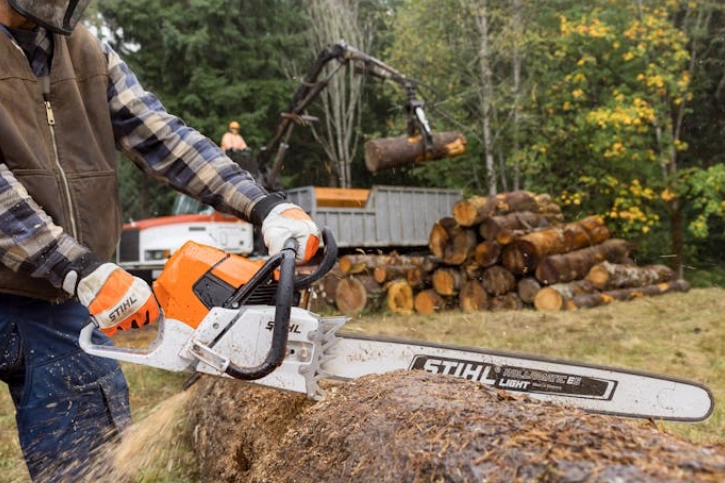
Today, I want to share a story about how a German chainsaw giant found its Canadian home right here in London.
A Global Powerhouse with a London Address
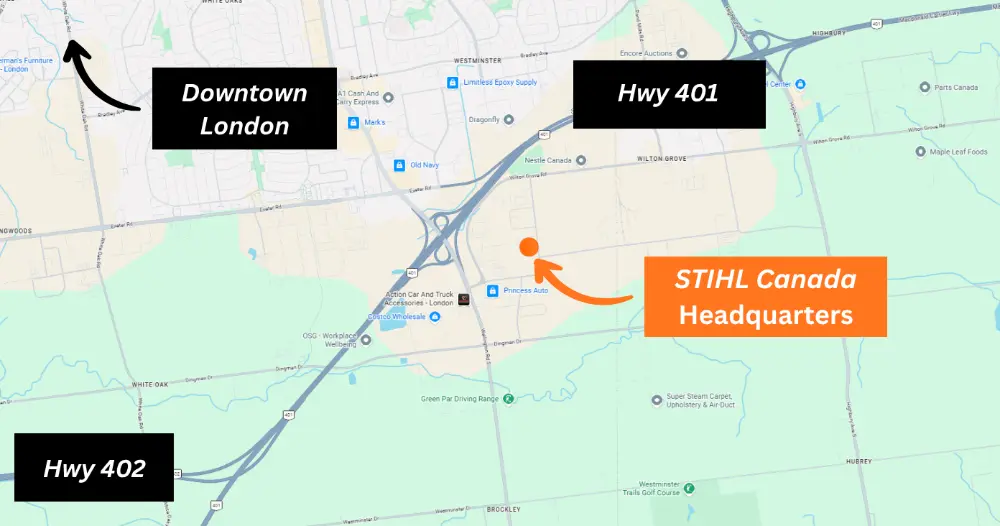
If you’ve ever driven down Sise Road in London’s industrial south end, you might have noticed a building with a familiar orange and grey logo. That’s the Canadian headquarters of STIHL Limited, the subsidiary of the German company ANDREAS STIHL AG & Co.

(Photo credit: STIHL Canada).
Incorporated in 1981, STIHL Canada has called London home for over four decades, employing around 90 people at its head office and operating three distribution centres across the country, plus a sales office in Quebec.
But why London?
What does a southwestern Ontario city known for its trees have to do with a company famous for cutting them down? As it turns out, the connection runs deeper than you might think.
The Strategic Case for London
A Location Built for Logistics
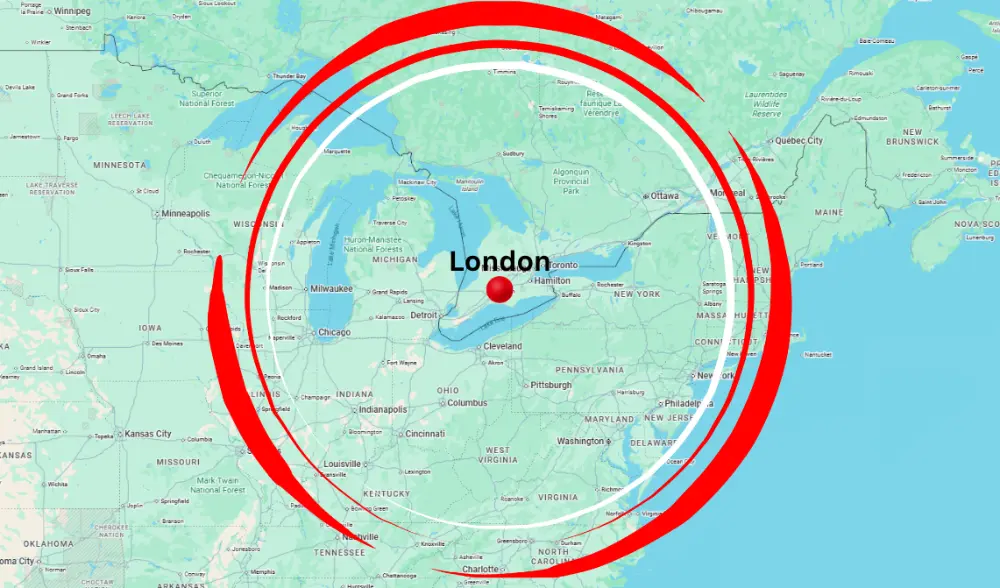
London sits directly along the 400-series highway corridor, a critical artery that handles over $1.5 billion in daily trade. From this vantage point, businesses can reach more than 150 million consumers within a single day’s drive. For a company like STIHL, which relies on a network of over 1,000 authorized, full-service dealers coast to coast, that kind of access is invaluable. The city’s position helps support STIHL’s three massive distribution centres and its sprawling dealer network, ensuring that everything from chainsaws to trimmers gets where it needs to go, quickly and efficiently.
Close to the Border, Close to the Action
Historically, entrepreneurs and multinational corporations have flocked to southwestern Ontario hubs like London for another reason: proximity to the United States border. This closeness facilitates highly efficient cross-border supply chains and international corporate management. For a company with global operations, being able to move people and products seamlessly across the border is a significant advantage.
Room to Grow
London also offered something that’s increasingly hard to find in major cities: space. Ample commercial real estate meant that in 1981 STIHL could build a custom distribution centre tailored to its needs. It joined other manufacturers with Canadian headquarters in London, such as 3M Canada and McCormick Canada.
The Forest City Connection
A Name That Goes Back Centuries
London’s nickname, “The Forest City,” isn’t just a modern marketing slogan. It goes back to the city’s earliest days. When the first settlers arrived in the late 1700s, they found themselves in the middle of a vast, thick forest. The nickname stuck, and today London boasts over four million trees within its boundaries. The city replants 5,000 trees for every 1,500 it removes due to poor health. In 2026, the Canadian Institute of Forestry named London the Forest Capital of Canada, making the nickname more official than ever.

(Photo credit: Mike Hensen/The London Free Press).
A Brand Built for the Forest
For STIHL, this identity is a perfect fit. The company was founded in 1926 with a simple but revolutionary vision: “to bring the saw to the tree, rather than the tree to the saw.” At the time, forestry and logging work relied heavily on manual axes and hauling massive, heavy logs back to stationary steam-powered sawmills. Andreas Stihl wanted to alleviate this grueling labor by inventing a portable machine that could be taken directly into the woods, thus changing forestry forever.
Since 1971, STIHL has been the world’s best-selling chainsaw brand. The company’s tools are designed for people who work in nature, from the wildest forests to the neatest gardens. What better place for its Canadian home than a city that wears its forest heritage with pride?
Where Art Meets the Forest City
The synergy between STIHL and London isn’t just symbolic. It’s visible on the streets. London is home to the Tree Trunk Tour, a collection of nearly thirty chainsaw-carved sculptures scattered throughout the city, mostly in the Hamilton Road area and downtown core. The project began as a partnership between Tourism London, the City of London, the Hamilton Road Business Association, and STIHL Canada itself.
STIHL has matched Tourism London’s financial contribution to the project and supplied artists with equipment and clothing. The carvers hail from London, British Columbia, New Brunswick, and even South Africa, and their work transforms dead tree stumps into everything from a 15-foot sasquatch playing an electric guitar to a pig carrying a keg. It takes about four weeks to complete each sculpture, with roughly 95% of the carving done using chainsaws ranging from large blocking saws to delicate carving tools. The finished pieces are preserved with automotive polyurethane enamel to withstand the weather.

(Photo credit: Lawrence Durham).

(Photo credit: Lawrence Durham).

(Photo credit: Tourism London).
Come, See It for Yourself
London is a city full of surprises: a global chainsaw leader that calls London home, a forest heritage that stretches back centuries, and public art that grows out of old tree stumps.

(Photo credit: Lawrence Durham).
Hi, I’m Lawrence – bicycle tour guide, storyteller, and unapologetic London cheerleader. If you’d like to explore the Forest City up close, with stories like this one, come on a bicycle tour with me. We’ll pedal past the sculptures, roll through the neighbourhoods, and discover the hidden gems that make London so special. Small groups, big laughs, and a whole lot of London pride.
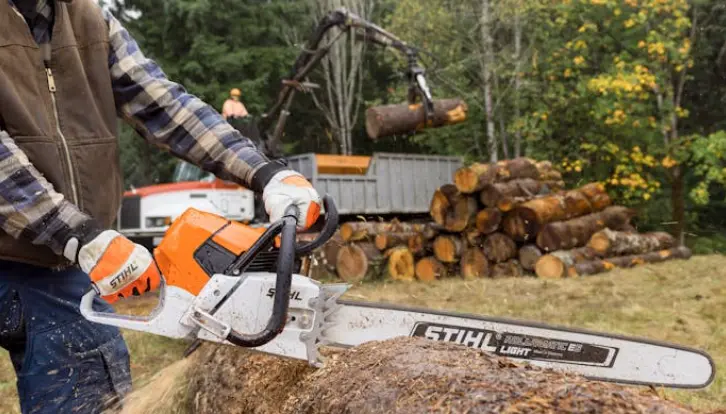
Credit for featured cover photo: Alberta Small Engine Service.
Leave a Reply