
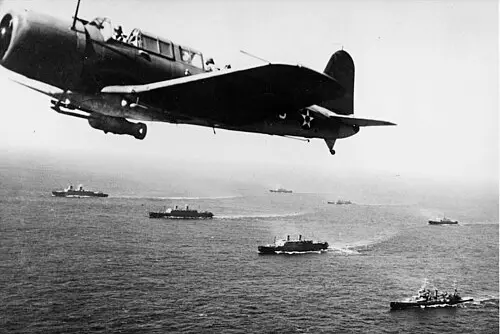
Some stories happen in places we wouldn’t expect.
If you drive along Wonderland Road in southwest London today, you will pass a busy retail complex: big box stores, parking lots, the usual hum of modern life. But during the Second World War, this exact spot held one of the most secret and vital listening posts in the Allied war effort.
The Lambeth Radio Station was not a grand fortress. It was a small white shack in a farmer’s field, sitting beside a quiet airfield on the edge of what was then the separate village of Lambeth.
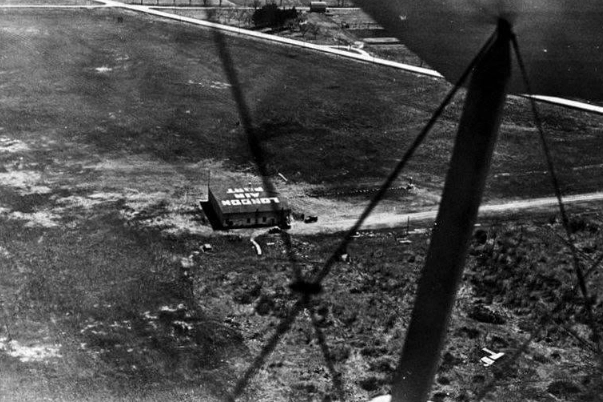
(Photo credit: Vintage London).
A crew of roughly a dozen to twenty Royal Canadian Navy wireless operators worked inside, day and night, from January 1943 until the end of the war. Their job was simple.
They listened for the enemy.
The Problem: Burst Transmissions and the Wolfpack
To understand why Lambeth mattered, you have to understand the Atlantic in 1943. German U-boats were hunting Allied convoys in what became known as Wolfpack attacks. A single scouting submarine would spot a convoy, surface, and send a rapid radio message back to Germany, coordinating dozens of other submarines to converge for the kill.
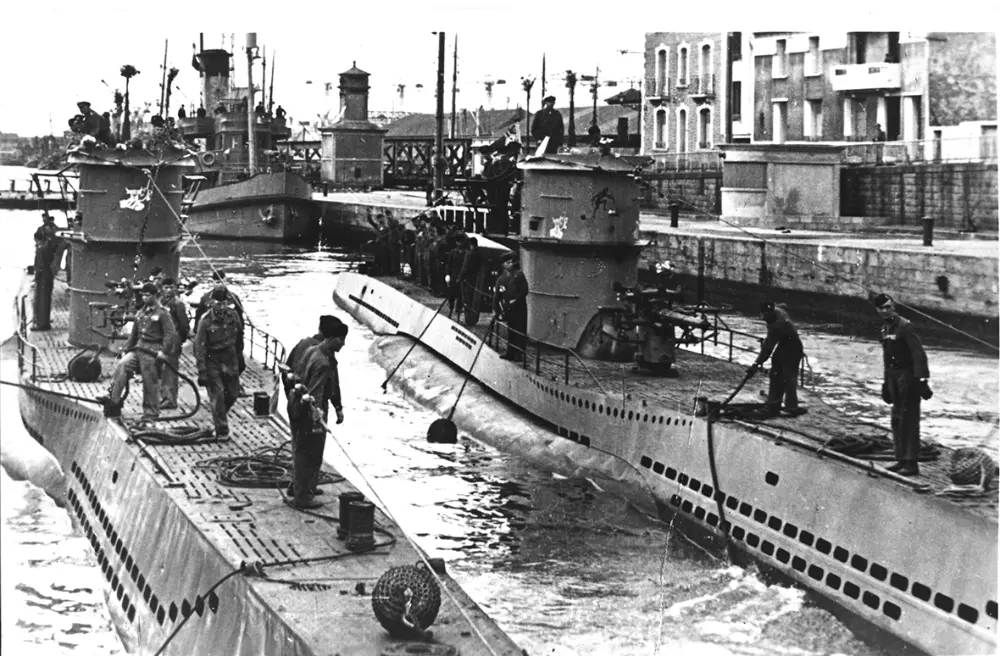
(Photo credit: Government of Canada).
German commanders knew the Allies had direction-finding technology. They also knew that traditional direction-finding required an operator to manually rotate a large loop antenna to find where a signal was strongest. That took time. So U-boat crews used burst transmissions. They compressed their Morse code messages into a few seconds, long enough to send coordinates and orders, but far too short for a manual antenna to spin and catch a bearing. For a while, this worked. The U-boats believed they were safe.
They were wrong.
The Solution: Huff/Duff Comes to Lambeth
The technology that changed everything was High-Frequency Direction Finding (HF/DF), universally nicknamed Huff/Duff. Instead of a single moving antenna, Huff/Duff used a fixed array of four vertical poles arranged in a precise square, with a fifth sense antenna in the middle. This was called an Adcock antenna system.
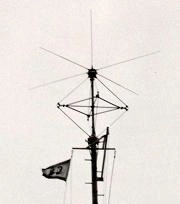
(Photo credit: Naval History).
When a German radio signal swept across the array, it struck each pole at a fractionally different microsecond. That tiny difference in timing created a phase and voltage differential between the antenna pairs. One pair controlled the vertical deflection of an electron beam on a cathode-ray tube screen. The other pair controlled the horizontal deflection. The moment a U-boat tapped its wireless key, the incoming energy painted a flashing streak of light across a circular glass screen lined with a compass rose. Even if the message lasted a fraction of a second, the streak pointed directly to a bearing. The operator read the number, and that was that.
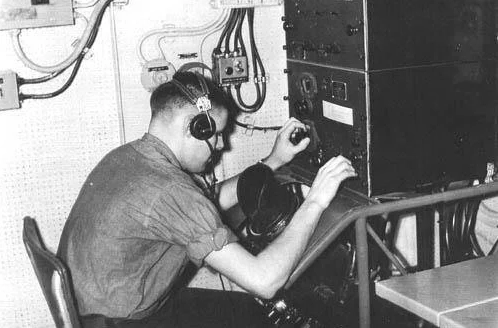
(Photo credit: USS Slater).
This breakthrough was pioneered by Robert Watson-Watt, the same physicist who helped develop radar. At Lambeth, the white shack housed the receiving equipment. The operators tracked the precise bearings of German transmissions, and then relayed those bearings over a dedicated teletype line to the Officer-in-Charge in Ottawa.
One station alone could only tell you the direction a signal came from. It could not tell you distance. But Lambeth was not alone. It was part of a network of nearly fifty listening posts scattered across Canada, the United States, and Britain, all feeding bearings into plotting rooms in Ottawa, Washington, and London. When multiple stations caught the same burst transmission, plotters drew lines of bearing on a massive map. Where those lines intersected, a U-boat was hiding.
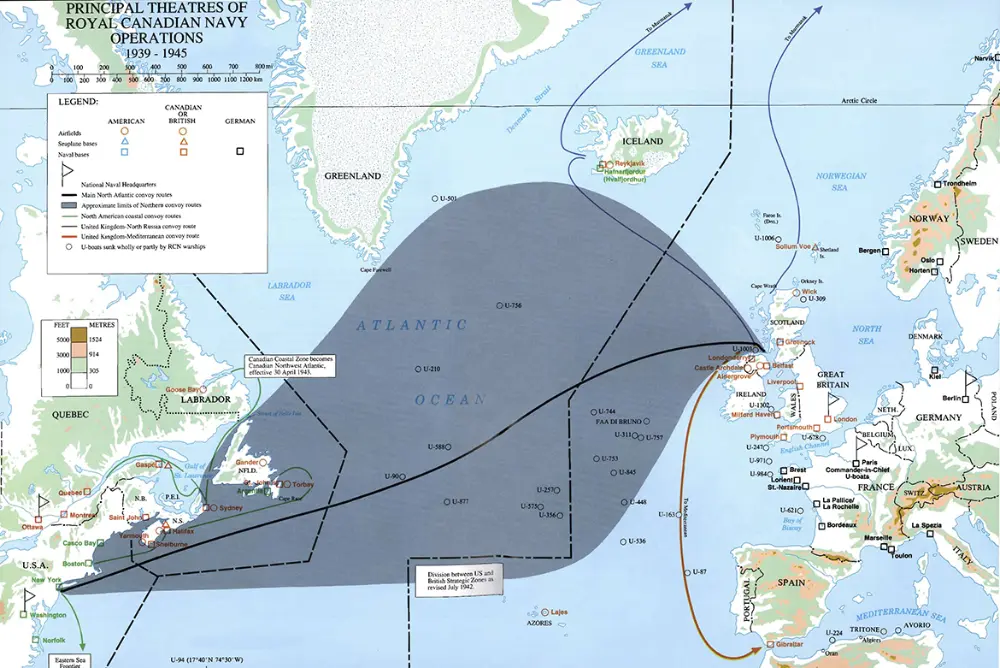
(Source: Government of Canada).
From Bearing to Battle: The Tactical Chain
The intelligence flowing out of Lambeth did not sit in a filing cabinet. It moved fast, and it changed the war.
Strategic Rerouting
When land-based stations like Lambeth intercepted a U-boat’s sighting report, the bearings went straight to tracking rooms. Intelligence officers plotted the crosshairs and saw where a Wolfpack was gathering. If a convoy was heading toward that trap, heavily encrypted orders went out to the Convoy Commodore. The entire fleet pivoted, sometimes steering hundreds of miles around the waiting submarines. The Wolfpack sat in empty ocean, burning fuel and waiting for prey that never arrived.
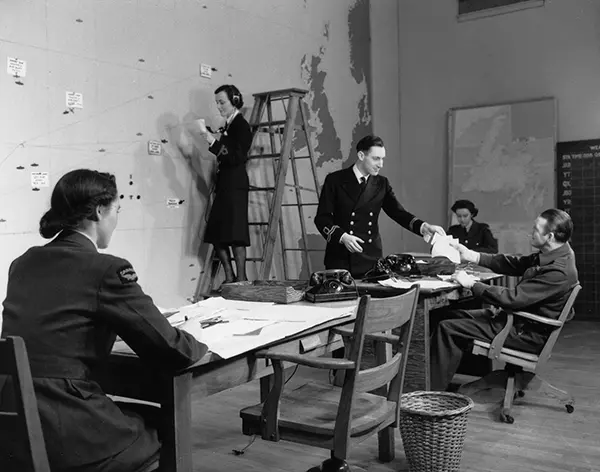
(Photo credit: Government of Canada).
Tactical Hunter-Killer Groups
If a U-boat slipped close enough to a convoy to transmit, shipboard Huff/Duff took over. The escort commander would see a flashing streak on an onboard oscilloscope pointing directly toward the submarine. Rather than waiting for an attack, fast destroyers or corvettes would sprint down that exact line of bearing, far beyond visual range. The racing warships would locate the surfaced U-boat, force it to crash-dive, and then subject it to depth charge or Hedgehog mortar attacks.
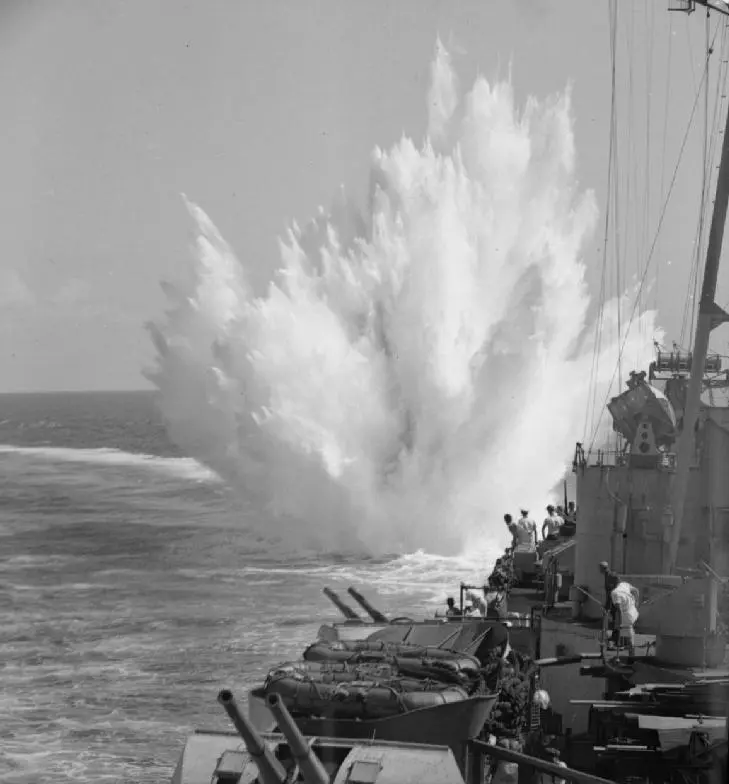
(Photo credit: Wikimedia Commons).
The Hedgehog, a forward-firing mortar that exploded only on contact, was nearly three times more effective than traditional depth charges because it did not blind the attacking ship’s sonar.
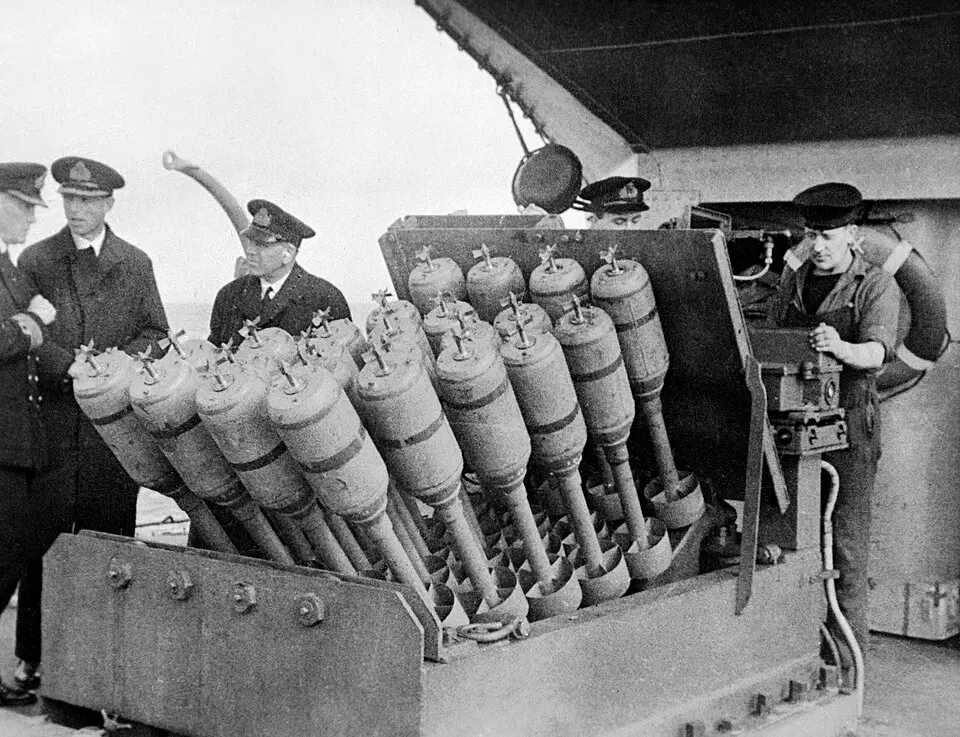
(Photo credit: Imperial War Museum).
The psychological effect was devastating. German captains, convinced their burst transmissions were untraceable, were bewildered by the lightning-fast counterattacks. Many broke off contact entirely or stopped using their radios. The communication lines that held the Wolfpack strategy together began to fray.
The Wider Web: VLR Aircraft and the Closing of the “Air Gap”
Huff-Duff was one piece of a larger Allied puzzle. For the first years of the war, a 500-mile stretch of the mid-Atlantic known as the “Black Pit” or the “Air Gap” was a safe haven for U-boats. Standard patrol planes could not reach it.
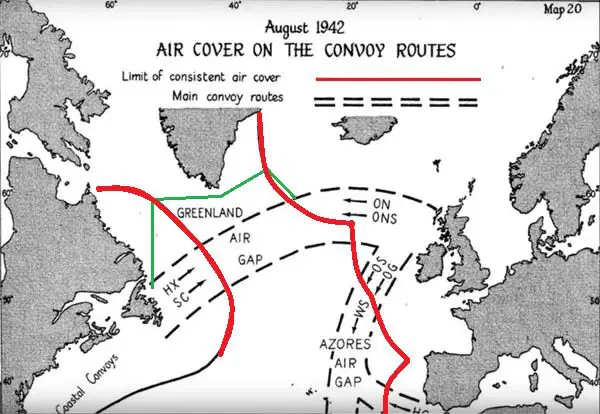
(Photo credit: History).
That changed with Very-Long-Range (VLR) aircraft.
The Royal Canadian Air Force, operating alongside the RAF, modified Consolidated B-24 Liberators for 16-hour, 2,500-mile patrols. Technicians stripped away heavy armor and defensive gun turrets, installing massive auxiliary fuel tanks in the bomb bays instead. The RCAF No. 10 Squadron, based in Gander, Newfoundland, flew these stripped-down VLR Liberators deep into the Black Pit. By May 1943, continuous air patrols had flooded the gap. U-boats could no longer surface safely to recharge batteries or shadow convoys. Aircraft equipped with Leigh Lights and centimetric radar could spot a tiny conning tower from miles away, even in fog or darkness.
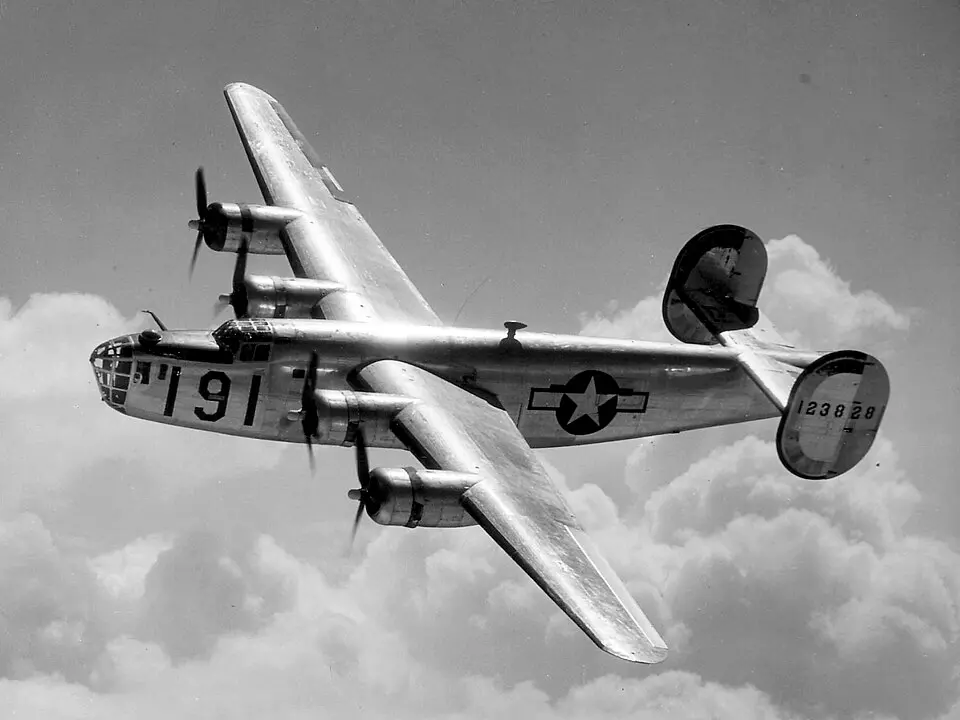
(Photo credit: Wikimedia Commons).
When you combine Huff/Duff bearings, shipboard hunter-killer tactics, and VLR air cover, you get a system that closed every escape hatch. The Battle of the Atlantic turned decisively in the Allies’ favour by the summer of 1944.
What Remains in Lambeth Today
Nothing remains of the runways or the buildings of the Lambeth Station. The white shack is gone. The airfield is now a retail complex. If you stand at the corner of Wharncliffe and Wonderland, you are standing on ground where history was made, but you would never know it.
That is what makes this story worth telling. London, Ontario, did not just support the war effort from a distance. A small crew of wireless operators in a farmer’s field, working in shifts around the clock, listened for the faintest whisper of an enemy signal and sent it down a wire to Ottawa. That bearing, multiplied by dozens of other stations, helped steer convoys away from ambush and guided hunter-killer groups to their targets.
The next time you ride past that corner, or any of the quiet corners of our city where history hides, remember the listeners of Lambeth. They did not fire a shot. They did not see a submarine. But they heard the enemy, and they told the fleet exactly where to look. That is a legacy worth remembering, and worth sharing.

(Photo credit: Lawrence Durham).
Hi, I’m Lawrence, a bicycle tour guide here in London, Ontario, and a lover of the stories that hide in plain sight. I help curious folks discover the best parts of our city, from a bicycle seat, of course. If you want to experience London’s hidden gems up close and personal, come on a bicycle tour with me. Small groups and big laughs. Your next adventure awaits.
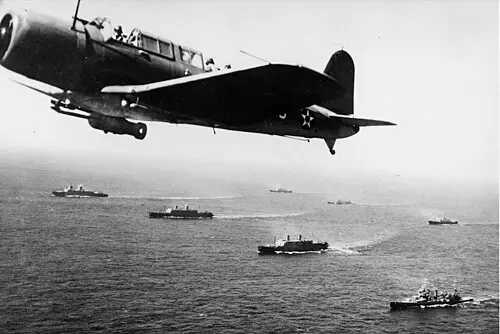
Credit for featured cover photo: U.S. National Museum of Naval Aviation
Leave a Reply