
Any city can build a neighbourhood on nice, stable, dry land.
But then there’s London’s Blackfriars District, a heritage neighborhood erected almost two centuries ago on a low-lying flood plain.
Defiantly, it sits beside a river that regularly threatens to devour it.

(Photo Credit: Ben Durham).
The Great Floods
The Thames River can be very unpredictable.
Sometimes it slows to a trickle, but when heavy rains fall upstream, it becomes a swollen torrent.
Photo credits: Unless otherwise indicated, the following photos were taken by the author.


In July 1883, a catastrophic flood swept through London, killing 17 people.
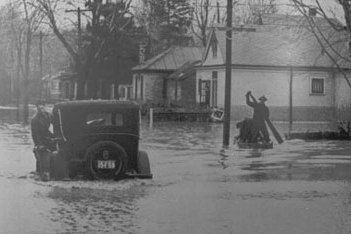
In April 1937, another devastating flood poured river water into the Blackfriars neighbourhood, a reminder that you can’t just wish a river away.


In the 1937 flood, roads became rivers, and boats came in handy.
(Photo credits: UTRCA).
In the 1950s, in response to the continued risk of flooding, the newly formed Upper Thames River Conservation Authority (UTRCA) built a series of dams upstream and dikes downstream.
They reinforced the West London Dike, a 2,374-meter-long, sloped mound of compacted earth and concrete walls to protect the low-lying Blackfriars District.
By 2030, further upgrades by the UTRCA will ensure that the dikes can withstand a 1-in-250-year flood.

(Photo Credit: Ben Durham)
The Bridge That Refused to Quit
During the 1800s, a combination of floodwaters and winter ice systematically destroyed each wooden bridge that was erected to cross the river.
Finally, in 1875, the city decided to build for the long run and constructed a bridge made of iron.

The Blackfriars Bridge is an iron bowstring truss bridge that looks delicate, but is deceptively strong. Some say it’s a miracle that something that looks so intricate has lasted so long.
It is now the oldest wrought-iron bridge in North America still used for vehicular traffic.

Yet a century and a half of high floodwater and vehicle wear-and-tear took its toll. By 2017, the bridge was in such poor repair that it was closed for a year, painstakingly restored, and then reopened in 2018.
Its latest comeback proves that in Blackfriars, they don’t discard their history; they polish it up and send it back into battle.
Blackfriars Bistro: A Taste of the Modern Harvest
Just a couple of blocks west of Blackfriars Bridge sits Blackfriars Bistro, the district’s culinary crown jewel.
Housed in a heritage building that was once a hotel and broom factory, this celebrated farm-to-table, chef-inspired restaurant offers seasonal menus, catering, and pastries baked from scratch.


(Photo credit: Blackfriars Bistro)
Labatt Memorial Park
Also behind the dike is Labatt Memorial Park, the “World’s Oldest Continually Operating Baseball Grounds,” as proclaimed by Guinness World Records in 2008.


(Photo credit: UTRCA).
Over time, this park has hosted legends such as Ty Cobb, Satchel Page, and Fergie Jenkins.
It has hosted a wide variety of events, including bicycle racing, soccer, football, boxing, wrestling, winter skating, political rallies, show jumping for horses, civic receptions, the Royal Canadian Mounted Police Musical Ride, and even a 21-gun salute to Queen Elizabeth in 1997.
Your Invitation to a District That Earned Its Place
The Blackfriars District is one of London’s best comeback stories. It’s a lesson in grit… and proof that the most interesting places are often the ones that had to fight the hardest to survive.

Hi. I’m Lawrence – bicycle tour guide, storyteller, and lover of puns.
The Blackfriars District, with its elevated bicycle path, is just one of the many amazing things I’ve found while exploring London on my bicycle. But there’s sooo much more to discover.
Come see for yourself.
Small groups, big laughs, and zero chance of being swallowed in a flood. I help curious folks like you discover the best parts of London – from the seat of my bicycle, of course.
Leave a Reply