
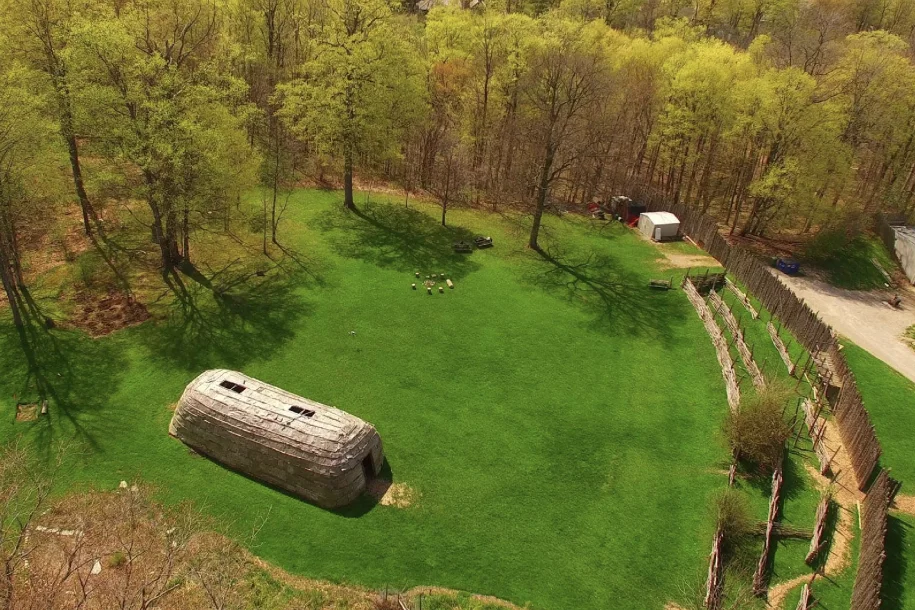
You normally wouldn’t expect to find a noted archaeological site at the end of a quiet suburban street, but that’s exactly what you’ll find in London, Canada.
In the north end of the city are two significant historical treasures: The Museum of Ontario Archaeology, along with the adjacent Lawson Site.
Here you will find the remains of a bustling, fortified 16th-century village, a place where nearly 2,000 people once lived, 500 years ago.

(Photo credit: Mishkin Berteig).

Notice how close The Lawson Site is to the suburban development next door.
No doubt, this ancient site would have eventually been overtaken by developers and destroyed if it hadn’t been proactively protected.
(To explore the area around these sites, click here on Google Maps).
From Pre-European Contact to Subdivision
Imagine it’s the year 1500.
Well over a century before Europeans ever made it this far into the North American wilderness, the Attawandaron (Neutral Iroquoian) people had already built a thriving settlement on a plateau overlooking the confluence of the Medway River and Snake Creek.

(Photo credit: Lawrence Durham).
And this was no temporary camp. It was a heavily fortified settlement, a pre-European contact masterpiece of urban planning and defense.
It was surrounded by a series of palisade walls, earthworks, and maze-like entrances designed to keep enemies out.
Inside, the remains of at least 39 longhouses were discovered, each a home to multiple families.

(Illustration credit: Ontario Museum of Archaeology).
The inhabitants were master farmers, who cultivated the “Three Sisters” – corn, beans, and squash – in the fertile fields outside their walls.
But they were also sophisticated traders, craftspeople, and hunters. Over 500,000 artifacts have been recovered from the site, telling a vivid story of daily life.

(Photo credit: Ontario Museum of Archaeology).
| Aspect of Life | Evidence Found at the Lawson Site |
| Food & Agriculture | Carbonized corn, beans, and squash seeds; evidence of cultivated fields. |
| Hunting & Tools | Projectile points for arrows/darts; stone drill bits for crafting. |
| Art & Craftsmanship | Intricately carved pipes; beads made of bone, shell, and stone; bone needles for sewing. |
| Trade & Connection | Materials sourced from as far as the Atlantic seaboard and Lake Superior. |
| Home & Defense | Post molds from 39+ longhouses; evidence of complex palisade walls and earthworks. |
The Museum now has Virtual Reality
The Museum of Ontario Archaeology is dedicated to the study and interpretation of over 11,000 years of human history in Ontario.
In addition to traditional exhibits, you can now step into their VRchaeology lab, where you will be immersed in a reconstructed 16th-century longhouse through virtual reality, a truly cutting-edge way to walk in the footsteps of the past.

(Photo credit: Lawrence Durham)
But how did this all come to be?
In the late 1960s, local archaeologist Wilfrid Jury convinced property owner Colonel Tom Lawson to donate a portion of his property (on which this archaeological site was located) to the University of Western Ontario, ensuring it was saved from development and preserved for generations to come.

(Photo credit: Ontario Museum of Archaeology).
The Lawson Site was the first archaeological site in Ontario to be placed on the Canadian Register of Historic Places.
So, the next time you’re in North London, come in for a closer look.
The Lawson Site is a powerful reminder that you don’t have to travel far to find world-class history. Sometimes, the greatest adventures are buried right in your own backyard.

(Photo credit: Lawrence Durham).
Hi. I’m Lawrence – bicycle tour guide, storyteller, and lover of puns.
This 500-year-old village is just one of the many things I’ve come across while exploring London on my bicycle. But there’s sooo much more to see.
Why not come along for a ride? I help inquisitive folks learn about the best parts of London – from my bicycle seat, of course.
Leave a Reply